Introduction
In the crowded market of men’s health supplements, a new website called jellyfil com has emerged, promoting a product known as JellyFil Gummies. At first glance, the website appears to offer an appealing solution for men seeking health improvements, backed by bold claims and enticing discounts of up to 65% off. However, a closer look reveals a deeply troubling picture that raises serious questions about the website’s legitimacy and the safety of making a purchase.
This investigative review of jellyfil com was conducted to protect consumers from potential financial fraud and health risks. We have analyzed every available data point from WHOIS domain registration records and trust scores to product claims, contact information, social media presence, and return policies to provide you with a comprehensive, unbiased assessment.
Whether you stumbled upon JellyFil Gummies through a social media ad, a search engine result, or a promotional email, this article will help you determine whether jellyfil com is a trustworthy retailer or a sophisticated online scam. Read every section carefully before you consider placing an order.
Section 1: WHOIS Data & Domain Age A Freshly Minted Red Flag
Domain Registration Details
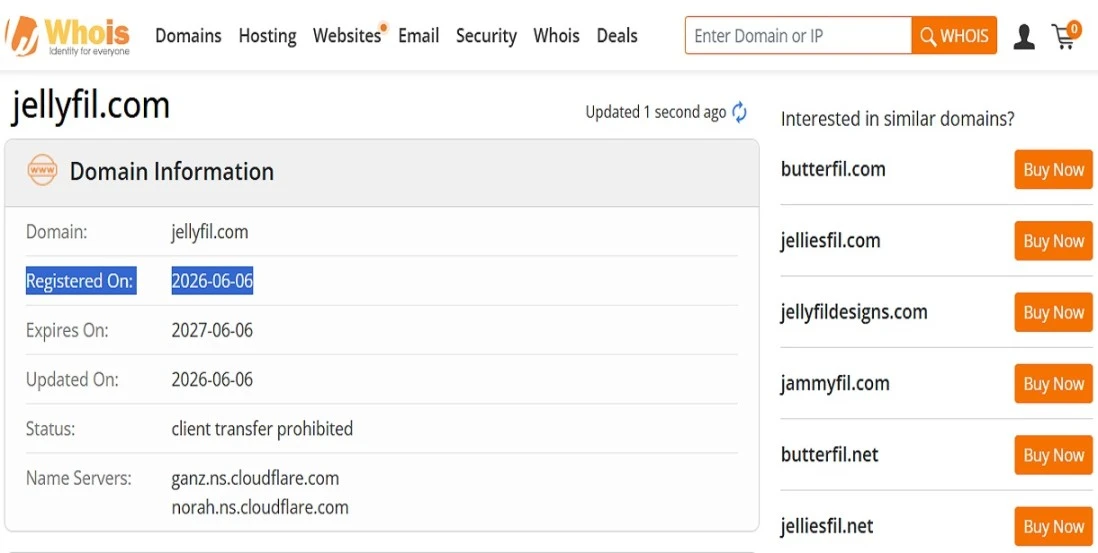
One of the very first things any seasoned online shopper or cybersecurity investigator checks is the age of a domain. For jellyfil com, this check immediately raises a glaring alarm. According to publicly available WHOIS data, the domain was registered on June 6, 2026 making it less than a few weeks old at the time of this review.
Legitimate businesses, especially those selling health supplements and claiming to offer proven, trusted products, typically have an established online presence spanning several years. An overnight website selling medical or health-adjacent products is one of the most recognized hallmarks of a scam operation. Fraudulent sites are built quickly, designed to harvest credit card information or ship low-quality or nonexistent products, and then abandoned once complaints pile up only to reappear under a new domain name.
Hidden Ownership & Registrar Information
What makes the WHOIS data even more suspicious is the complete absence of transparent ownership information. Most scam websites use privacy protection services to hide the identities of their registrants, making it virtually impossible to trace the real persons or companies behind the operation. This lack of accountability is not a feature of legitimate businesses it is a shield used by fraudsters.
Reputable supplement brands proudly display their corporate identity, registered addresses, and clear ownership information. When a website selling men’s health products hides behind anonymous registration and a domain that is only days old, consumers have no recourse if something goes wrong with their order.
Why Young Domains Are Dangerous
Security experts universally agree that a domain age of less than six months is a significant risk factor for online shoppers. Studies by cybersecurity firms consistently show that the majority of scam websites are abandoned within three to six months of registration — right after collecting enough fraudulent payments to be profitable. With jellyfil com registered on June 6, 2026, the clock is already ticking, and consumers who place orders now may find themselves with no website to complain to in just a few weeks.
Section 2: Trust Score & Reputation A Damning 1% Credibility Rating
Scam Detection Tool Analysis
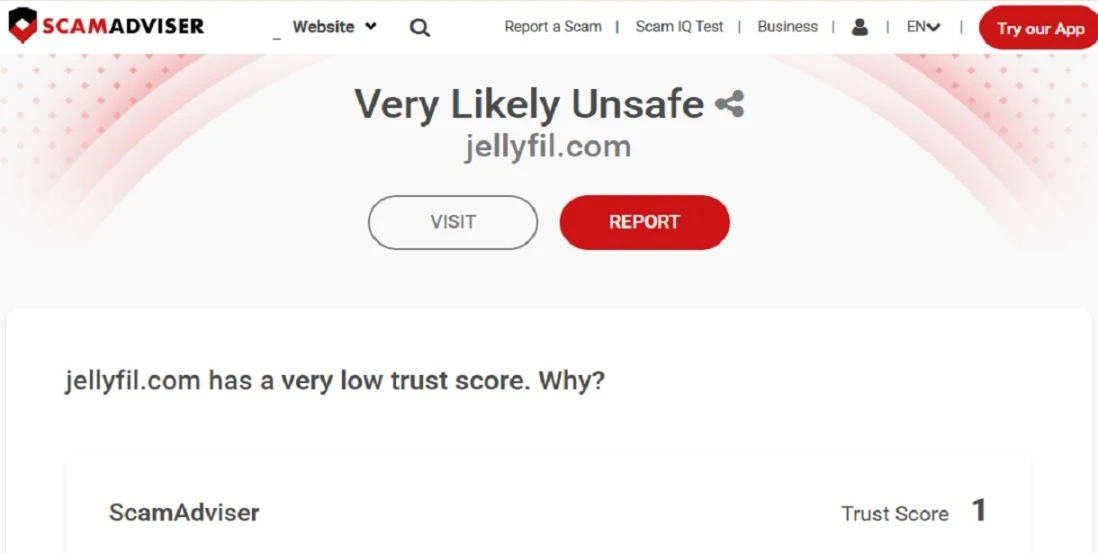
Trust scores generated by reputable scam-detection platforms such as Scamdoc, ScamAdviser, and Web of Trust (WOT) are invaluable tools for evaluating the legitimacy of online stores. In the case of jellyfil com, the trust score returned is a staggering 1% one of the lowest possible ratings on the scale. To put this in perspective, even moderately suspicious websites typically score between 20% and 40%. A score of just 1% is reserved for websites that display nearly every known red flag associated with online fraud.
What the Score Reveals
A trust score this low is not arbitrary it is computed from dozens of algorithmic and heuristic factors including domain age, owner transparency, SSL certificate type, hosting location, social media footprint, user review history, and pattern matching against known scam networks. The fact that jellyfil com scores 1% across these vectors means it has failed on almost every measurable trust criterion available to automated analysis tools.
By contrast, legitimate health supplement retailers such as GNC, Vitamin Shoppe, or certified Shopify stores typically score between 85% and 99% on the same tools. Even newer but legitimate brands usually clear 60% to 70% through verifiable business registration, transparent ownership, active social media channels, and real customer reviews.
Reputation Across the Web
Beyond automated trust scores, a search for user reviews, complaints, or any independent mentions of JellyFil Gummies or jellyfil com reveals virtually nothing. There are no verified purchaser reviews on third-party platforms like Trustpilot, Reddit, or consumer protection forums. The complete absence of an organic online reputation is itself a red flag — it suggests the website is brand new and has not yet had time to build legitimate credibility, or that it is deliberately operating under the radar to avoid scrutiny.
Section 3: Product Information & Images Extraordinary Claims, Zero Evidence
JellyFil Gummies: What Is Being Sold?
JellyFil Gummies are marketed as a men’s health supplement, a category that encompasses everything from testosterone boosters and libido enhancers to general wellness and vitality products. However, the product description on jellyfil com is suspiciously vague. There are no specific active ingredients listed with clinical dosages, no references to peer-reviewed studies, no details about manufacturing standards (such as GMP certification), and no information about the country of production.
Legitimate supplement companies are required by FDA guidelines and consumer protection laws to disclose supplement facts panels, ingredient lists, serving sizes, and any relevant warnings. The absence of this critical information on jellyfil com suggests either regulatory non-compliance or deliberate obfuscation designed to prevent informed purchasing decisions.
Reverse Image Search Findings
A standard investigative technique for evaluating e-commerce websites is conducting reverse image searches of the product photos used on the site. This reveals whether the images are original or stolen from other websites. In the case of sites like jellyfil com with suspicious profiles, product images are typically sourced from stock photo libraries, other supplement brands, or unrelated health product websites then reused without permission and rebranded.
This practice is extremely common among scam supplement sites because creating original product photography requires an actual physical product to exist. When photos are lifted wholesale from other sites, it strongly suggests that the product being advertised may not exist in its advertised form, or may be a generic, low-quality substitute shipped purely to avoid outright non-delivery fraud.
Unrealistic Product Claims
The marketing language used on websites like jellyfil com for men’s health gummies typically includes unsubstantiated superlatives — phrases suggesting dramatic, rapid, or guaranteed results. Such claims are not only misleading but also potentially illegal under FTC advertising guidelines, which require substantiation for health claims. Consumers are warned to be deeply skeptical of any supplement promising transformative results without clinical evidence.
Section 4: Return Policy & Customer Service A Policy That Protects No One
The 60-Day Money-Back Guarantee: Promise vs. Reality
On the surface, a 60-day money-back guarantee sounds reassuring and that is precisely why scam websites use them. The guarantee is prominently featured on jellyfil com as a trust signal designed to lower consumer resistance and encourage purchases. However, the presence of a return policy means nothing if the company behind it has no verifiable identity, no physical address, and no functioning customer service infrastructure.
Scam supplement sites routinely advertise generous return policies that are impossible to enforce in practice. Customers who attempt to claim refunds are met with unresponsive email addresses, automated responses, endless delays, shifting requirements (such as returning the product at the buyer’s expense with tracking), or outright silence. By the time the refund window closes, the customer has no recourse.
Missing Contact Information A Critical Failure
According to our investigation, jellyfil com provides an email address (contact@customercs com) but no physical company address and no contact phone number both listed as ‘Not Found.’ This is a serious deficiency that would immediately disqualify a website from trust certification by organizations like the Better Business Bureau or Norton Shopping Guarantee.
The email domain ‘customercs com’ is itself suspicious it is not the same domain as the product website (jellyfil com), suggesting that customer service is handled through a generic or shared contact infrastructure commonly used by scam networks operating multiple fake storefronts simultaneously. This pattern different domains for the store and customer service is a well-documented tactic used by fraudulent e-commerce operations to create distance between the scam and any paper trail.
No Physical Address, No Accountability
The complete absence of a verifiable company address means consumers have no ability to send formal legal correspondence, initiate chargebacks with supporting documentation, or file complaints with local consumer protection authorities against a known entity. This anonymity is not accidental it is structural fraud prevention designed to protect the scammer, not the consumer.
Section 5: Additional Red Flags The Full Pattern of Deception
Unrealistic Discount Offers
One of the most reliable psychological triggers used by scam e-commerce sites is the promise of extreme discounts. jellyfil com advertises discounts of up to 65% off. While genuine sales do occur, permanent or perpetually-available discounts of this magnitude on health supplements where production, testing, and certification costs are real are economically implausible for any legitimate business. This discount is designed to create urgency, override the consumer’s rational evaluation process, and trigger impulsive purchasing behavior.
No Social Media Presence
In 2026, the complete absence of any social media presence for a consumer-facing health supplement brand is extraordinarily suspicious. Legitimate supplement companies regardless of size maintain active profiles on Instagram, Facebook, TikTok, YouTube, or X (formerly Twitter) to engage with customers, share product information, and build brand credibility. The fact that jellyfil com has no social media links on its website and no discoverable accounts across major platforms means there is no community, no organic customer base, and no brand history. This is consistent with a website built purely for short-term fraud.
Suspicious Payment Methods
jellyfil com accepts Visa, MasterCard, and American Express all standard payment methods. However, the absence of PayPal, Shop Pay, or other buyer-protection-enabled payment gateways is notable. Scam sites sometimes prefer direct card processing because it can be marginally harder for consumers to dispute charges compared to PayPal’s robust buyer protection system. Always use a credit card (not a debit card) when shopping on unfamiliar sites, as credit cards offer stronger chargeback protections.
Fake or Absent Reviews
The absence of any verifiable third-party customer reviews for JellyFil Gummies across major review platforms is a telling sign. Websites that manufacture fake reviews typically populate their own pages with suspiciously positive, generic testimonials that lack specificity and detail. Real customer reviews include product complaints, shipping delays, and mixed opinions the perfectly curated positive review section on scam sites is itself a red flag.
Section 6: Website Design & Technical Footprint A Cloned Façade
Site Layout and Design Patterns
Scam supplement websites follow predictable design templates because they are built quickly and cheaply, often using plagiarized website themes or white-label e-commerce platforms configured for fraud. These sites typically feature high-contrast urgency elements (countdown timers, ‘limited stock’ warnings, flashing discount banners), stock photography of attractive results, and minimal original content. While a visually polished website can appear credible at first glance, the underlying architecture reveals a hastily assembled storefront with no depth.
Legitimate supplement brands invest in extensive website content: detailed About Us pages with team biographies, lab testing pages with certificate of analysis (COA) links, educational blog content, video testimonials, and transparent ingredient sourcing stories. The absence of these content layers on jellyfil com is consistent with a site designed for conversions, not long-term customer relationships.
Plagiarized and Thin Content
Investigative tools used to detect content plagiarism frequently reveal that scam supplement sites copy product descriptions, health claims, and even FAQ sections wholesale from other websites. This thin, derivative content is not only an intellectual property violation but also signals that no genuine team of health experts or product specialists is behind the website. When a site cannot produce original, substantive content about the very product it is selling, it suggests that the product and the business may not be real in any meaningful sense.
Hosting Location and Server Reliability
Scam websites are commonly hosted on servers located in jurisdictions with limited consumer protection enforcement often outside the United States, European Union, or other major regulatory zones. Hosting decisions made by fraudulent operators are specifically designed to complicate legal action and international cooperation between consumer protection agencies. The server infrastructure behind jellyfil com has not been verified as belonging to any registered, accountable business entity, adding another layer of concern about the reliability and continuity of the website itself.
SSL Certificate Concerns
While many scam sites now use basic SSL certificates (the padlock icon in your browser) to appear legitimate, an SSL certificate alone does not mean a website is safe to purchase from. It only means that data transmitted between your browser and the server is encrypted it says nothing about the honesty or legitimacy of the business operating the site. Scammers routinely obtain free SSL certificates through services like Let’s Encrypt to mimic the appearance of security.

Section 7: Expert Verdict Is jellyfil com a Scam or Legit?
VERDICT: jellyfil com displays the full profile of a fraudulent e-commerce website. Our expert assessment is that this site should be avoided entirely.
After conducting a thorough, multi-dimensional investigation of jellyfil com and its product JellyFil Gummies, the conclusion is clear and unequivocal: this website exhibits every major hallmark of an online scam. The evidence against its legitimacy is not a matter of one or two suspicious details it is a comprehensive, consistent pattern of deception that spans every evaluated category.
The domain was registered on June 6, 2026 making it brand new. The trust score is an abysmal 1%. There is no verifiable physical address, no phone number, no social media presence, and customer service is routed through a different and generic-sounding email domain. The product makes vague health claims without ingredient transparency. The return policy, while advertised, is unenforceable without contact information. And the 65% discount offer exists purely to manufacture urgency and override rational judgment.
Our strong recommendation to all readers is: Do not purchase from jellyfil com. If you are looking for men’s health supplements, seek out brands with verifiable histories, independent third-party lab testing, transparent ingredient lists, authentic customer reviews on Trustpilot or Amazon, and clear physical business addresses. Your health and your financial security are worth protecting.
If you have already placed an order on this website, take immediate action as outlined in the FAQ section below.
Section 8: Frequently Asked Questions (FAQ)
Q1: Is jellyfil com safe to buy from?
No. Based on our comprehensive investigation, jellyfil com is not safe to buy from. The website scores only 1% on trust evaluation tools, was registered on June 6, 2026 (making it brand new), has no verifiable contact address or phone number, and shows no social media presence or independent customer reviews. These are collectively the hallmarks of a fraudulent e-commerce storefront. We strongly advise against making any purchase or entering your personal or financial information on this website. You can read more about Hewelth Mendable Shoulder Massager Review 2026.
Q2: How can I check if a site is a scam?
There are several reliable methods to verify an online store’s legitimacy before purchasing. Start by checking the domain age using tools like WHOIS.domaintools.com any website less than six months old should be treated with caution. Run the URL through ScamAdviser.com or Scamdoc.com to get an automated trust score. Search for independent reviews on Trustpilot, Reddit, and the Better Business Bureau. Look for a verifiable physical address, a working phone number, and clear ownership information. Check for active social media accounts with real engagement. Finally, look for SSL certificates, transparent return policies, and third-party payment options like PayPal that offer buyer protection.
Q3: What should I do if I already ordered from this site?
If you have already placed an order on jellyfil com, act quickly. First, contact your bank or credit card provider immediately to report the transaction as potentially fraudulent and request a chargeback most financial institutions allow this within 60 to 120 days of the transaction. Take screenshots of your order confirmation, payment receipts, and any correspondence with the site. File a complaint with the Federal Trade Commission (FTC) at reportfraud.ftc.gov, and with your country’s relevant consumer protection authority. Monitor your bank account and credit card statements closely for any unauthorized charges, as your card details may have been compromised.
Q4: Can I get my money back if I was scammed?
Recovering money lost to online scams is possible but not guaranteed. Your best option is to contact your credit card issuer immediately and dispute the charge through the chargeback process this is why paying with a credit card rather than a debit card or bank transfer is always recommended. PayPal also offers robust buyer protection for qualifying purchases. If the merchant fails to respond or provide a refund, your bank will typically side with you after an investigation. Do not expect the scam website to honor its advertised return policy voluntarily, as fraudulent operators rarely process legitimate refunds.
Q5: How do scam websites trick people?
Scam websites use a sophisticated combination of psychological and technical tactics to deceive consumers. They create professional-looking storefronts using stolen design templates. They advertise extreme discounts (such as 65% off) to create urgency and override rational decision-making. They use stock photos or images stolen from legitimate brands to make products appear real. They promise generous return policies that are unenforceable in practice. They list fake or generic contact details to appear credible while remaining untraceable. They use basic SSL certificates to display the security padlock icon. And they rely on the fact that most consumers do not check domain age or trust scores before making purchases.
Q6: What are the warning signs of fake online stores?
The key warning signs of fraudulent online stores include: a very recently registered domain (less than six months old); an extremely low trust score on tools like ScamAdviser; no verifiable physical address or phone number; customer service handled through a different email domain than the store; no social media presence or accounts with zero engagement; unrealistic discounts (40% or more off permanently); vague or plagiarized product descriptions without ingredient specifics; no independent third-party reviews on platforms like Trustpilot; and prices that seem too good to be true for the category. If you see three or more of these signs, do not proceed with a purchase.
Q7: Which trusted sites can I use instead?
For men’s health supplements, stick to well-established, verifiable retailers and brands. Amazon.com offers robust buyer protection and genuine customer reviews for most supplement brands. GNC (gnc.com) is a long-established physical and online retailer with verifiable credentials. Transparent Labs, Legion Athletics, and Thorne Research are examples of supplement brands with strong reputations, transparent ingredient sourcing, and third-party lab testing. Always look for brands that publish Certificates of Analysis (COAs) from independent labs, disclose full ingredient panels, and have years of authentic customer reviews across multiple platforms.
Disclaimer: This article is written for consumer protection and educational purposes. All findings are based on publicly available data and investigative analysis conducted at the time of writing. Readers are encouraged to conduct their own due diligence before making any purchase online.