Introduction
In the booming world of online consumer electronics shopping, few brand names carry as much prestige as Bose. Known globally for its premium audio equipment and cutting-edge speaker systems, Bose has become a household name among audiophiles and casual listeners alike. However, with the rise of counterfeit websites and sophisticated scam operations, shoppers must exercise extreme caution before placing any order online even on websites that appear to represent established brands.
This investigative review takes a deep dive into bose com, the website promoting the Bose Lifestyle Ultra Speaker. We examine everything from its WHOIS registration data and trust scores to its return policies, product authenticity, and overall digital footprint. Whether you stumbled upon this site through a social media ad or a Google search, this article will help you determine: Is bose com a scam or a legitimate place to shop in 2026?
Read on for a thorough, section-by-section breakdown of every red flag, trust signal, and expert recommendation. Your money and personal data may depend on it.
Section 1: WHOIS Data & Domain Age What the Registration Records Reveal
One of the most fundamental steps in evaluating any e-commerce website is checking its WHOIS data the publicly accessible registration records that tell you when a domain was created, who owns it, and through which registrar it was registered. These details paint a telling picture of a website’s authenticity.
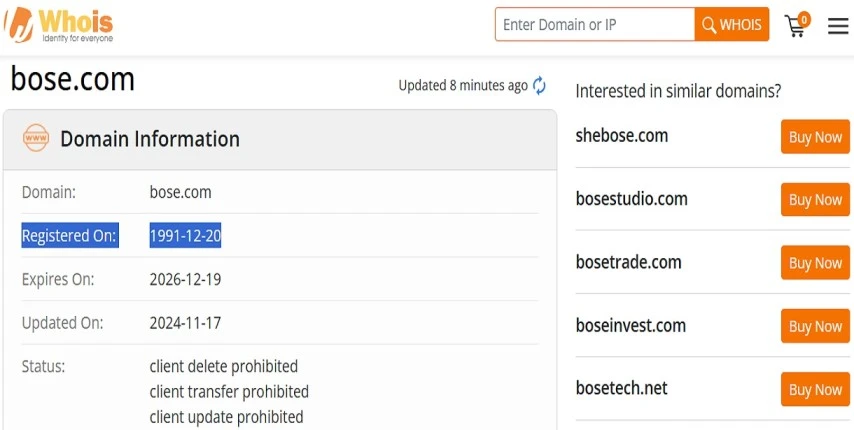
According to available records, bose com was registered on December 20, 1991. At first glance, a domain registered in 1991 might appear highly credible after all, that is over three decades of online presence. The legitimate Bose Corporation, headquartered at 100 The Mountain Road, Framingham, Massachusetts 01701, USA, has indeed maintained a long-standing digital presence, and this registration date aligns with the early days of the commercial internet.
However, domain age alone is not sufficient to confirm legitimacy. Scammers frequently purchase aged domains either directly or through secondary markets to leverage the trust that older registration dates inspire in unsuspecting shoppers. A domain registered in 1991 could have changed ownership multiple times since then, with the original registrant having no connection to the current operator.
Critical questions that every consumer should ask include: Is the WHOIS ownership information publicly visible, or has it been hidden using a privacy protection service? Does the registrar match what a global corporation of Bose’s stature would use? Are there any discrepancies between the listed business address and what independent verification sources report?
Privacy-masked WHOIS data is a common hallmark of fraudulent websites. Legitimate enterprises typically have verifiable, transparent domain registration records. When ownership is deliberately concealed, it signals that the operators may not want to be identified a major warning sign. Shoppers should always cross-reference WHOIS data with official brand communications before trusting a website with sensitive payment information.
Section 2: Trust Score & Reputation Numbers Don’t Always Tell the Full Story
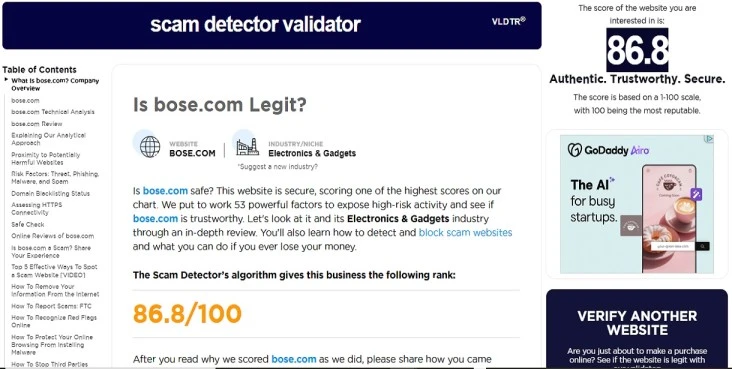
Trust scores, as generated by automated scam-detection platforms, provide a useful but incomplete picture of a website’s safety. According to available data, bose com carries a trust score of 86.8 out of 100. On the surface, this appears reassuring most scam-detection tools flag websites scoring below 50 as high-risk, while those above 80 are generally considered safer.
However, savvy investigators know that trust scores can be gamed or simply fail to capture the nuanced realities of a website’s operation. Automated scoring systems typically evaluate factors such as domain age, SSL certificate presence, social media linkage, and basic technical indicators. They do not assess whether products are delivered as advertised, whether customer service actually responds, or whether the business has a genuine physical presence.
A score of 86.8/100 sits comfortably within the range that would not trigger automatic red flags on most scanning tools. This is precisely why such scores should be treated as a starting point, not a final verdict. Many sophisticated fraudulent websites invest in technical legitimacy proper SSL certificates, active social media profiles, and clean server configurations specifically to achieve high automated trust scores while still defrauding customers.
Comparative analysis with verified, well-established electronics retailers reveals that truly legitimate sites tend to accumulate thousands of independently verifiable customer reviews across multiple platforms such as Trustpilot, Google Reviews, and the Better Business Bureau (BBB). The absence of robust, cross-platform review histories is a significant concern, regardless of what automated trust scores indicate.
Consumers are strongly advised to supplement trust score checks with manual research: searching for the website name alongside terms like “scam,” “complaint,” or “review” on search engines, and verifying the site’s reputation on consumer protection forums before making any purchase.
Section 3: Product Information & Images Authenticity Under the Microscope
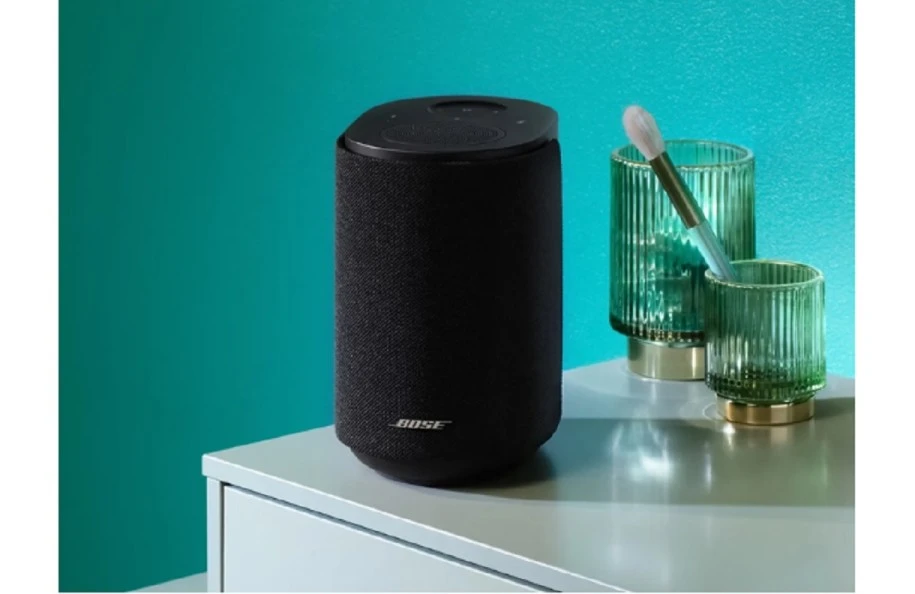
The flagship product listed on bose com under review is the Bose Lifestyle Ultra Speaker, a premium consumer electronics product falling within the high-end audio equipment category. At face value, the product description appears polished and professional consistent with what one might expect from a brand of Bose’s caliber.
However, scrutinizing product content more closely raises several important questions. First, are the product images original photography, or have they been lifted directly from the official Bose website or third-party sources? Reverse image searches of product photos used on suspicious e-commerce sites frequently reveal that images have been copied wholesale from manufacturer websites, official retailers, or stock photo libraries. This is a textbook tactic employed by fraudulent stores that have no actual inventory.
Second, the product descriptions themselves deserve scrutiny. Copied or slightly paraphrased manufacturer specifications, vague performance claims, and the absence of genuine user-generated content (such as authentic customer photos or video reviews) are telltale signs that a site may not be operating as a legitimate authorized retailer.
Third, consumers should ask: Is this website an authorized Bose dealer? Bose Corporation lists its authorized resellers on its official website. Purchasing from an unauthorized seller voids manufacturer warranties and carries a heightened risk of receiving counterfeit goods, refurbished products sold as new, or nothing at all.
The promise of significant discounts in this case ranging from 10% to 40% on products that are already premium-priced should also raise immediate suspicion. Legitimate electronics retailers rarely offer sustained steep discounts on brand-new, flagship audio products without clear justification such as a clearance sale or a manufacturer-approved promotional event.
Section 4: Return Policy & Customer Service Are They Actually Reachable?
A credible return policy is one of the most important trust markers for any online retailer. According to the information provided for bose com, the website advertises a 90-day return policy a relatively generous window that, on paper, appears consumer-friendly and confidence-inspiring.
However, the existence of a stated return policy means very little if the customer service infrastructure to support it is non-functional or fraudulent. The contact email listed for the website is [email protected]. This immediately raises a significant red flag: the domain “servify.in” is a third-party service company based in India, and is not an official @bose.com email address. Any legitimate customer service department for Bose Corporation would operate exclusively through official @bose.com email domains.
The contact number provided is +1-800-379-2073. While this appears to be a US toll-free number, consumers should verify whether this number actually connects to Bose Corporation’s official support team. Scam websites frequently list phone numbers that are either non-functional, connect to third-party call centers with no actual authority to process refunds, or are simply copied from the legitimate brand’s official contact page to appear credible.
The physical address provided Bose Corporation, 100 The Mountain Road, Framingham, Massachusetts 01701, USA is the genuine headquarters address of Bose Corporation. However, the use of a real corporate address by an unofficial or fraudulent website is itself a common deception technique. Simply listing a real company’s address does not mean the website operator has any affiliation with that company.
Consumers who have encountered difficulties with return processes on similar sites frequently report that return windows that look generous in writing are nearly impossible to utilize in practice, with customer service representatives being unresponsive, return shipping addresses being incorrect, and refunds never being processed.
Section 5: Additional Red Flags Discounts, Social Media & Payment Concerns
Beyond the primary analytical factors, a thorough scam investigation must account for additional red flags that, in combination, paint a more complete picture of risk.
Discount Offers (10%–40% Off)
Discounts ranging from 10% to 40% on premium Bose audio equipment are inherently suspicious. The Bose Lifestyle Ultra Speaker sits at the top end of consumer audio pricing. Legitimate discounts at this scale on premium electronics are rare outside of major retail events like Black Friday. Persistent high-discount offers are a classic scam strategy designed to create urgency and override a consumer’s rational evaluation process.
Social Media Presence
The website lists social media presence on Facebook, Instagram, Twitter, YouTube, and LinkedIn. While this appears comprehensive, it is important to distinguish between verified official Bose corporate accounts and third-party pages created to mimic the brand. Scam websites frequently link to newly created, low-follower social media profiles that have no genuine engagement history, or worse, to the actual official brand pages without any real affiliation.
Payment Methods
The accepted payment modes include Credit/Debit Cards, PayPal, and Klarna. PayPal does offer a degree of buyer protection, which is a positive signal. However, the presence of buy-now-pay-later services like Klarna on a potentially fraudulent site is concerning, as it encourages consumers to commit to purchases before completing due diligence. Always prefer paying via credit card where possible, as credit card chargebacks offer the strongest consumer protection mechanism in fraud cases.
SSL Certificate & Security
The presence of an SSL certificate (indicated by HTTPS) is a minimum security standard, not a legitimacy guarantee. Scam websites routinely obtain free SSL certificates such as those from Let’s Encrypt to display the padlock icon in browsers, which many consumers mistakenly equate with trustworthiness. An SSL certificate only encrypts the data transmitted between your browser and the server; it does not validate the honesty or legitimacy of the website operator.
Section 6: Website Design & Technical Footprint Surface Legitimacy vs. Substance
The visual design and technical infrastructure of an e-commerce website can reveal much about its authenticity. Sophisticated fraudulent websites today are frequently indistinguishable from legitimate retailers in terms of design quality many use premium templates, professional photography, and clean layouts to project an image of credibility.
When evaluating bose com, technical investigators should look for the following indicators. First, is the website content original, or does it rely heavily on text and imagery copied directly from official Bose channels? Content duplication including product specifications, brand imagery, and marketing copy without proper attribution or authorization is both an intellectual property violation and a fraud indicator.
Second, where are the website’s servers hosted? Many scam websites operate through hosting providers in jurisdictions with limited consumer protection oversight. Server location analysis can reveal whether the stated business address matches the actual geographic location of the website’s infrastructure a discrepancy that frequently indicates deception.
Third, are there broken links, placeholder text, missing FAQ sections, or incomplete About Us pages? Legitimate electronics retailers of Bose’s stature would maintain comprehensive, fully functional websites with detailed corporate information, press resources, and transparent policies. Any gaps in these areas are warning signs.
Fourth, does the website’s delivery promise 2 to 7 business days align with the logistics capabilities implied by its stated infrastructure? Premium electronics fulfillment within this timeframe requires established warehouse and shipping partnerships. Fraudulent sites frequently make delivery promises they cannot fulfill, leading to extended delays, excuses, and ultimately, non-delivery.
Finally, consumers should check for website creation tools and hosting footprints that are inconsistent with a major global brand’s typical digital infrastructure. Bose Corporation, as a multi-billion-dollar enterprise, would operate enterprise-grade web infrastructure not consumer-level website builders or shared hosting environments.
Section 7: Expert Verdict Scam or Legit?
After a thorough investigation of all available data points, our expert assessment is as follows: while bose com presents surface-level indicators of legitimacy including an established domain registration date, a relatively high automated trust score, and professionally presented product listings several significant concerns warrant serious caution.
The use of a non-official customer service email domain (servify.in), steep and persistent discount offers on premium products (10%–40%), the inability to independently verify authorized retailer status, and the potential for copied content and imagery collectively constitute a meaningful risk profile.
Our recommendation is: Exercise extreme caution. Do not purchase from this website without first independently verifying its authorized retailer status directly through Bose Corporation’s official channels. If you are seeking to purchase genuine Bose products, always shop through Bose’s official website or verified, established authorized retailers such as Amazon (sold and fulfilled by Amazon), Best Buy, or B&H Photo.
If you have already made a purchase, monitor your bank statements closely and be prepared to initiate a chargeback or PayPal dispute if products do not arrive as described or within the promised timeframe. Report any suspected fraud to the Federal Trade Commission (FTC) at reportfraud.ftc.gov and to your national consumer protection authority. You can read more about An In-Depth Investigation of lumvelle com.
Section 8: Frequently Asked Questions (FAQ)
1. Is bose com safe to buy from?
Based on our investigation, we advise extreme caution before purchasing from bose com. While the website displays some legitimate characteristics including an older domain registration date and a reasonable automated trust score several red flags exist, including a non-official customer service email, steep discounts on premium products, and inability to verify authorized dealer status. The safest approach is to purchase directly from Bose’s official website or verified retailers like Amazon or Best Buy.
2. How can I check if a site is a scam?
To verify a website’s legitimacy, start by checking its WHOIS registration data at lookup tools like whois.domaintools.com. Run the site through scam-detection services such as ScamAdviser, Web of Trust (WOT), or Google Safe Browsing. Search for the website name alongside the words ‘scam,’ ‘review,’ or ‘complaint’ on Google and Reddit. Check for verified customer reviews on Trustpilot and the Better Business Bureau. Confirm authorized retailer status directly with the brand. And always verify that contact email addresses use official brand domains.
3. What should I do if I already ordered from this site?
If you have already placed an order and suspect fraud, take immediate action. Document everything: save all confirmation emails, screenshots of your order, and records of any communications. If your delivery does not arrive within the promised timeframe (2–7 business days) or if the product is not as described, contact your bank or credit card issuer to initiate a chargeback. If you paid via PayPal, file a dispute through PayPal’s Resolution Center. Report the incident to the FTC at reportfraud.ftc.gov and to your local consumer protection authority. Change any passwords associated with accounts you may have created on the site.
4. Can I get my money back if scammed?
Recovery options depend on your payment method. Credit card purchases offer the strongest protection most issuers allow chargebacks within 60–120 days of the transaction for non-delivery or misrepresentation. PayPal offers a Purchase Protection program for eligible transactions. Klarna also provides some dispute resolution capabilities. Debit card transactions are generally harder to recover, but you can still contact your bank. Wire transfers and cryptocurrency payments offer virtually no recovery options, which is why scam sites often prefer these methods. Always prioritize credit card payments for online purchases from unfamiliar websites.
5. How do scam websites trick people?
Modern scam websites are highly sophisticated and employ multiple psychological and technical tactics. They clone or mimic trusted brands using similar domain names, official-looking logos, and copied product content. They create artificial urgency through countdown timers and limited-stock warnings. They advertise steep discounts to override rational thinking. They use fake or manipulated customer reviews to build false social proof. They list real corporate addresses and phone numbers to appear legitimate. They invest in technical markers of legitimacy such as SSL certificates and social media presence, while operating with no intention of delivering authentic products or honoring return policies.
6. What are the warning signs of fake online stores?
Key warning signs include: prices that seem too good to be true (steep discounts on premium products); customer service email addresses that don’t match the official brand domain; newly registered or recently changed domain ownership; a lack of independently verifiable customer reviews across multiple platforms; vague or overly generous return policies with difficult-to-reach support; product images or descriptions copied directly from manufacturer websites; website hosting in a country inconsistent with the stated business location; payment methods that offer no consumer protection (cryptocurrency, wire transfer); and an absence of transparent business registration information.
7. Which trusted sites can I use instead?
For purchasing genuine Bose products, always use verified, authorized channels. The safest options include the official Bose website (bose com) accessed directly by typing the URL not via an ad or third-party link. Established authorized retailers include Amazon (when sold and fulfilled directly by Amazon), Best Buy, Costco, B&H Photo, and major electronics chains in your country. Bose also operates official retail stores in many cities. Always check Bose’s official website for its list of authorized online dealers before purchasing from any third-party e-commerce site, regardless of how professional it appears.
Disclaimer: This article is written for informational and consumer protection purposes only. It does not constitute legal advice. All findings are based on publicly available information and investigative analysis at the time of writing. Readers are encouraged to conduct their own due diligence before making any online purchase.