TryEasewell com is an online store promoting the Easewell Restore Seat Cushion, also described as the Easewell Seat Cushion. The product is marketed as a comfort cushion for long sitting, office chairs, car seats, travel, and back-support needs. At first look, the website appears polished, with claims such as free shipping, a 30-day trial, multiple payment options, and a large discount on the cushion. For shoppers dealing with back discomfort or long sitting hours, this type of product can easily look attractive.
But before buying from any new online store, especially one offering heavy discounts on a single trending product, it is important to check the background carefully. In this TryEasewell com review 2026, we analyzed the domain age, WHOIS data, trust score, product claims, website transparency, customer support details, return policy, social media presence, and technical footprint. The goal is not to make a random accusation, but to understand whether TryEasewell com looks like a safe website or a risky online store that buyers should approach with caution.
WHOIS Data & Domain Age
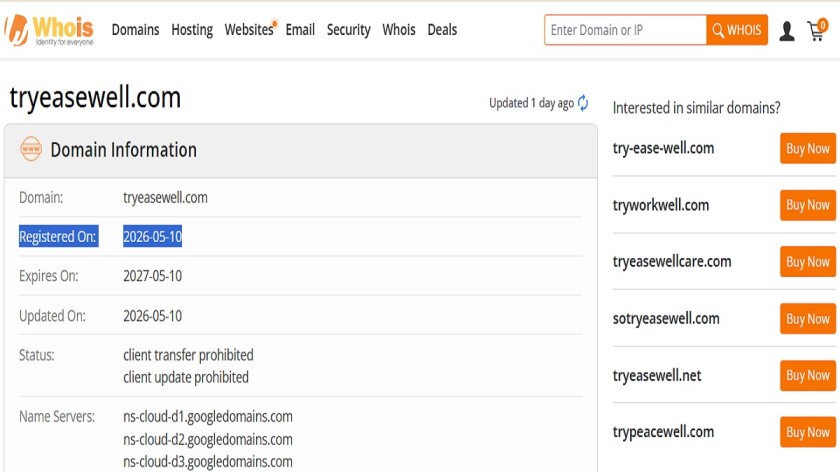
One of the first things to check when reviewing TryEasewell com is the age of the domain. According to the provided WHOIS information, TryEasewell com was registered on 2026-05-10. That means the website is very new. A young domain does not automatically mean a website is a scam, but it does reduce buyer confidence because there has not been enough time for genuine customer feedback, long-term reputation, dispute history, or independent reviews to appear.
ScamAdviser also flags TryEasewell com as a recently registered website and notes that the website owner is hiding their identity through WHOIS privacy protection. It also mentions low traffic and says it is unsure whether the website is legit. ScamAdviser explains that hidden ownership can sometimes be used for privacy, but it can also make it harder for buyers to identify who is really behind a website.
For a legitimate health or comfort product brand, transparency matters. A trusted online store usually provides a clear company name, full business address, active support channels, public brand history, and visible ownership details. In the case of TryEasewell com, the brand presents itself as Easewell, but the public business identity is limited. The address shown is partial, and the WHOIS ownership is not openly visible.
This matters because scam websites often operate on recently registered domains, run paid ads, offer large discounts, collect orders quickly, and disappear before many complaints become public. Again, this does not prove TryEasewell com is a scam, but the combination of a very young domain and hidden ownership is a clear risk signal. Buyers should not treat this website like an established brand with years of public reputation.
Trust Score & Reputation
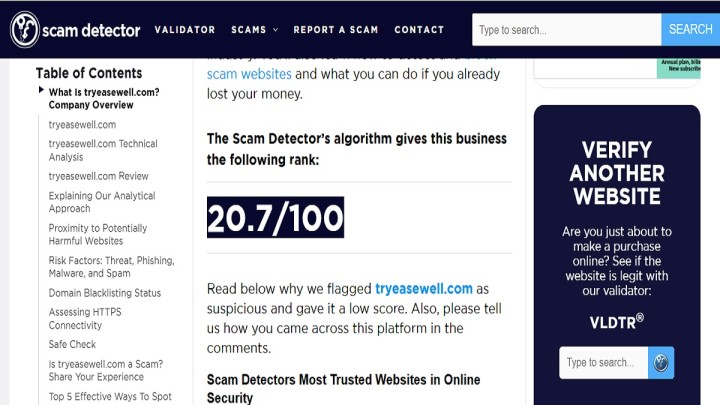
The trust score provided for TryEasewell com is 20.7/100, which is low. A low trust score usually means the website has multiple warning signals, such as young domain age, limited reputation, hidden WHOIS details, low visitor traffic, or weak transparency. ScamAdviser says its trust score is a risk indicator, not a final verdict, and a lower score generally means more warning signs have been detected by automated checks.
ScamAdviser’s page for TryEasewell com says the site has a slightly low trust score and that it is unsure if the website is legit. The negative highlights include hidden WHOIS identity, low visitor traffic, and recent domain registration. These are important because genuine stores usually build a track record across search engines, review platforms, social media pages, customer complaints, marketplace mentions, and brand references over time.
Compared with established ecommerce websites, TryEasewell com does not appear to have a strong public reputation yet. There are no clearly visible long-term customer reviews from independent sources, no strong brand footprint, and no widely recognized company background. A new website selling a health-related comfort product should ideally provide more evidence of legitimacy, especially when the product claims to help with sitting comfort and physical support.
There are some positive signals. ScamAdviser notes that the site has a valid SSL certificate and offers payment methods that may allow buyers to get money back. However, SSL only means the connection is encrypted; it does not confirm that the seller is honest. Many suspicious websites also use SSL certificates. Payment options like PayPal or credit cards can provide some protection, but that does not remove the risk of delayed refunds, poor product quality, or difficult returns.
Overall, the reputation profile of TryEasewell com is weak. The low trust score does not prove fraud, but it gives enough reason for shoppers to slow down and verify everything before ordering.
Product Information & Images
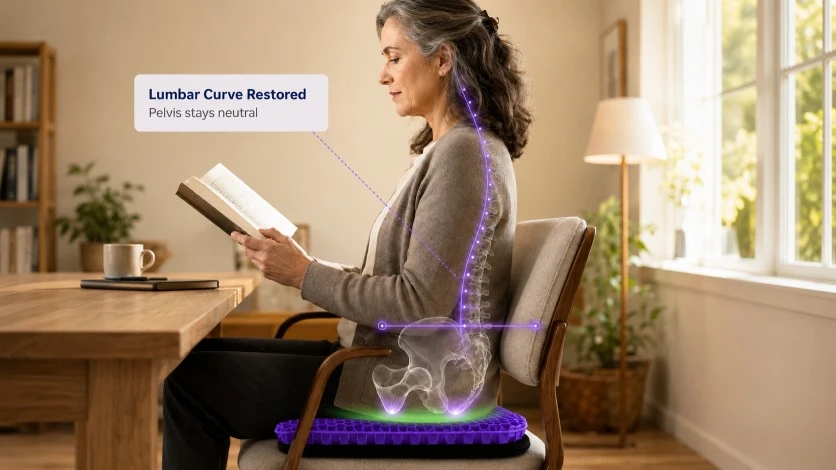
TryEasewell com mainly promotes the Easewell Restore™ Seat Cushion. The product is described as a honeycomb gel seat cushion designed for long sitting, office use, car seats, travel, and general comfort. The website also claims the cushion is “designed with Dr. of Physical Therapy,” and promotes it with free shipping and a 30-day risk-free trial.
The product page says the cushion ships within 1–3 business days and offers standard delivery in 7–10 business days. It also promotes a 30-day guarantee, saying customers can try the cushion and return it if it does not change how the chair feels. These claims sound reassuring, but buyers should look deeper. Many single-product ecommerce stores use strong comfort claims, emotional marketing, and countdown-style discount offers to push quick buying decisions.
The main concern is that gel seat cushions are widely available across many ecommerce platforms. Similar-looking honeycomb cushions are often sold under different brand names, sometimes at very different prices. If a product image or design looks generic, shoppers should do a reverse image search before buying. This can reveal whether the same product photo appears on marketplace listings, dropshipping stores, or cheaper supplier websites.
A strong product page should clearly explain materials, size, weight capacity, medical limitations, exact usage instructions, warranty terms, and independent testing. If the product claims physical therapy involvement, the site should ideally provide the expert’s full name, credentials, license information, and a way to verify the endorsement. Without that, “designed with Dr. of Physical Therapy” remains a marketing claim rather than a fully verified trust signal.
The large discount is another point to watch. The site shows the product at around $71, down from $143, with a “SAVE 50%” style offer. Heavy discounts are common in online retail, but when a new website uses a big price drop on a generic-looking product, it can be a pressure tactic. Buyers should compare the cushion with similar products on Amazon, Walmart, official medical supply stores, or trusted local retailers before paying.
Return Policy & Customer Service
TryEasewell com displays a 30-day risk-free trial and money-back guarantee. Its refund policy says customers can return the cushion within 30 days, opened or not, but refunds may be reduced if parts are missing or the item has damage beyond normal use. It also says defective or damaged products must be reported within 7 days of delivery, and that customers cover return shipping for change-of-mind returns.
On paper, this looks better than many suspicious websites that hide refund rules completely. Still, the details need careful reading. A “risk-free trial” does not always mean a buyer will receive a simple refund. If the customer must contact support first, pay return shipping, use a trackable service, and wait for the seller to approve the return, the process can become difficult. This is especially important if the return warehouse is far away or if the company does not provide a clear return address upfront.
The contact information found for Easewell includes info@tryeasewell com and a phone number listed as +1 (800) 363-5082, described as voicemail only. The address shown is Yonge St, North York, Toronto, Ontario, M2M 4M6, Canada, but it appears to be a partial address rather than a complete business location. A legitimate company should usually provide a full address with unit number, building number, city, postal code, and business identity.
A voicemail-only number is also not ideal for a store selling physical products. Buyers may need support for order tracking, cancellations, damaged products, refund requests, and missing shipments. If phone support is not active, the customer depends heavily on email replies. The refund policy says support replies within 24 hours on business days, but shoppers should test support before buying by asking a simple product or return question.
Customer service transparency is one of the biggest differences between a trusted store and a risky store. TryEasewell com has some policy pages, but the support setup still feels limited. The partial address, voicemail-only number, new domain, and low trust score make the return process something buyers should not ignore.
Additional Red Flags
Several additional red flags appear in this TryEasewell com review. The first is the heavy discount. The product page shows a major price reduction, around 50% off. Large discounts are not always suspicious, but scam-style stores often use them to create urgency. Buyers may feel they are getting a limited deal and place an order without checking the website background.
The second concern is the limited social media presence. No clear official social media links were found on the visible pages checked. A real consumer product brand usually promotes itself on Facebook, Instagram, TikTok, YouTube, or Pinterest, especially if it sells a visual lifestyle product like a seat cushion. Social media pages also allow buyers to see comments, complaints, product videos, and real customer interactions. A missing or weak social footprint makes it harder to verify public reputation.
The third concern is the product category itself. Comfort products, posture aids, pain-relief accessories, and “doctor-designed” items are frequently used in dropshipping-style marketing. These products often rely on emotional buyer needs: back pain, long work hours, sitting discomfort, travel pain, and office fatigue. If the claims are not supported by clear evidence, shoppers may end up paying a premium for a generic cushion.
The fourth point is payment safety. TryEasewell com lists payment methods such as American Express, Apple Pay, Diners Club, Discover, Google Pay, Mastercard, PayPal, Shop Pay, and Visa. These are better than direct bank transfer or cryptocurrency. But payment availability alone does not prove legitimacy. Suspicious stores can also use trusted payment processors, and buyers may still face problems with returns, shipping delays, or product quality.
The fifth point is buyer review quality. If a website shows only positive reviews, no verified buyer system, no independent review links, and no critical feedback, shoppers should be careful. Fake review patterns are common in ecommerce, especially on newly launched product pages. Real brands usually have mixed feedback, including complaints, sizing issues, delivery delays, and support experiences. You can read more about Trinity Meds Review 2026: Is trinitymeds com a Scam or Legit GLP-1 Weight Loss Platform?
Website Design & Technical Footprint
TryEasewell com has a clean ecommerce layout. It includes product pages, policy links, tracking page, region selector, cart system, and checkout-style payment options. A professional-looking design can make a new website appear more trustworthy, but website design alone is no longer a reliable legitimacy signal. Many risky stores use polished Shopify-style templates, high-quality stock images, and well-written sales sections.
The official site includes pages such as Contact, Track Your Order, Shipping Policy, Privacy Policy, Refund Policy, and Contact Information. The homepage also displays claims such as free shipping and a 30-day risk-free trial. These are useful pages, but the real issue is whether the company behind them is transparent and accountable. A policy page is only valuable if the seller actually honors it.
ScamAdviser notes that the SSL certificate is valid and that DNSFilter considers the site safe. This is a positive technical sign, but it has limits. A valid SSL certificate simply protects data transmission between the browser and the website. It does not confirm product quality, refund reliability, ownership honesty, or shipping performance. Many scam websites also use SSL because certificates are easy to obtain.
Another point is the “Track Your Order” page using 17TRACK-style tracking. This is common among ecommerce and dropshipping stores. It is not suspicious by itself, but it often appears on stores that ship from third-party suppliers. If tracking updates are slow, unclear, or international, buyers may experience longer delivery than expected.
The technical footprint of TryEasewell com looks functional, but the public business footprint is thin. There is no strong evidence of a long-running brand, broad customer base, independent media coverage, or active community. A website can be technically functional and still be risky for shoppers if transparency, reputation, and support are weak.
Expert Verdict
Based on the available findings, TryEasewell com should be considered a high-risk new online store, not a fully trusted ecommerce brand. We cannot say with certainty that TryEasewell com is a confirmed scam because the website does show product details, payment options, shipping information, refund policy, and contact information. But the warning signs are serious enough that buyers should be very careful.
The biggest concerns are the very new domain registration, hidden WHOIS ownership, low trust score, limited public reputation, partial address, voicemail-only phone support, missing clear social media presence, and a large discount on a product that appears similar to many generic honeycomb gel cushions sold online. ScamAdviser also says it is unsure if the website is legit and highlights hidden owner identity, low traffic, and recent registration.
Our recommendation is simple: do not rush to buy from TryEasewell com without comparing prices and checking independent reviews. If you still decide to order, use PayPal or a credit card, avoid debit cards, take screenshots of the product page and policy pages, save all emails, and test customer support first. Do not buy because of urgency, discount claims, or emotional product promises alone.
Final verdict: TryEasewell com is not proven to be a scam, but it looks risky in 2026. Buyers should proceed with caution and consider trusted alternatives first.
Frequently Asked Questions
Is TryEasewell com safe to buy from?
TryEasewell com does not currently look like a fully trusted website. It has some positive elements, such as policy pages, payment options, SSL, and a refund policy. But the domain is very new, WHOIS ownership is hidden, the trust score is low, and the public reputation is limited. For that reason, shoppers should be cautious before buying.
How can I check if a site is a scam?
Start by checking the domain age, WHOIS details, contact information, company address, customer reviews, return policy, payment options, and social media activity. Also search the product image on Google Lens or another reverse image tool. If the same product appears on many websites under different brand names, the store may be using dropshipping-style marketing.
What should I do if I already ordered from TryEasewell com?
Save your order confirmation, payment receipt, product page screenshots, refund policy screenshots, and all emails with the seller. Track your package carefully. If the item does not arrive within the promised time or the product is different from what was advertised, contact the seller immediately and keep records of every reply.
Can I get my money back if scammed?
It depends on your payment method. If you paid by PayPal or credit card, you may be able to open a dispute or chargeback. Explain the issue clearly and provide evidence, such as screenshots, tracking details, refund refusal messages, and photos of the product received. Debit card payments may be harder to recover, but you can still contact your bank.
How do scam websites trick people?
Scam websites often use attractive product images, large discounts, fake urgency, copied reviews, vague company details, and emotional claims. They may promise fast shipping and easy returns, but later make refunds difficult. Some send cheap items, wrong products, or low-quality versions of what was advertised.
What are the warning signs of fake online stores?
Common warning signs include a very new domain, hidden WHOIS ownership, no full company address, no working phone support, poor grammar, copied product images, unrealistic discounts, only positive reviews, missing social media pages, and unclear return instructions. One red flag alone may not prove a scam, but several together increase the risk.
Which trusted sites can I use instead?
For seat cushions or back-support products, compare options on established platforms such as Amazon, Walmart, Target, official medical supply stores, or trusted local retailers. Look for verified reviews, clear return windows, real brand information, and customer photos. A slightly higher price from a trusted seller may be safer than a big discount from a new and low-trust website.