Pinemoor is a newly launched online store selling herbal drops that are promoted as an alternative to conventional tick sprays and topical repellents. Its flagship product, Pinemoor Tick Protection Drops, is marketed for daily oral use and claims to provide around-the-clock protection by changing the scent ticks use to identify a host.
That is an unusual promise, especially because the website connects the product with serious conditions such as Lyme disease, alpha-gal syndrome, Powassan virus and Rocky Mountain spotted fever. The store also advertises deep discounts, thousands of positive reviews, a lifetime guarantee and claims that tens of thousands of families trust the product.
At first glance, Pinemoor co looks polished and professionally designed. It accepts recognized payment methods and uses a secure Shopify checkout. A closer inspection, however, raises questions about the company’s age, ownership transparency, scientific claims, customer-service structure and refund conditions.
This Pinemoor review 2026 examines the available WHOIS information, automated trust ratings, product descriptions, customer testimonials, return policy, technical setup and health-related marketing claims. The purpose is not to declare the company fraudulent without evidence, but to determine whether shoppers have enough reliable information to treat Pinemoor co as an established and trustworthy retailer.
Our verdict is that Pinemoor co should be treated as an unproven and potentially high-risk store, rather than an established health-and-wellness brand. There are some positive technical signals, but the lack of corporate transparency and the strength of the medical-style claims outweigh those basic positives.
WHOIS Data and Domain Age
Domain history is one of the first points worth checking when investigating an unfamiliar online store. A website that has operated for several years has had time to develop independent customer feedback, resolve complaints and establish a visible business record. A newly registered domain has little or no history against which its claims can be tested.
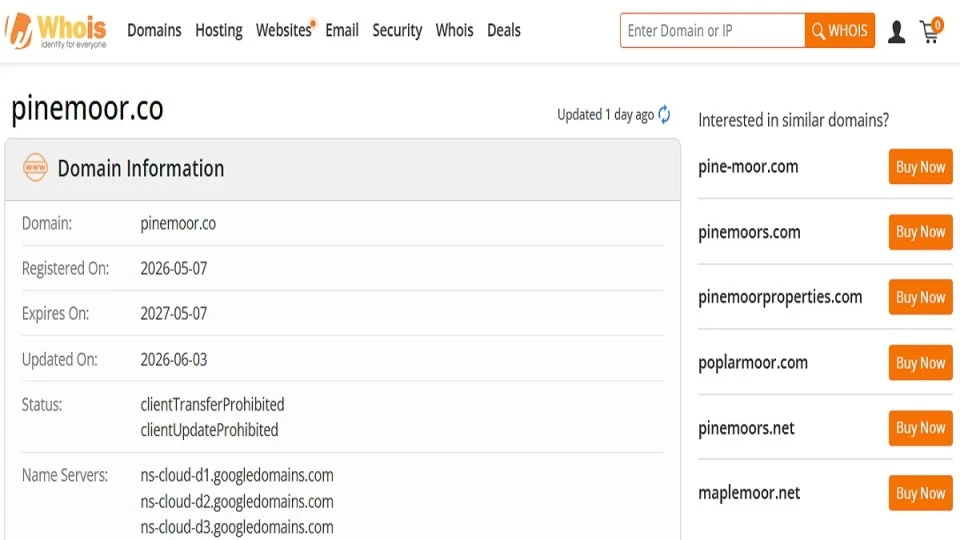
The registration date supplied for this investigation was June 11, 2026. However, current automated domain-analysis services report that Pinemoor co was created on May 7, 2026 and registered through Tucows Domains Inc. They also indicate an expiration date in May 2027. The difference between the supplied June date and the May date may come from different databases, update dates or data-collection methods. Either way, the central issue remains unchanged: the domain is extremely young.
Public ownership information is also unavailable. This does not prove dishonesty, because privacy protection is commonly used by legitimate domain owners. Still, hidden ownership becomes more concerning when combined with the absence of a legal company name, named executives, full street address and working business telephone number.
The privacy policy identifies the contact location only as “Pinemoor, United States.” It does not provide a street, city, state, ZIP code or registered company number. The listed support email is [email protected], which is a free Gmail address rather than an email using the company’s own domain.
A professional brand can certainly begin with a new domain and a Gmail account. Those details alone do not make Pinemoor co a scam. The problem is cumulative: shoppers are being asked to buy an ingestible product associated with disease prevention from a company whose identifiable legal and physical presence is unclear.
Young websites require stronger supporting evidence, not weaker evidence. Ideally, Pinemoor would publish its registered business name, complete address, manufacturing location, company registration details, laboratory certificates and the identities of qualified professionals connected with its product claims.
Trust Score and Online Reputation
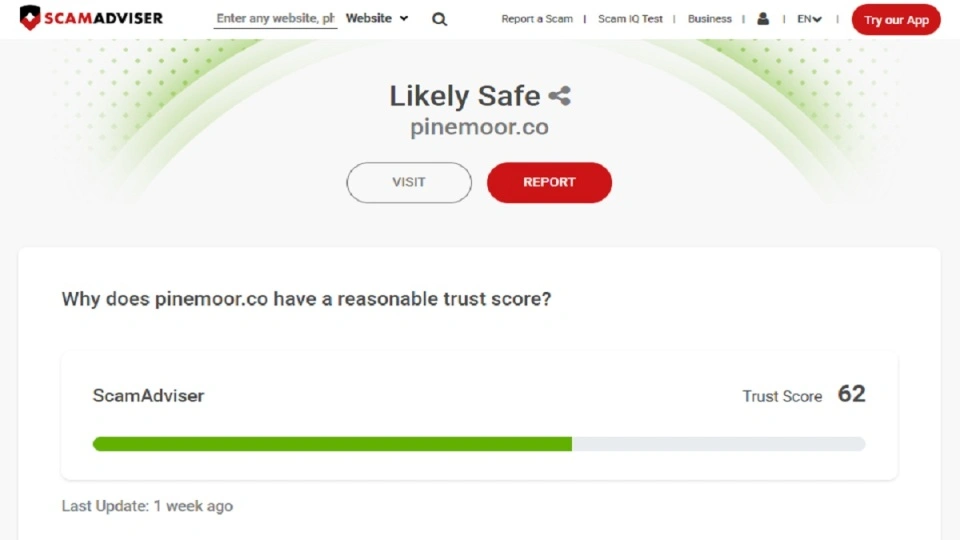
The trust score supplied for Pinemoor co is 62 out of 100. That rating suggests a mixed profile rather than an automatic scam classification. However, automated scores vary considerably depending on the system, the date of the scan and the factors included in each algorithm.
During this investigation, Scam Detector displayed a substantially lower rating of 24.1 out of 100 and described the website as suspicious or doubtful. Its report noted the recent registration date, limited company data and other automated risk indicators. At the same time, the service found a valid HTTPS connection and did not report that the domain was present on a blacklist.
Gridinsoft offered a more moderate result of 52 out of 100. Its scan found no major malware or phishing detections and recognized that Pinemoor co uses Shopify, Cloudflare infrastructure and established payment methods. Its main warnings involved the young domain, low apparent traffic and limited independent reputation data.
These different numbers show why a trust score should never be treated as a final verdict. A website can receive a medium score because it has SSL encryption and clean technical files while still lacking reliable business credentials. Automated tools can evaluate code, hosting and known threat reports, but they cannot confirm whether a supplement works, whether testimonials are genuine or whether refunds are handled fairly.
The website itself displays “Trustpilot Excellent 4.8” with 1,206 reviews. It separately says the product is rated 4.9 out of 5 and trusted by more than 47,000 families.
A targeted search did not reveal a corresponding independent Trustpilot company profile containing those 1,206 reviews. The review figure appeared primarily as text displayed by Pinemoor itself. That does not automatically mean the rating is fabricated, but visitors should not treat a Trustpilot-style badge as independently verified unless it links to a genuine profile hosted on Trustpilot.
The claim of serving more than 47,000 families also deserves scrutiny because the domain had existed for only around two months when checked. It is theoretically possible that the business operated elsewhere before launching the domain, but the site does not clearly document an earlier company history that would explain such rapid customer volume. This is an inference based on the available timeline, not proof that the customer number is false.
Product Information, Images and Health Claims
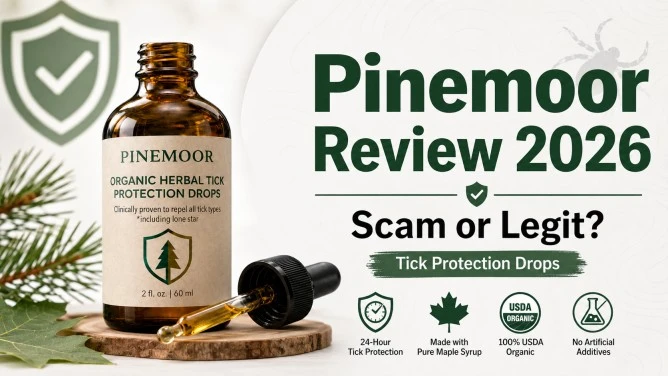
Pinemoor Tick Protection Drops are promoted as a daily herbal supplement that allegedly changes a person’s scent so ticks no longer identify them as a suitable host. The sales page says users can take eight drops each morning for 24-hour protection. It describes the formula as natural, safe for children, third-party tested and free from harsh chemicals.
The strongest statement on the page calls Pinemoor the only tick repellent clinically proven to prevent all tick-borne diseases, including Lyme disease and alpha-gal syndrome. Elsewhere, the page describes the drops as daily protection that stops ticks before they latch onto the user.
This language is unusually strong for an herbal supplement. The same website includes a disclaimer at the bottom stating that its claims have not been evaluated by the FDA and that the product is not intended to diagnose, treat, cure or prevent any disease. That creates an obvious tension between the prominent sales claim and the smaller disclaimer.
FDA guidance explains that a dietary supplement cannot legally claim to diagnose, treat, cure or prevent a disease in the same way as an approved drug. A standard disclaimer does not give a company permission to make unsupported disease-prevention promises.
The CDC states that reducing exposure to ticks is the best defense against tick-borne disease. Public-health guidance commonly focuses on protective clothing, tick checks and repellents selected through the EPA’s registered-repellent system.
The product page mentions clinically studied compounds and third-party testing, but no clearly accessible clinical trial, published peer-reviewed study, certificate of analysis or named laboratory was visible in the reviewed sales material. Ingredient research may show that certain plant compounds have insect-repellent properties under particular conditions, but that is not the same as proving that swallowing a specific mixture prevents tick attachment or every tick-borne disease for 24 hours.
There are also inconsistencies within the ingredient section. One part lists oregano, thyme, clove, lemongrass, cinnamon and peppermint. Another image heading says “Garlic Extract,” while the description beneath it refers to black seed. “Soursop Root” is connected with cinnamaldehyde, a compound normally associated with cinnamon, while the description under “Pau D’Arco” discusses menthol.
Those mismatches could be editing mistakes, but accuracy matters on a product intended for ingestion. Consumers should know the exact ingredients, quantities, serving sizes, possible allergens, manufacturing standards and safety warnings before taking the drops or giving them to children.
The product photographs look professionally prepared, but their original source and authenticity could not be independently confirmed from publicly searchable information. No conclusive duplicate-image match was established during this review, so it would be unfair to state that the images are stolen. Nevertheless, product images created by a seller do not independently prove manufacturing quality or clinical effectiveness.
Return Policy and Customer Service
Pinemoor co promotes a “lifetime money-back guarantee” near its purchase buttons. That phrase suggests that buyers may be able to try the product and receive a full refund if they are dissatisfied.
The written return policy is much narrower.
Customers must contact the company within 14 days after confirmed delivery. Approved returns are subject to a 20% restocking fee, original shipping charges are non-refundable and the buyer must pay the cost of return shipping. Products must remain in their original condition and packaging, and shoppers must receive written authorization before sending anything back.
These conditions raise an important question: how can a customer meaningfully test an ingestible tick-protection product while also returning it in original condition? If opening or using the product makes it ineligible, the practical value of the advertised lifetime guarantee becomes uncertain.
The policy does not clearly explain how the lifetime promise interacts with the 14-day refund deadline. When a prominent marketing statement and a detailed legal policy appear inconsistent, shoppers should assume the stricter written conditions may be applied during a dispute.
The shipping policy says processing can take up to seven business days, followed by an estimated five to ten business days after shipment. This means an order could require approximately 12 to 17 business days before arrival, excluding additional delays. The store also states that carrier delays do not automatically entitle a customer to cancellation, replacement or refund.
Cancellation requests must reportedly be submitted within 24 hours and before shipment. Even approved cancellations may face a 10% processing fee. The return policy additionally includes a long warning about chargebacks and says the company may contest disputes, report cardholders to fraud-prevention services or pursue collection where permitted.
Businesses have the right to defend themselves against dishonest chargebacks. Still, aggressive dispute language may discourage legitimate customers from contacting their card provider when a product is not delivered, significantly misrepresented or not refunded according to applicable consumer protections.
Customer support appears limited to the Gmail address. No official phone number was found, and the company does not publish a full return address in advance. Customers may therefore have to request authorization before discovering where the product must be returned or how expensive the return postage will be.
Additional Pinemoor co Red Flags
One of the most noticeable marketing tactics is the repeated Summer Sale offering discounts of up to 70%. Buyers are shown bundle options such as Buy 2 Get 1 Free and Buy 3 Get 3 Free, along with free gifts, shipping insurance and limited-time countdown messaging.
Discounts are common in ecommerce, but very large reductions combined with countdown timers can create pressure to purchase before completing proper research. Consumers should compare the sale price with the product’s historical selling price rather than assuming the crossed-out amount represents a genuine previous price.
The website also presents a large collection of highly positive testimonials. Many describe families, hunters, hikers and dog owners experiencing entire seasons without ticks. The testimonials are marked “verified,” but the site does not explain the verification method or provide a transparent independent review system.
The FTC advises consumers to compare reviews across multiple independent sources, examine how recently reviews appeared and watch for unusual concentrations of positive feedback. Reviews hosted entirely by the seller should not carry the same weight as verified purchases recorded by an independent platform.
A further concern is the product’s emotional sales framing. The page discusses severe diseases, long-term complications, fatal outcomes and fear experienced by families and pet owners. Informing consumers about tick-borne diseases is reasonable. Pairing those fears with a claim that a daily herbal product prevents all tick-borne illnesses can, however, lead people to rely on the drops instead of using evidence-based prevention methods.
The absence of verified official social-media accounts is another limitation. A new business is not required to maintain Facebook, Instagram or YouTube accounts, but established profiles can help customers examine earlier posts, public complaints, product history and the company’s responses.
Recognized payment methods are a positive sign. Pinemoor co accepts Visa, Mastercard, American Express, PayPal, Apple Pay, Google Pay and Shop Pay. These options may offer stronger dispute protection than bank transfers, cryptocurrency or direct payment applications. Their presence improves checkout safety but does not verify the product’s medical claims or guarantee satisfactory fulfilment. You can read more about Lumvelle Drops Review 2026: Scam or Legit? An In-Depth Investigation of lumvelle com.
Website Design and Technical Footprint
From a design perspective, Pinemoor co is more polished than many obvious fake stores. The layout is mobile-friendly, product bundles are clearly presented and the checkout system uses recognizable payment providers.
Technical scans identify Shopify as the ecommerce platform. The detected IP address is associated with Shopify and Cloudflare infrastructure, while the website uses an active SSL certificate and TLS encryption. No major malware or phishing blacklist warning was detected during recent automated checks.
These are genuine positive signals, but their importance should not be exaggerated. Shopify allows businesses to create stores quickly, and SSL only encrypts data moving between the user and the website. Neither feature proves who operates the company, whether a product works or whether customer disputes will be handled fairly.
Cloudflare or Shopify server locations should also not be confused with a company’s physical location. A site may be technically served through infrastructure in Canada or the United States while its owner, warehouse or fulfilment partner is located elsewhere.
During the investigation, the Terms of Service link returned a 404 error when fetched. This could be a temporary technical issue rather than a permanently broken page, but legal terms should be consistently accessible before checkout.
The website also contains signs of rushed content assembly. Ingredient headings do not always match their descriptions, and the product page alternates among different ingredient lists. The page claims clinically studied doses and third-party testing without providing easy access to supporting documents.
Some testimonial patterns also appear reused between the human and dog versions of the product. Similar reviewer names, narratives and wording appear across both pages, with the subject changed from families or people to dogs. That does not prove the testimonials are invented, but it weakens their value as independent evidence.
A technically functional website can still contain unreliable marketing. In this case, the storefront appears operational, but the business and scientific footprint behind it is much thinner than the polished design suggests.
Expert Verdict: Should You Buy Pinemoor Tick Protection Drops?
Based on the available evidence, Pinemoor co cannot currently be classified as a confirmed scam. The website is active, encrypted, hosted through established infrastructure and accepts payment methods that may provide buyer protection. Automated scanners have not reported major malware or blacklist detections.
That said, there is not enough evidence to consider Pinemoor co a trustworthy or scientifically established health brand.
The domain is very new. Public ownership details are hidden, the company provides no complete business address, customer support relies on a Gmail account and no telephone number is published. The site promotes a 4.8 Trustpilot rating and more than 47,000 customers without providing easily verifiable independent evidence supporting those numbers.
The greatest concern is the product claim. Saying that an oral herbal formula is clinically proven to prevent all tick-borne diseases is an extraordinary statement. The sales page does not clearly provide the clinical research, EPA registration, FDA approval or laboratory documentation needed to support such confidence. The claim also sits uneasily beside the site’s own statement that the product is not intended to prevent disease.
The advertised lifetime guarantee is weakened by a 14-day return period, a 20% restocking deduction, customer-paid return shipping and original-condition requirements.
Our final Pinemoor review 2026 verdict is therefore:
Pinemoor co is an unproven, high-risk online store that should be approached with substantial caution. It is not proven to be an outright scam, but its product should not be relied on as a replacement for EPA-registered repellents, protective clothing, tick checks, veterinary preventatives or medical advice.
Consumers who still decide to order should use PayPal or a credit card, avoid purchasing large bundles, save screenshots of all promises and consult a healthcare professional before ingesting the drops or giving them to children.
Frequently Asked Questions About Pinemoor co
Is Pinemoor co safe to buy from?
Pinemoor co uses a valid encrypted connection, Shopify checkout and recognized payment methods. These technical features reduce certain payment-security risks. However, the company’s recent domain registration, limited ownership details, missing phone number, unclear address and unverified product claims mean it cannot currently be considered fully established. Buyers should avoid large orders and should not rely on the product as medically proven tick protection.
Is Pinemoor co a scam or legit website?
There is not enough evidence to call Pinemoor co a confirmed scam. There is also insufficient evidence to describe it as a proven legitimate health brand. The most accurate classification is suspicious or high-risk due to its limited history, aggressive health claims and restrictive refund conditions.
Does Pinemoor Tick Protection really prevent Lyme disease?
The website claims that its herbal drops can prevent tick bites and tick-borne diseases. No clearly linked peer-reviewed clinical trial was found on the reviewed product page proving that this specific oral formula prevents Lyme disease. Consumers should follow CDC tick-prevention guidance and use properly evaluated repellents rather than relying only on an unverified supplement.
How can I check whether an online store is a scam?
Check the domain age, public business registration, address, telephone number and independent customer reviews. Search important sentences from the website to identify copied material. Read the return policy before paying and look for inconsistencies between advertising promises and legal terms. A secure padlock or professional design should never be treated as proof of legitimacy.
What should I do if I already ordered from Pinemoor co?
Save the order confirmation, product page, guarantee statement, shipping promise and all email communication. Request tracking information in writing. When the package arrives, photograph the label and packaging before opening it. For an ingestible product, review the complete ingredients and speak with a healthcare professional before use.
Can I get my money back if the company does not deliver?
First contact the seller in writing and request a clear resolution. PayPal and credit-card providers may offer dispute procedures for qualifying non-delivery, unauthorized charges or materially misrepresented products. Submit accurate evidence and follow the deadlines imposed by the payment provider. Do not file a dishonest chargeback merely because you changed your mind.
Which trusted tick-protection options should consumers use instead?
Choose tick repellents listed through the EPA’s repellent search system and follow CDC guidance on clothing, tick checks and safe removal. For pets, use products recommended by a licensed veterinarian because some ingredients that are tolerated by humans can be dangerous to animals. No single product eliminates all risk, so several prevention methods should be used together.