Aurum Foundation presents itself as a modern cryptocurrency and financial technology ecosystem offering artificial-intelligence trading tools, digital tokens, DeFi services, payment cards, exchange facilities and neo-banking products. Its advertised services include the EX-AI Bot, Zeus AI Bot, flash loans, Aurum Exchange, Aurum Neo-Bank, AURUM Cards and the NEYRO AI Trading Agent.
At first glance, this broad collection of crypto-related services may make the platform appear established and innovative. The website also displays multiple international business addresses and links to social media accounts. These details can create an impression of a globally operating financial company.
However, financial platforms must be judged by more than polished branding and ambitious product descriptions. Aurum Foundation has received warnings from financial regulators, its Trustpilot rating has become unavailable following a guidelines breach, and several questions remain about its licensing, legal structure, refund conditions and customer protections.
This Aurum Foundation review for 2026 examines the domain’s age, reputation scores, company information, products, payment system, regulatory warnings, customer reviews and technical trust signals. The aim is not to make unsupported accusations but to determine whether Aurum Foundation appears safe, properly regulated and transparent enough for consumers to trust with their money.
WHOIS Data and Domain Age
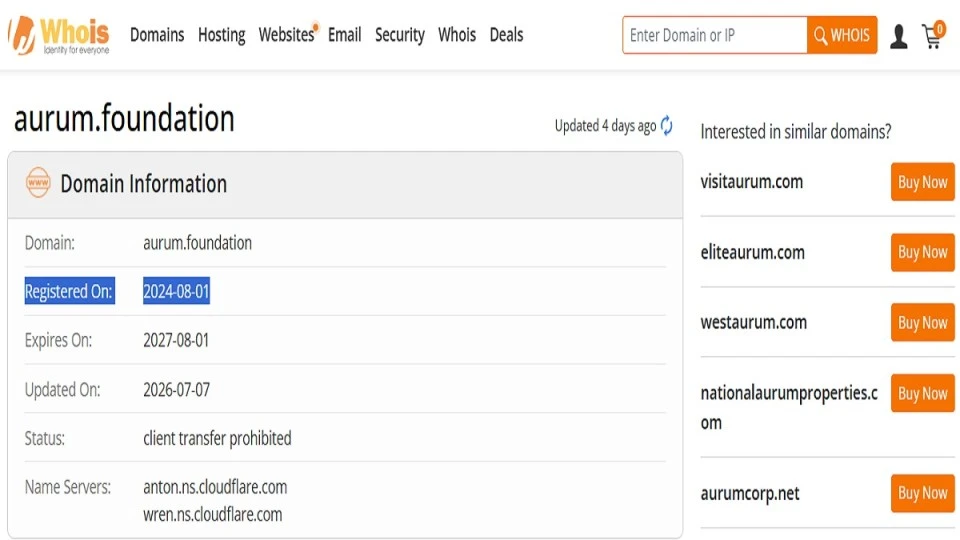
The aurum foundation domain was reportedly registered on August 1, 2024. This means the website is nearly two years old as of July 2026. It is not an overnight domain created only a few days or weeks ago, but it also lacks the long operating history normally associated with established financial institutions.
Domain age matters more when a website handles investments, cryptocurrency deposits or financial transactions. A regular online store may be able to build credibility within a relatively short period. A financial platform, however, needs a verifiable corporate history, regulatory permissions, audited operations and a dependable record of processing withdrawals.
The supplied WHOIS information confirms the registration date, but complete verified details about the registrant, registrar and hosting country were not included in the available information. It is therefore not possible to confirm from the supplied evidence whether the ownership information is publicly disclosed or protected by a privacy service.
WHOIS privacy is not automatically suspicious. Many legitimate companies use privacy protection to reduce spam and prevent misuse of personal information. The concern arises when hidden domain ownership is combined with unclear licensing, several operating entities and multiple international addresses.
Aurum Foundation identifies several entities and locations, including Aurum Foundation Limited and Aurum Neo-Bank Sp. z o.o. The website also reportedly refers to operations under the NEYRO name. This makes it important to determine which company legally owns the website, which entity receives deposits and which jurisdiction governs customer disputes.
The domain’s registration date alone does not prove that Aurum Foundation is fraudulent. Nevertheless, a relatively young domain operating in cryptocurrency and investment services should be evaluated carefully. Consumers should look for licensing records, audited financial statements, verifiable directors, transparent withdrawal rules and evidence that the business has operated continuously under the same legal ownership.
Trust Score, Reputation and Regulatory Warnings
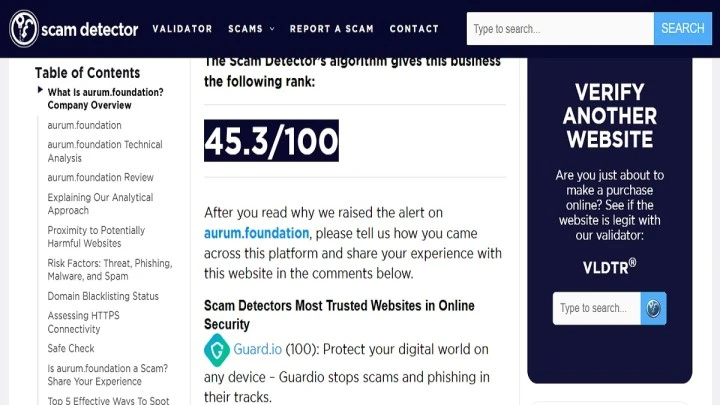
Aurum Foundation reportedly received a trust score of 45.3 out of 100 from a third-party scam-detection service. This is not the lowest possible rating, but it is far below the level most consumers would expect from a trusted financial institution.
Automated trust scores should never be treated as a final verdict. These tools usually assess domain age, technical configuration, website popularity, hosting data, contact transparency and other automated signals. A moderate rating may mean that the system found both positive and negative indicators.
FindTheScam reportedly assigns aurum foundation a score of 66 out of 100 with a “Use Caution” verdict. The scan recognizes the presence of valid HTTPS but says that several WHOIS, reputation and safe-browsing signals were incomplete. This result is more favorable than the 45.3 score, although it still does not classify the platform as completely safe.
ScamAdviser reportedly describes the website as likely legitimate while warning that its scan is more than 30 days old. It also highlights the high-risk nature of cryptocurrency and financial services and reportedly identifies references connected to multilevel marketing. ScamAdviser’s assessment should therefore be read as an automated risk estimate rather than confirmation that the business is licensed or financially reliable.
The most serious concerns come from official financial regulators rather than automated website scanners.
Hong Kong’s Securities and Futures Commission reportedly added Aurum Foundation to its suspicious virtual-asset-platform alert list on June 22, 2026. The regulator stated that the platform was not licensed by the SFC and was suspected of conducting unlicensed activities.
France’s Financial Markets Authority reportedly blacklisted the aurum foundation domain on June 12, 2026, for offering financial services or products without authorization. Australia’s MoneySmart investor alert list also reportedly identifies Aurum Foundation as an unlicensed entity.
These regulator warnings carry considerably more weight than a website trust score. They do not necessarily prove every service offered through the platform is fraudulent, but they indicate that consumers may not receive the regulatory protections normally associated with authorized financial providers.
Product Information, Images and Investment Claims
Aurum Foundation promotes a wide range of cryptocurrency and financial products. These reportedly include an annual AURUM Subscription, the EX-AI Bot, Zeus AI Bot, flash loans, Aurum Exchange, Aurum Neo-Bank, payment cards, the Aurum Token and the NEYRO AI Trading Agent.
The platform’s product catalogue appears designed to position Aurum Foundation as a complete crypto-financial ecosystem rather than a single-purpose trading website. A broad service range is not inherently suspicious, but each financial product requires clear documentation, risk disclosures and legal authorization.
AI-powered trading products deserve particular scrutiny. Automated trading systems are often promoted through claims about advanced algorithms, market prediction or passive income. Consumers should not assume that the use of terms such as artificial intelligence, automation or algorithmic trading means that profits are likely or that losses are controlled.
A legitimate trading product should clearly explain how the system works, which markets it trades, what fees apply, how historical performance is calculated and whether results have been independently audited. Performance claims should include losses and drawdowns rather than only favorable examples.
The available information does not establish whether Aurum Foundation provides independently audited performance records for its AI bots. It also does not confirm whether its token, exchange, flash-loan service or neo-banking operation is regulated in each country where it is promoted.
No verified reverse-image-search findings were supplied for this review. It would therefore be inappropriate to claim that Aurum Foundation copied its product images from other websites. Consumers can perform their own checks by uploading promotional images to Google Lens or another reverse-image-search tool.
Similar images appearing on multiple unrelated investment websites may indicate the use of stock photography or generic marketing templates. Stock imagery is not proof of fraud, but financial platforms should support promotional visuals with genuine documentation, identifiable management and verifiable operational evidence.
Consumers should also be cautious when a platform combines trading bots, tokens, payment cards, referral rewards, flash loans and banking terminology under one brand. Each product should be evaluated separately rather than assuming the entire ecosystem is trustworthy because one part appears professional.

Return Policy, Refund Terms and Customer Service
Aurum Foundation does not operate like a conventional online store, so standard delivery and return policies may not apply to most of its services. Cryptocurrency deposits, subscriptions, token purchases and completed trades are generally different from purchases of physical consumer goods.
No clearly defined public refund policy was identified in the supplied information. Customers are advised to inspect all subscription, cancellation, withdrawal and transaction-reversal conditions inside their accounts before making a payment.
This is important because cryptocurrency transactions are often irreversible. Once digital assets are transferred to a wallet controlled by another party, a bank or card provider may not be able to recover the funds. A platform can also impose withdrawal fees, minimum withdrawal amounts, identity-verification requirements or account restrictions.
Aurum Foundation lists [email protected] as its support email address. A domain-based email is generally more professional than a free email account. However, an official-looking email does not prove that customer complaints will be resolved efficiently.
No public telephone number was found. The absence of telephone support is not unusual for a cryptocurrency platform, but it reduces the number of ways customers can obtain assistance during account restrictions or withdrawal disputes.
The website reportedly displays several addresses:
- Exchange Tower, Business Bay, Office 1806, Dubai, UAE.
- Unit 503, 5/F, Silvercord Tower 2, 30 Canton Road, Tsim Sha Tsui, Hong Kong.
- Room D, 10/F, Tower A, Billion Centre, 1 Wang Kwong Road, Kowloon Bay, Hong Kong.
- Aurum Neo-Bank Sp. z o.o., ul. Długa 29, 00-238 Warsaw, Poland.
Multiple addresses may reflect genuinely separate subsidiaries, offices or service providers. The concern is that users may struggle to determine which entity is legally responsible for their deposits.
Before depositing money, customers should request the legal name of the contracting company, its registration number, the applicable financial licence and the jurisdiction in which a complaint can be filed. Address listings alone are not equivalent to regulatory authorization.
Payment Methods and Financial Security
Aurum Foundation’s card service reportedly mentions Apple Pay and Google Pay. Its privacy policy also refers generally to credit-card processing. However, the exact methods available for investment deposits appear to be shown mainly after account registration.
The AURUM Card page reportedly mentions USDT top-ups and a 2.2 percent top-up commission. This indicates that cryptocurrency plays a significant role in the platform’s payment ecosystem.
Crypto payments create additional risk because they normally do not include the chargeback protections associated with major credit cards. A consumer who pays through a credit card may be able to dispute an unauthorized or misleading charge, depending on the circumstances. A consumer who transfers USDT to an external wallet may have fewer recovery options.
The presence of HTTPS is a basic positive technical signal. HTTPS encrypts information exchanged between the user’s browser and the website. It helps reduce interception risks but does not prove that the company itself is trustworthy.
Many questionable investment websites have valid SSL certificates. Modern certificates are inexpensive and can be issued automatically. Consumers should never interpret the padlock icon as evidence that an investment platform is licensed or safe.
The available evidence does not establish that Aurum Foundation lacks a secure payment gateway or steals payment-card information. Such claims would require direct technical proof. Nevertheless, users should avoid storing card information on any platform whose licensing and legal responsibility remain unclear.
Consumers should also be careful if they are instructed to pay through cryptocurrency, wire transfers or wallet-to-wallet transfers. These payment methods can make disputes and refunds much harder.
Before making any payment, users should verify the recipient name, wallet address, payment processor and contractual entity. Screenshots of the offer, deposit instructions, fee schedule and account terms should be saved in case a dispute occurs later.
Website Design and Technical Footprint
Aurum Foundation appears more sophisticated than many basic scam websites. It promotes multiple products, uses branded terminology and presents itself as an international crypto-financial operation.
Professional design, however, is not a substitute for legal transparency. Modern website builders and templates allow almost any operator to create a polished financial platform. The more important questions concern licensing, ownership, management, custody of funds and withdrawal reliability.
No verified evidence was supplied showing widespread broken links, copied website text, hidden malicious subdomains or persistent server failures. These issues should therefore not be presented as confirmed findings.
The website’s technical footprint should still be monitored. Investigators can check historical versions of the website, DNS records, subdomains, hosting changes and archived company claims. Frequent changes in legal names, addresses or service descriptions may indicate instability.
Consumers should compare information across the website’s privacy policy, terms of service, contact page, card documentation and investment pages. Contradictions between these documents can reveal copied policies or unclear corporate responsibility.
The presence of several companies and operating regions also deserves close examination. A platform may use different entities for software, payments, cards or marketing, but the relationship between them should be explained clearly.
A reliable financial website should prominently display the licence number connected to each regulated service. Users should be able to verify that number directly on the relevant regulator’s official register.
Given the warnings reportedly issued in Hong Kong, France and Australia, technical professionalism should not be allowed to overshadow regulatory risk. A website can function smoothly and still operate without authorization in the countries where it attracts customers.
Social Media and Online Presence
Aurum Foundation reportedly links to Telegram, YouTube, Instagram and X or Twitter. An active social media presence can help users follow announcements and communicate with a company, but it does not independently prove legitimacy.
Crypto projects commonly rely on Telegram groups, influencer promotions and referral campaigns. These communities may contain genuine customers, paid promoters, automated accounts or individuals who benefit financially when new members join.
Follower counts should therefore be treated cautiously. A large number of followers does not necessarily indicate a large number of active users. Signs of an artificially inflated audience can include low engagement, repetitive comments, generic praise and sudden increases in follower numbers.
The available information does not provide enough evidence to determine whether Aurum Foundation purchased followers or operates fake social media accounts. Such claims should not be made without examining follower quality, engagement patterns and account history.
Users should look at how the platform responds to difficult questions. Genuine support teams should be willing to explain licences, withdrawal delays, fees and account restrictions. A social media channel that deletes criticism or redirects every concern to private messages may reduce transparency.
Telegram users should be particularly cautious of impersonators. Scammers often copy the profile image and username of a legitimate project representative and then contact users privately. Aurum Foundation customers should verify every account through links published on the official website.
Users should never share wallet seed phrases, private keys, passwords or one-time security codes with anyone claiming to be a support agent. Genuine support staff do not need a customer’s private recovery phrase to investigate an account.
A company’s online presence becomes meaningful only when it is supported by consistent legal disclosures, verifiable management, transparent policies and a history of resolving customer complaints.
Customer Reviews and Testimonials
Trustpilot reportedly shows 283 reviews for Aurum Foundation, with 279 posted during the previous 12 months. Approximately 76 percent were five-star reviews, while around 19 percent were one-star reviews.
The most important detail is that the Trustpilot rating is reportedly unavailable because of a breach of the platform’s guidelines. Trustpilot also reports that fake reviews were detected and removed.
This does not prove that every positive review is fabricated or that every negative review is genuine. It does, however, weaken the reliability of the overall rating. When a review profile receives a warning related to fake feedback, consumers should analyze individual reviews rather than relying on the headline score.
Potential warning signs include large numbers of reviews posted within a short period, repetitive wording, reviewers with no previous activity and praise that focuses mainly on earnings or recruitment. Genuine financial-service reviews are usually more specific. They may mention identity verification, fees, withdrawal times, customer service and actual account experiences.
One-star reviews should also be assessed carefully. Complaints involving withdrawal restrictions, unexpected charges or account freezes deserve attention, but each allegation should be compared with the platform’s stated terms.
No verified SiteJabber information was included in the supplied evidence. It would therefore be inaccurate to claim that Aurum Foundation has a positive or negative SiteJabber reputation.
Consumers should search for independent discussions outside affiliate websites and promotional social media channels. Searches should include the company name alongside terms such as “withdrawal problem,” “account blocked,” “refund,” “regulator warning” and “customer complaint.”
Testimonials published directly on the Aurum Foundation website should be treated as marketing material unless the identities and experiences can be independently verified. The Trustpilot guidelines warning is one of the strongest reputation concerns surrounding the platform.
Additional Red Flags and Risk Indicators
Aurum Foundation reportedly advertises an annual subscription costing $19.99. Its flagship card page also mentions a $249 issuance fee, a 2.2 percent USDT top-up commission and a referral bonus of up to $150 for each card sale.
Referral rewards are not automatically fraudulent. Many legitimate companies use affiliate programmes. However, high commissions can encourage promoters to focus on recruitment rather than presenting risks objectively.
Potential users should determine whether rewards are funded by genuine service revenue or depend heavily on continued customer recruitment. References to multilevel-marketing characteristics, as reportedly noted by ScamAdviser, make this question particularly relevant.
The platform’s broad product range is another risk factor requiring investigation. Aurum Foundation appears to combine banking-style services, crypto exchange functions, trading bots, tokens, cards, subscriptions and referral incentives.
Operating all these services legally across several countries would require significant compliance infrastructure. Users should expect detailed disclosures about licensing, anti-money-laundering controls, asset custody, client-fund protection and dispute resolution.
The official regulator warnings are more serious than ordinary website-quality concerns. Hong Kong’s SFC reportedly identifies the platform as unlicensed and suspected of conducting unauthorized activities. France’s AMF reportedly blacklisted the domain, while Australia’s MoneySmart investor alert list identifies it as unlicensed.
No confirmed malware or phishing warning was included in the supplied evidence. It would therefore be irresponsible to claim that the website distributes malware or directly steals credentials.
The primary risks are related to financial authorization, review credibility, unclear legal responsibility, crypto payment reversibility and the difficulty of recovering money if a dispute develops.
Consumers should also be cautious of unsolicited advertisements promising easy profits, passive income or guaranteed performance. No trading platform can eliminate market risk. Any representative who promises fixed returns or pressures users to deposit quickly should be treated with suspicion. You can read more about Uproot Clean Review 2026: Is uprootclean com a Scam or Legit Pet Hair Removal Brand?
Expert Verdict: Is Aurum Foundation a Scam or Legit?
Based on the information currently available, Aurum Foundation should be classified as a high-risk and insufficiently verified financial platform.
There are some positive indicators. The aurum foundation domain is not newly registered, the website uses HTTPS, it lists a domain-based support email and it provides information about several products and business locations. Automated scanners do not universally classify it as fraudulent.
These positive points are outweighed by more serious concerns. Financial regulators in Hong Kong, France and Australia have reportedly issued warnings or listed Aurum Foundation as unauthorized or unlicensed. Its Trustpilot rating is unavailable after a guidelines breach, with fake reviews reportedly detected and removed.
The website also uses several legal entities and international addresses, making it difficult for an ordinary user to determine which company is responsible for deposits, card services, subscriptions and withdrawals.
This review cannot conclusively prove that every Aurum Foundation service is a scam. However, the regulatory warnings mean consumers should not treat it as a verified or safely regulated financial provider.
The practical verdict is to avoid depositing money, purchasing tokens or transferring cryptocurrency until the platform can provide independently verifiable licensing and clear customer-protection information.
Anyone considering the service should verify its licence directly with the regulator in their country, read the complete withdrawal terms and avoid relying on social media promoters or referral representatives. Existing users should keep detailed records of all transactions and avoid sending additional funds to unlock withdrawals.
Frequently Asked Questions
Is Aurum Foundation safe to invest with?
Aurum Foundation cannot currently be considered a low-risk investment platform. It has reportedly appeared on warning or blacklist pages maintained by financial regulators in Hong Kong, France and Australia. These warnings suggest that the platform may be offering financial or virtual-asset services without the required authorization. Consumers should avoid depositing funds until its licences can be independently verified.
Is Aurum Foundation a confirmed scam?
The available evidence does not provide a legal judgment proving that every Aurum Foundation service is fraudulent. However, the regulator warnings, Trustpilot guidelines breach, unclear legal structure and crypto-payment risks are serious concerns. It is more accurate to classify the platform as high risk rather than making an unsupported absolute accusation.
How can I check whether an investment website is a scam?
Search the website’s name on the official register of your country’s financial regulator. Check the domain’s registration date, legal company name, directors, address and licence number. Read independent customer complaints and examine withdrawal experiences. Do not rely only on website testimonials, influencers or automated trust scores.
What should I do if I already deposited money?
Do not send additional funds if you are asked to pay a tax, verification fee or security deposit before withdrawing. Save screenshots, wallet addresses, transaction IDs, emails and chat records. Contact your bank, card provider or cryptocurrency exchange immediately. You should also report the incident to your national financial regulator and cybercrime authority.
Can I recover money sent through cryptocurrency?
Recovery is difficult because blockchain transactions are usually irreversible. Contact the exchange used to purchase or send the cryptocurrency as soon as possible. The exchange may be able to flag the recipient wallet or preserve account information for investigators. Be cautious of recovery agents demanding upfront payment, as recovery scams frequently target previous victims.
How do questionable investment platforms attract customers?
They may use professional websites, artificial-intelligence terminology, referral bonuses, social media influencers, testimonials and claims of passive income. Some platforms allow small early withdrawals to build confidence before encouraging larger deposits. Pressure to act quickly or recruit other members is a major warning sign.
What trusted alternatives should consumers use?
Choose cryptocurrency exchanges, brokers or financial platforms authorized by the regulator in your country. Verify the licence directly through the regulator’s official database rather than relying on a licence image published by the company. Established providers should clearly disclose fees, custody arrangements, withdrawal policies and the legal entity responsible for customer funds.@Deep Research