Black GLP Freedom presents shoppers with unusually large advertised discounts and a wide spread of displayed prices, but the available evidence does not explain which products or packages correspond to every amount. That transparency gap prompted our closer buyer check of blackglpfreedom com. ZeroThought examined the seller-displayed pricing captured on August 14, 2026, the domain’s WHOIS com history, and the availability of independent reputation records. The result is not proof of fraud, but it does leave important questions about the store’s history, business identity, policies, and independent customer record unanswered.
Quick Verdict
Our investigation found a very recently registered domain, seller-displayed discounts as high as 96%, and no accessible independent reputation result in the supplied evidence. Those points justify caution, although they do not establish fraud. Buyers should seek clear product, fulfillment, return, operator, and payment-protection details before placing an order.
Why blackglpfreedom com prompted a closer review
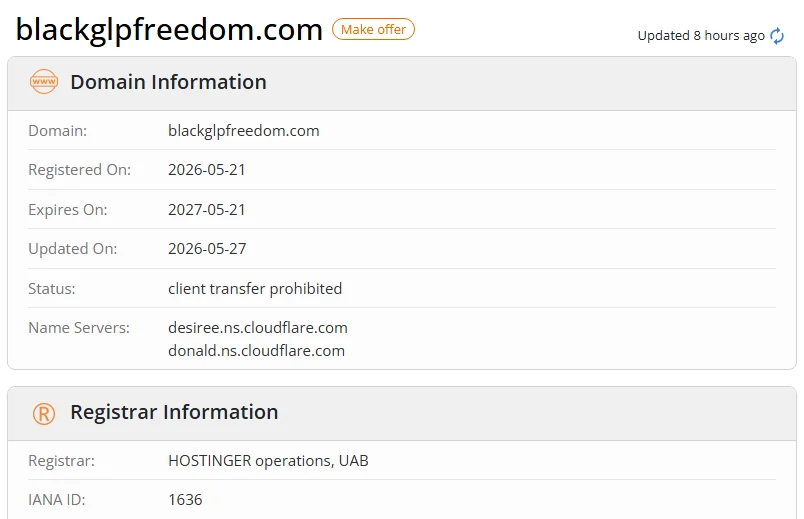
The seller’s captured presentation included prices ranging from $49 to $1,074, alongside discount claims of 89%, 93%, and 96%. Large markdowns can attract attention, but the evidence ledger does not identify which item, bundle, quantity, subscription, or comparison price belongs to each figure. We therefore treat every amount strictly as a seller-displayed claim—not as a verified market value or confirmed final checkout price.
The limited operating history also matters. The domain was registered only on May 21, 2026, less than three months before our August 14 evidence collection. A young domain can belong to a genuine new venture, but it provides shoppers with little history against which to evaluate fulfillment consistency or complaint handling.
For context on the kinds of checks worth making around unfamiliar stores, ZeroThought’s guide to identifying potentially unsafe shopping websites explains why domain age, traceable identity, realistic pricing, and usable buyer policies should be considered together rather than in isolation.
Products, prices, and discount claims
On August 14, 2026, the seller displayed the following distinct prices: $49, $51, $89, $150, $177, $294, $360, $537, $780, $1,000, and $1,074. The same capture also recorded advertised discounts of 89%, 93%, and 96%.
These figures should not be combined into a single price range for one product. The ledger records multiple amounts but does not provide the accompanying product names, package sizes, quantities, billing intervals, or crossed-out comparison-price context. It would therefore be unsafe to infer that $1,074 was a regular price for an item offered at $49, or that any particular discount applied to a specific package.
Before paying, a shopper should preserve the exact offer page and checkout summary, then confirm the item name, quantity, whether billing recurs, the currency, taxes, shipping charges, and the final total. The same discipline is useful when assessing other steeply promoted stores; our Uproot Clean buyer review illustrates why an offer should be evaluated through its complete terms rather than its headline price alone.
Domain history: a short public timeline
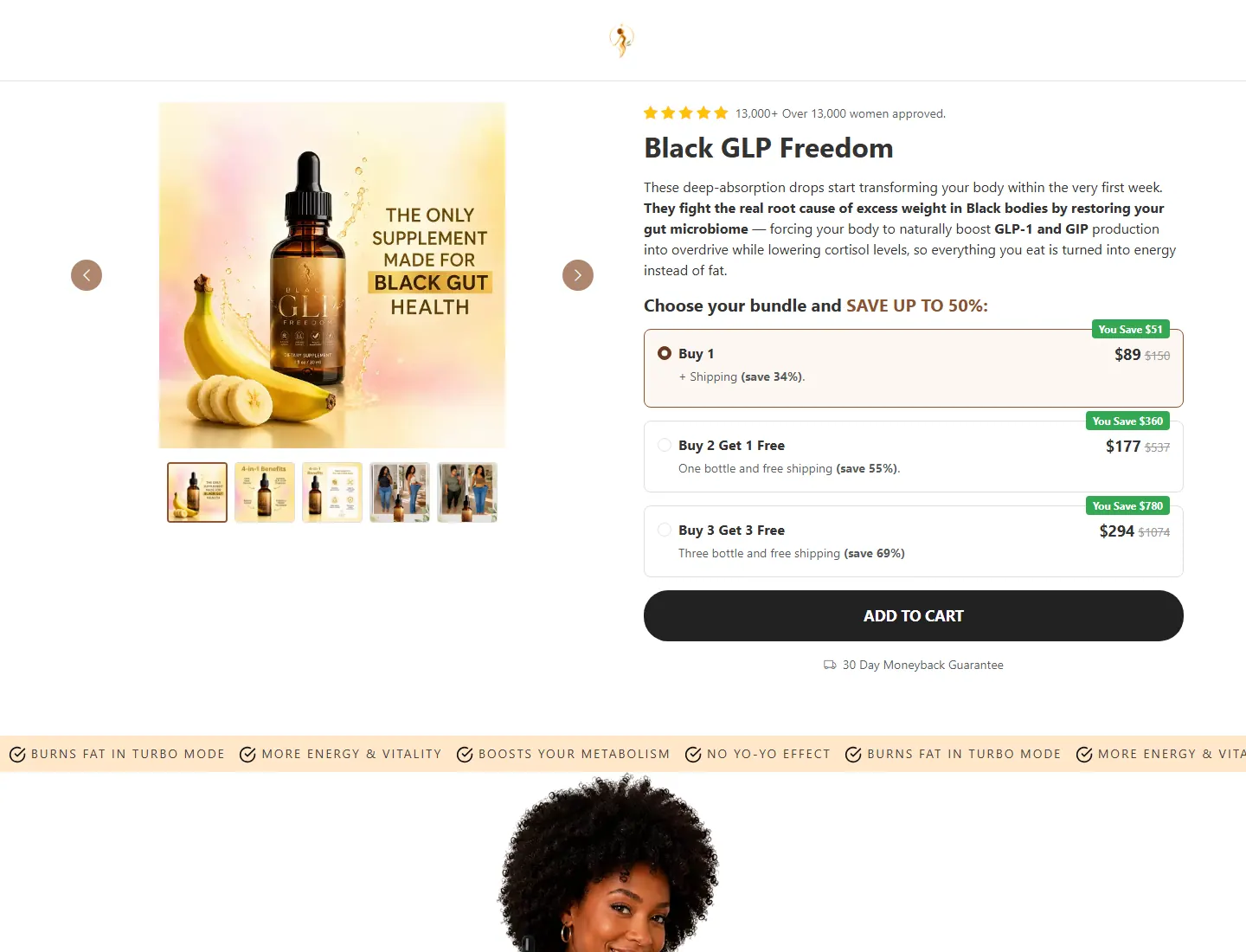
The WHOIS com record for blackglpfreedom com lists May 21, 2026 as the registration date and May 21, 2027 as the expiry date. It names HOSTINGER operations, UAB as the registrar and lists desiree.ns.cloudflare com and donald.ns.cloudflare com as the nameservers.
That record verifies technical registration details, not the seller’s legitimacy, ownership, inventory, customer service, or delivery performance. Registrar and nameserver providers supply infrastructure to many unrelated websites and should not be treated as endorsements. Likewise, a one-year registration period is a data point rather than proof of intent.
The meaningful limitation is the brief observable domain history. At the August 14, 2026 collection date, the registration was under three months old. Consumers consequently have less time-based evidence available than they would for a long-established storefront. A similarly careful separation between infrastructure and seller identity is important in cases involving confusing branding, as discussed in ZeroThought’s Bose review and domain-mismatch analysis.
Business identity and contact transparency
The supplied evidence identifies the storefront name and technical registrar, but it does not contain a verified legal company name, company-registration record, named operator, telephone number, physical return destination, or independently validated mailing address. It also does not record a customer-service email address. This means our review cannot establish who legally operates the store or where a buyer would direct a formal return.
Importantly, HOSTINGER operations, UAB appears in the evidence only as the domain registrar. That does not make it the merchant, seller, fulfillment company, or customer-support provider. The nameservers similarly identify technical routing infrastructure, not the party taking orders.
An unfamiliar fashion or wellness storefront may still be genuine, but traceability matters if an order goes wrong. Our investigation of another recently reviewed online boutique offers a useful comparison for why buyers should distinguish a brand presentation from independently checkable operator details.
Independent reputation checks were inconclusive
Our evidence collection did not produce a usable third-party reputation score. Trustpilot, ScamAdviser, and Scam Detector were blocked during collection with HTTP 403 responses, so their results are unavailable; no score from any of those platforms should be inferred. The check identified as “find the scam” returned no result and was not independently verified.
A reliable BBB match was also unavailable because a business name and location could not be established from the URL alone. That is not equivalent to a negative BBB rating, an absence of complaints, or proof that no profile exists. It simply means the collected evidence could not associate the domain with a dependable listing.
ZeroThought never substitutes an unavailable result with an assumed score. The absence of accessible review evidence leaves the store insufficiently established in this investigation, but it does not itself demonstrate customer harm.
Returns, shipping, and payment protection
The research ledger does not include captured return, refund, cancellation, shipping, warranty, privacy, or subscription terms. It also records no order-processing period or delivery/transit estimate. We therefore cannot say how long the seller promises to take before dispatch, how long a carrier may take afterward, who pays return postage, whether opened products qualify for refunds, or whether any guarantee is offered.
Processing time and delivery time are different commitments: processing covers the period before dispatch, while delivery or transit begins after shipment. Buyers should require both in writing rather than relying on a single broad arrival statement. They should also check for a concrete return window, eligible product condition, return destination, refund method, cancellation deadline, and any restocking or handling charges.
The ledger does not verify which payment methods the checkout accepts. If proceeding, use a payment method that provides a documented dispute process, avoid irreversible transfers, save the complete checkout screen, and retain confirmation and tracking messages. For a broader example of examining payment and seller-identity mismatches together, see our Margot & Ivy Greenville review.
Positive signals and warning signs
What can be verified
- The domain has a public WHOIS com record with a registration date, expiry date, registrar, and nameservers.
- The storefront displayed concrete prices rather than leaving every cost undisclosed.
- The supplied research does not contain verified allegations of non-delivery, counterfeit goods, unauthorized recurring charges, or refused refunds.
What remains concerning or unresolved
- The domain was registered on May 21, 2026, giving it only a short history at the time of review.
- The seller displayed very large discount claims—89%, 93%, and 96%—without enough captured product context to test the comparisons.
- Eleven different displayed prices were recorded, but the evidence does not map them to specific items or offers.
- No verified operator identity or usable policy terms are contained in the ledger.
- Independent reputation checks produced unavailable, blocked, unmatched, or unverified results rather than a dependable customer record.
These warning signs do not conclusively prove that the website is a scam. They do, however, shift more verification responsibility onto the buyer.
Practical assessment: is blackglpfreedom com legit?
The available evidence is not strong enough for ZeroThought to classify Black GLP Freedom as an established retailer. Its recent domain registration, steep seller-claimed discounts, unexplained collection of price points, missing operator verification, and unavailable independent reputation results create meaningful uncertainty.
At the same time, our investigation found no supplied evidence proving fraudulent transactions or a coordinated deceptive operation. A responsible conclusion must therefore stop short of calling the website a scam.
A cautious buyer should pause until the seller supplies clear product-level pricing, a non-recurring or recurring billing statement, processing and transit estimates, a complete return policy, an identifiable operator, and a return destination. Before entering payment details, compare these particulars with ZeroThought’s practical scam-website checklist, independently verify contact channels, and keep screenshots of every material term. If those details remain vague or change at checkout, the safer choice is not to proceed.
Final Verdict
ZeroThought’s evidence-qualified verdict is “more evidence needed.” Black GLP Freedom had a domain registered less than three months before the review capture and displayed discounts of up to 96%, while the available record did not establish the operator, buyer-policy details, or an accessible independent reputation history. These warning signs do not conclusively prove that the website is a scam. Until the seller’s identity, offer terms, fulfillment commitments, return process, and payment protections can be independently checked, cautious consumers should avoid high-value or irreversible purchases.
Frequently Asked Questions
How old is blackglpfreedom com?
WHOIS com lists the domain registration date as May 21, 2026. It was therefore under three months old when ZeroThought’s evidence was collected on August 14, 2026.
What prices did Black GLP Freedom display?
The August 14, 2026 capture recorded $49, $51, $89, $150, $177, $294, $360, $537, $780, $1,000, and $1,074. The ledger does not map those figures to specific products or packages, so they should remain separate seller-displayed claims.
Are the advertised discounts verified?
No. The seller displayed 89%, 93%, and 96% discounts, but the supplied evidence does not preserve enough product and comparison-price context to validate them.
Does Black GLP Freedom have a Trustpilot or BBB score?
No usable score was collected. Trustpilot access was blocked, while a reliable BBB match was unavailable from the URL alone. Neither result should be interpreted as a rating.
Is blackglpfreedom com a scam?
The supplied evidence does not prove that conclusion. The young domain, large advertised discounts, missing operator verification, and unavailable independent reputation results justify caution. These warning signs do not conclusively prove that the website is a scam.
What should buyers verify before ordering?
Buyers should obtain product-level pricing, the final checkout total, recurring-billing status, separate processing and transit estimates, return eligibility, a return destination, and a payment method with a dispute process. The supplied ledger does not establish those seller-policy details.@Deep Research