Looknesty is an online clothing store selling products such as cargo pants, casual shirts, hoodies, shorts, socks, sweaters, and accessories. At first glance, the store resembles a fairly ordinary fashion retailer: there are product categories, promotional discounts, multiple payment options, shipping and return policies, and an About Us section describing the brand’s approach to clothing. The question becomes more complicated once the website’s ownership history, reputation footprint, product catalog, technical infrastructure, and independent safety ratings are examined.
For this Looknesty review 2026, I checked the WHOIS record, current website pages, policies, product listings, payment indicators, ScamAdviser, FindTheScam, Gridinsoft, Trustpilot visibility, and other public signals. Several points deserve attention, including a very young domain, private WHOIS ownership, extremely poor ratings from some automated reputation services, reused product descriptions, unusual subscription options on clothing products, and a limited independent customer-review history.
None of those points alone proves that Looknesty is a fraudulent business. Taken together, however, they create enough uncertainty that buyers should verify the seller carefully before placing an order or providing payment information.
Looknesty Quick Facts
| Detail | Information Found |
|---|---|
| Brand Name | Looknesty |
| Website | looknesty com |
| Listed Company | KEYMAR TRADING INC |
| Company Address | 10 EL CAMINO REALS TE 202, SAN CARLOS, CA 94070 |
| Product Category | Clothing, fashion and accessories |
| Products Seen | Cargo pants, shirts, sweaters, hoodies, shorts, socks and bow ties |
| Domain Registration | June 8, 2026 |
| Domain Expiration | June 8, 2027 |
| Registrar | Cloud Yuqu LLC |
| WHOIS Ownership | Privacy protected |
| Registrant Country | China |
| Delivery Estimate | 7–20 business days after dispatch |
| Processing Time | Usually within 24 business hours |
| Change-of-Mind Return Window | 7 days after delivery |
| Damaged/Wrong Item Reporting | Up to 30 days |
| Phone Support | No public customer-service phone number found |
| Social Media | No prominent official social links visible in the website footer |
| Payment Options | Major cards and digital-payment services displayed |
| Current ScamAdviser Score | 0 |
| FindTheScam Score | 56/100 – High Risk |
| Gridinsoft Score | 1/100 – Suspicious Shop |
| Independent Review History | Very limited |
The company information shown in Looknesty’s Terms of Service names KEYMAR TRADING INC and gives a California address. Public business-directory information derived from California state filings also identifies KEYMAR TRADING INC as an active corporation filed in April 2023. This is a positive piece of business-identification evidence, although it does not independently establish that every order placed through Looknesty will be fulfilled satisfactorily.
WHOIS Data & Domain Age
Looknesty Is a Very Young Website
WHOIS records are one of the first places I look when reviewing an unfamiliar online store. According to WHOIS data, looknesty com was registered on June 8, 2026 and is currently scheduled to expire on June 8, 2027. As of September 2026, the domain is only around three months old. The registrar is Cloud Yuqu LLC, with IANA ID 3824. Its listed nameservers are a.dnspod.com, b.dnspod.com and c.dnspod.com.
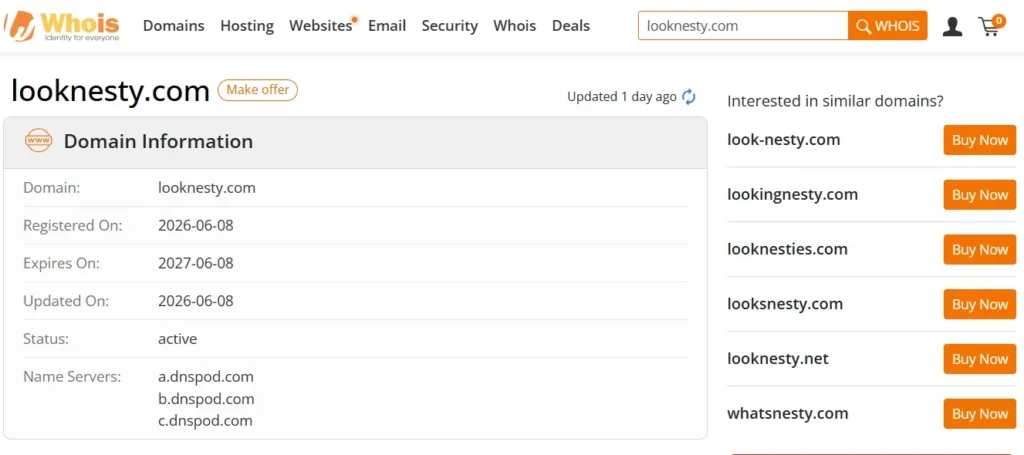
A young domain does not automatically mean a website is fraudulent. Every legitimate company has a launch date. The problem is that a newly created store has had very little time to establish a measurable history of order fulfillment, customer service, refunds, complaints and repeat customers. That makes independent verification especially important.
The WHOIS registrant information is privacy protected. The name, street address, city and other identifying fields are shown as “Registration Private,” while the registrant country is listed as China. Privacy protection is widely used by both legitimate businesses and questionable websites, so hidden WHOIS ownership should never be treated as proof of a scam by itself. Still, transparency matters more when a site is accepting payments from consumers.
Another detail is that the company listed on the website is a California corporation, while the domain registration record uses privacy-protected contact information associated with China. That difference may simply reflect an overseas operator or technical administrator working for a U.S.-registered company, but buyers cannot independently determine the relationship from the WHOIS record alone.
For an established retailer, I would normally expect a longer domain history, a stronger brand footprint and more independent customer feedback. Looknesty currently lacks that history.
Trust Score & Online Reputation
Independent Website Checkers Show Significant Risk Signals
Looknesty’s reputation scores are one of the strongest reasons I would hesitate before purchasing.
At the time of this investigation, ScamAdviser currently gives looknesty com a Trust Score of 0 and labels the website “Very Likely Unsafe.” ScamAdviser identifies the site’s young age and low traffic ranking as negative indicators, although it also acknowledges positive signals including a valid SSL certificate and payment methods that may provide money-back protection.
This is worth clarifying because older scans or previously supplied information may show a different score such as 17%. Automated trust scores can change when new reputation or security data becomes available, which is why the date of the check matters.
FindTheScam provides a less extreme result. Its current validator gives Looknesty 56/100 and classifies the website as “High Risk.” It confirms the June 8, 2026 registration date, valid HTTPS, Cloud Yuqu LLC as registrar and a limited public reputation footprint. Its scan also says that Google Safe Browsing verification was unavailable during that specific check, so that result should not be interpreted as a Google blacklist confirmation.
Gridinsoft is considerably more negative. Its September 4, 2026 scan gives Looknesty 1/100 and categorizes it as a “Suspicious Shop.” Gridinsoft reports four external-provider warnings, citing Forcepoint ThreatSeeker, Netcraft, alphaMountain.ai and Fortinet classifications in its report.
Automated trust services can produce false positives, especially for new websites, and they should never be the sole basis for accusing a business of fraud. In this case, however, multiple independent systems identifying elevated risk deserves serious consideration.
Product Information & Images
Generic Catalog Data Raises Questions
Looknesty primarily sells clothing and accessories. Its homepage currently displays cargo pants, three-pair sock packs, casual shirts, sweaters and bow ties, with many products carrying discounts of around 15% to 27%.
What caught my attention was not simply the product range but the structure and wording of several listings. Some titles are unusually repetitive, including names similar to “Refined Refined Everyday Sweater” and “Men’s Everyday Multi-Pocket Multi-Pocket Cargo Pants.” Those kinds of duplicated words can appear when product catalogs are generated or imported automatically rather than manually curated.
Certain product pages make the automated nature even clearer. One shirt description says that the product style was “rewritten from the original product information” and discusses retaining source-supported information and normalizing variants “from the CSV.” That language sounds more like internal catalog-processing instructions than consumer-facing fashion copy.
I also investigated whether the product material appeared elsewhere. A Looknesty shorts page contains wording describing soft cotton shorts with elasticity, comfort, minimalist details and a loose fit. Exact-text searches found essentially the same description and product specification structure on unrelated stores including Modiqueva, Arvysa and Gloamrose.
That does not prove Looknesty stole photographs or products. Many dropshipping suppliers distribute identical descriptions and images to multiple retailers. A broader image search also did not give me enough reliable evidence to claim that a specific Looknesty photograph was stolen from a particular brand.
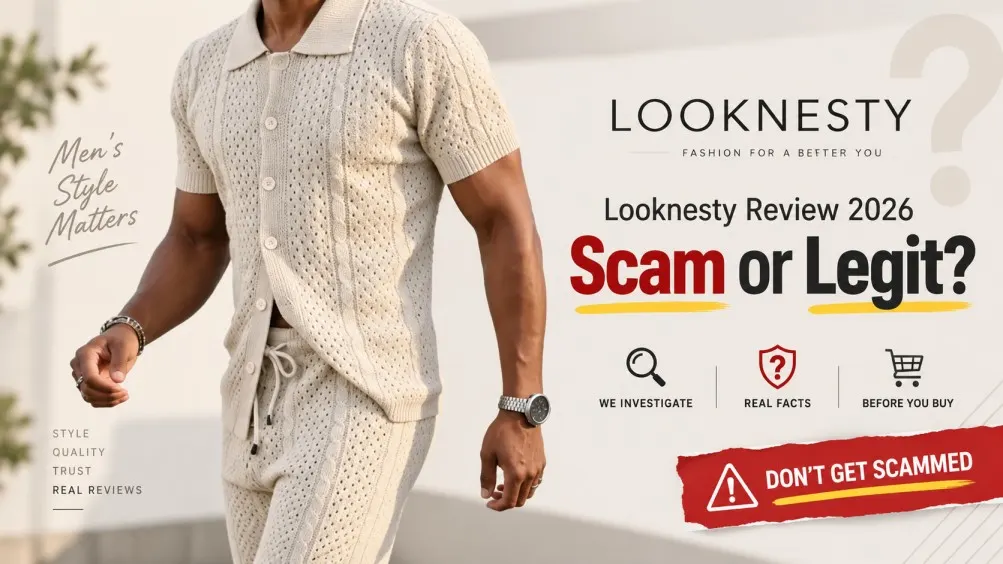
The stronger conclusion is that Looknesty appears to rely heavily on shared or supplier-generated catalog information. Buyers should therefore avoid assuming that the marketing photographs or generic descriptions represent exclusive Looknesty products.
Return Policy & Customer Service
Returns Exist, but the Rules Are Restrictive
Looknesty does publish a return policy, which is better than a store providing no refund information at all. According to that policy, customers who simply change their mind must request a return within 7 days of delivery, and return shipping is paid by the customer. Items must remain unworn, unused and unwashed, with original packaging. Sale or promotional items are generally not returnable unless there is a confirmed product problem.
For damaged, defective, incorrect or misrepresented items, the website gives customers up to 30 days after delivery to report the problem. If the issue is confirmed, Looknesty says it will provide a replacement or refund and cover return shipping. Refunds are described as taking approximately three to five business days after the returned item has been received and inspected.
One limitation is that customers cannot simply send an item to the publicly displayed company address. The return policy requires prior authorization, and return instructions are supplied individually. Unauthorized returns may be refused.
Looknesty’s Contact Us page provides email-based support and an online chat system, with responses normally expected within one to two business days. The page explicitly says support is handled online and that there is no in-person or offline service. I did not find a public customer-service phone number on the contact page.
The Terms of Service identifies the merchant as KEYMAR TRADING INC, located at 10 EL CAMINO REALS TE 202, SAN CARLOS, CA 94070. Public records aggregated from California state filings indicate a company by that name is active and was filed in 2023. Interestingly, the same company name and address also appear on several other ecommerce websites, including Zyreva, Stylistaura, Celavienne and Kilmera. That could simply indicate a company operating multiple retail brands, but consumers should understand that Looknesty may be part of a larger multi-store ecommerce operation rather than a standalone fashion company.
Payment Methods & Website Security
Looknesty Uses Standard Payment Options
One area where the evidence is more positive is payment infrastructure. I did not find evidence that Looknesty requires cryptocurrency, bank transfers or other irreversible payment methods.
The website displays payment icons for Visa, Mastercard, American Express, Discover, JCB, Diners Club, PayPal, Apple Pay and Google Pay. These payment services generally provide substantially more consumer protection than cryptocurrency or direct wire transfers.
Looknesty also has a valid HTTPS connection. FindTheScam identified a Let’s Encrypt SSL certificate, while ScamAdviser similarly confirms that SSL is active. This means information transmitted between a visitor’s browser and the website is encrypted during transport.
SSL is useful, but shoppers often misunderstand what it proves. HTTPS protects the connection; it does not independently verify the retailer’s fulfillment practices, product quality or refund reliability. Virtually any modern website can obtain an SSL certificate.
I found no direct evidence proving that Looknesty itself steals card information, and such a claim would be irresponsible without technical evidence. The more reasonable concern comes from the website’s overall reputation and the security-provider warnings reported by Gridinsoft.
Anyone who still decides to test the store should use PayPal or a credit card with dispute and chargeback rights rather than a debit card or irreversible method. Save screenshots of the product page, order confirmation, advertised delivery date and return policy before paying.
Website Design & Technical Footprint
The Site Looks Functional but Shows Signs of a Template-Based Operation
Looknesty is not a basic one-page scam website. It has a functioning catalog, account system, cart, policies, multiple currencies, multilingual options and product pages. The homepage loads product categories and appears reasonably fast.
The technical footprint, however, deserves closer inspection.
ScamAdviser reports Cloudflare infrastructure in the United States, while FindTheScam says the actual server location could not be detected. That distinction matters because Cloudflare acts as a content-delivery and security layer; its U.S. IP address does not necessarily reveal where the original ecommerce server is located.
The DNS configuration also points toward a third-party ecommerce environment. FindTheScam detected an A-record target involving qazwsx.uisksa com, while security analysis found Looknesty loading assets and services from domains connected with UISKSA, Salesmartly, Zshoppy and other external providers.
Using outside ecommerce technology is completely normal, so these hosts are not automatically suspicious. What they show is that Looknesty’s storefront appears heavily dependent on shared ecommerce infrastructure rather than a fully brand-specific technical platform.
Several visible design details also look unfinished. Some product names contain repeated words, product pages expose what appears to be catalog-processing language, and the website can display the cart in CNY while stating that the final checkout will be processed in USD.
These issues do not prove fraud, but they reduce the polished, carefully managed impression shoppers normally expect from an established clothing retailer.
Social Media & Online Presence
A Strong Independent Brand Community Is Missing
Social media is useful when reviewing a young ecommerce business because legitimate fashion brands often build a public history through Instagram, Facebook, TikTok, Pinterest or YouTube. Those accounts can reveal how long the company has been active, whether real buyers interact with it and how complaints are handled.
During my review, Looknesty’s main footer showed links to About Us, Contact Us, Terms of Service, Privacy Policy, Return Policy and Shipping Policy, but I did not see prominent official Facebook, Instagram, TikTok or other social-media links in that section.
That does not mean an account can never exist elsewhere. The issue is that the website itself does not currently provide shoppers with an obvious, verified social-media trail.
I also found no evidence strong enough to accuse Looknesty of purchasing followers or operating fake social accounts. Without identifiable official profiles, making that claim would be speculation.
For a three-month-old clothing brand, however, the lack of an established social footprint removes one useful layer of consumer verification. A shopper cannot easily browse months of tagged customer photographs, public conversations, influencer collaborations or complaint responses to decide whether the company has an active customer community.
Established retailers normally leave a much larger digital footprint. For Looknesty, most of the easily discoverable independent discussion currently consists of safety-checking or scam-review pages rather than substantial customer-generated content.
Customer Reviews & Testimonials
Lack of Reviews Is a Major Limitation
A new company should not be condemned simply because it has few reviews, but the absence of customer history matters when buyers are being asked to pay an unfamiliar seller.
The Trustpilot page associated with looknesty com has recently been presented as a page where consumers can be the first to review the business, indicating that a meaningful Trustpilot review history has not yet developed. There is therefore no substantial Trustpilot sample that can currently demonstrate consistent delivery, product quality or refund performance.
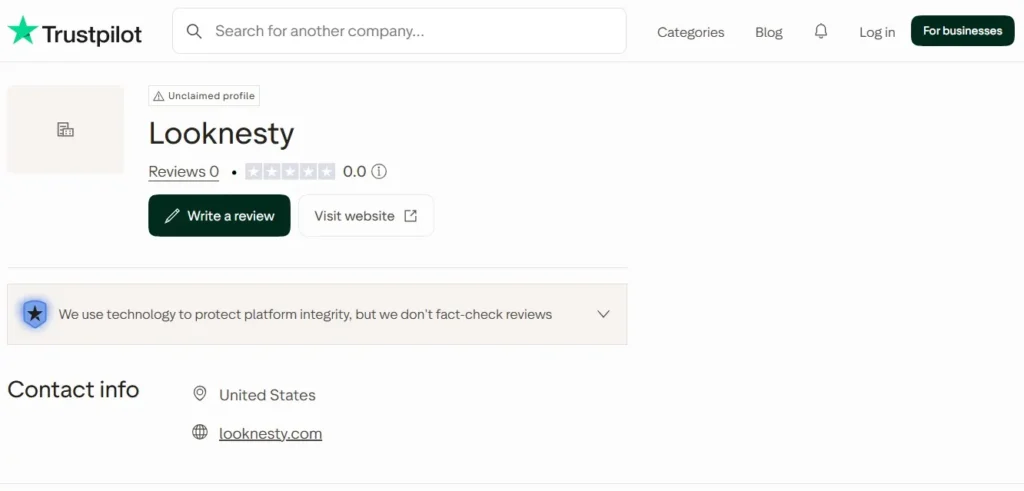
I also did not find enough established independent customer feedback from major review communities to confidently summarize a pattern of verified Looknesty buyer experiences.
That distinction is important. Security services such as Gridinsoft describe typical risks associated with websites falling into their “Suspicious Shop” category, including non-delivery, wrong items and lower-quality goods. Those descriptions should not automatically be presented as verified Looknesty customer complaints unless actual purchasers report them.
The website itself displays marketing-style notifications showing partially hidden names supposedly receiving coupons such as 10%, 20%, 30%, $20 or other promotional rewards. These notifications cannot be independently verified from the website alone. They are better treated as promotional widgets rather than evidence that those named shoppers represent genuine recent customers.
For me, the biggest review-related problem is therefore not a large number of negative reviews. It is the opposite: there simply is not enough credible customer history to establish trust.
Additional Looknesty Red Flags
The Subscription Option Deserves Special Attention
One of the strangest findings in this investigation is the “One-Time Purchase” versus “Subscribe & Save (cancel anytime)” option displayed on multiple clothing products.
For consumables such as coffee, supplements or household supplies, recurring subscriptions can make sense. Recurring purchases of casual shirts, shorts or sweaters are much less common. Yet Looknesty product pages for shorts, shirts, sweaters and hoodies visibly present subscription purchasing options.
The cart interface also contains a “Subscription Discount” field. At the same time, searches within the site’s Terms of Service and return-related content did not reveal a detailed subscription section explaining billing intervals, renewal dates or a clear cancellation procedure comparable to what I would expect from a mature subscription business. The product page does state “cancel anytime,” but shoppers should make sure they understand exactly which option is selected before completing payment.
Other concerns include the young domain, private registration, limited customer feedback, shared product descriptions, automated-looking catalog text and the serious reputation warnings already discussed.
Looknesty also uses frequent promotions. Homepage items show discounts reaching roughly the mid-20% range, while promotional widgets include messages mentioning discounts as high as 30%. Some product pages advertise quantity discounts such as “Buy 5 save 5%,” “Buy 10 save 10%” and “Buy 13 save 15%.”
Discounts themselves are normal in ecommerce. They become concerning only when combined with other weak trust signals or when urgency is used to discourage buyers from researching the seller. You can read more about GenieCloth Review 2026: Is GenieCloth com a Scam or Legit Cleaning Store?
Expert Verdict: Is Looknesty Scam or Legit in 2026?
After reviewing Looknesty’s domain history, company information, catalog, payment methods, return rules, technical setup, security ratings and reputation footprint, I do not have sufficient evidence to label Looknesty a legally confirmed scam. There are some positive signs: the website has HTTPS, publishes policies, lists a company name and address, offers mainstream payment methods, and the named company appears in public California business-registration data.
Those positives are outweighed, in my assessment, by significant unresolved risks.
The domain was only registered in June 2026. Ownership is privacy protected. Independent review history is extremely limited. Product content appears to rely heavily on shared or supplier-generated information. Some consumer-facing pages contain automated catalog language. Apparel items offer recurring “Subscribe & Save” purchasing, while detailed subscription terms are difficult to locate. ScamAdviser currently rates the website 0, FindTheScam rates it 56/100 High Risk, and Gridinsoft gives it 1/100 while reporting four external-provider warnings.
My 2026 assessment is therefore: High Risk / Not sufficiently verified.
I would personally wait until Looknesty develops a longer operating history and a meaningful body of independent customer feedback. Buyers who choose to order despite the uncertainty should use PayPal or a credit card, avoid accidentally selecting a recurring subscription, and retain complete purchase evidence. You can read more about Wellaray Review 2026: Is wellaray com a Scam or Legit Slim Coffee Booster Website?
Frequently Asked Questions About Looknesty
Is Looknesty Safe to Buy From?
I cannot currently describe Looknesty as a well-established or low-risk online retailer. It has HTTPS, mainstream payment options and published business information, but those positives coexist with a very young domain, limited customer feedback and serious warnings from multiple automated reputation services. Until a stronger customer history develops, buyers should treat Looknesty as a high-risk purchase rather than assuming the store has been fully verified.
How Can I Check If a Website Is a Scam?
Start by checking the domain’s WHOIS registration date, company details, independent reviews, contact methods and refund policy. Search product descriptions and photographs to see whether they are reused elsewhere. Check whether the merchant accepts payment methods with buyer protection. A trust-score website can provide another signal, but never rely on one automated score alone. A new domain, hidden ownership and no reviews do not individually prove fraud; the overall pattern matters.
What Should I Do If I Already Ordered From Looknesty?
Keep your confirmation email, receipt, screenshots of the product listing and copies of all conversations with customer service. Watch the tracking information carefully and contact the seller promptly if the stated delivery window passes. Looknesty’s shipping policy currently estimates 7–20 business days after dispatch, although it says delivery times are not guaranteed.
Also check your payment statement carefully. Because Looknesty displays both one-time and “Subscribe & Save” purchasing options, confirm whether your transaction created only a single purchase or any recurring authorization.
Can I Get My Money Back If I Am Scammed?
Possibly. Credit-card issuers and PayPal may provide dispute or chargeback procedures when an item does not arrive, is materially different from the description, or when another eligible transaction problem occurs. Contact the seller first when appropriate, then contact your payment provider if the issue remains unresolved. Do not wait indefinitely because financial institutions often impose deadlines for disputes.
How Do Scam Websites Trick People?
Questionable stores often rely on aggressive discounts, urgency messages, copied product photographs, recently registered domains and professional-looking website templates. Some disappear before customers can resolve complaints. Others send cheaper products rather than nothing at all. These are general fraud patterns and should not automatically be interpreted as claims that Looknesty has committed each of these actions.
What Are the Warning Signs of Fake Online Stores?
Common warning signs include a newly registered domain, unverifiable company details, copied content, unrealistic pricing, no genuine customer reviews, broken contact information, inconsistent policies and demands for irreversible payment methods. The more warning signs that appear together, the more verification a shopper should perform before ordering.
For Looknesty specifically, the biggest concerns are the young domain, weak independent reputation, reused catalog material, security-service warnings and unusual subscription options on fashion products.
Which Trusted Websites Can I Use Instead?
Consumers who do not want to accept the uncertainty associated with a newly launched store can choose established retailers with long operating histories, substantial independent customer feedback and clearly documented return systems. Depending on the product and location, mainstream platforms and fashion retailers such as Amazon, Walmart, Target, Nordstrom or Macy’s can provide a more established buying environment.
No retailer is completely risk-free, so buyers should still verify the individual seller when purchasing through a marketplace.
Final Buyer Advice
Looknesty has more business information than many obvious throwaway stores, which is why this case should not be reduced to a simple “new website equals scam” conclusion. KEYMAR TRADING INC appears to be a real registered corporate entity, mainstream payment services are displayed, HTTPS is active, and shipping and return policies exist.
At the same time, those features do not eliminate the more troubling evidence. Looknesty is only a few months old, independent buyer feedback remains scarce, product descriptions appear across multiple unrelated ecommerce stores, some catalog pages expose automated source-data language, and several security services currently consider the website high risk.
The “Subscribe & Save” functionality on ordinary apparel deserves particular attention because buyers may expect clothing purchases to be one-time transactions. Always inspect the selected purchase option carefully before entering payment details.
For now, my recommendation is to avoid making a large or expensive order from Looknesty until the retailer builds a stronger independent reputation. If you decide to test the store anyway, keep the order small, use PayPal or a credit card with buyer protection, save evidence before checkout, and monitor your account afterward.
Overall Trust Assessment: High Risk
Final Verdict: Looknesty cannot currently be verified as a reliably established online retailer. It is not proven to be a scam solely from the available evidence, but the number of unresolved warning signs makes waiting or choosing a better-established seller the safer option in 2026.@Deep Research