Yurodex and Molewin present themselves as modern blockchain casinos where users can gamble, deposit funds and potentially withdraw winnings through cryptocurrency. Their websites use familiar Web3 language, including claims about transparent smart contracts, provably fair games, secure transactions and years of industry experience. Such wording can make a platform appear established, particularly to users who associate blockchain technology with transparency.
Our Yurodex and Molewin reviews for 2026 found several issues that deserve closer attention. Molewin’s domain was registered in June 2026, despite the website claiming that the casino has operated since 2017. Security services have also assigned Molewin extremely low trust scores and reported phishing or blacklist detections. Yurodex publishes the name of a Curaçao-based operator, but its domain history, customer-support channels, licensing evidence and independent player reputation remain difficult to verify.
This investigation examines the WHOIS records, company claims, technical footprint, payment risks, promotional activity, customer-service information and independent security reports connected with both websites. The purpose is not to make unsupported accusations but to determine whether there is enough evidence to trust either platform with cryptocurrency, wallet access or personal information.
WHOIS Data and Domain Age
Domain-registration history is one of the most useful starting points when reviewing an unfamiliar crypto casino. It cannot prove that a website is legitimate or fraudulent by itself, but it helps investigators compare the platform’s claimed history with its verifiable online footprint.
The most significant finding concerns Molewin.com. WHOIS records show that the domain was registered on June 19, 2026, with an expiration date of June 19, 2027. Its registrar is Fewmoretaps OU, trading as Trustname.com, while the public registrant is listed through Perfect Privacy LLC. The domain uses Cloudflare nameservers, which can protect a website from attacks but also conceal its original hosting server.
Privacy protection is common and is not proof of wrongdoing. Many legitimate businesses hide personal registrant details to reduce spam and identity theft. The concern is the combination of hidden ownership, a recently registered domain and a website claiming that it has been providing crypto-casino services since 2017. Molewin’s own search description says it has been operating since 2017, creating a gap of approximately nine years between the marketing claim and the domain’s actual registration.
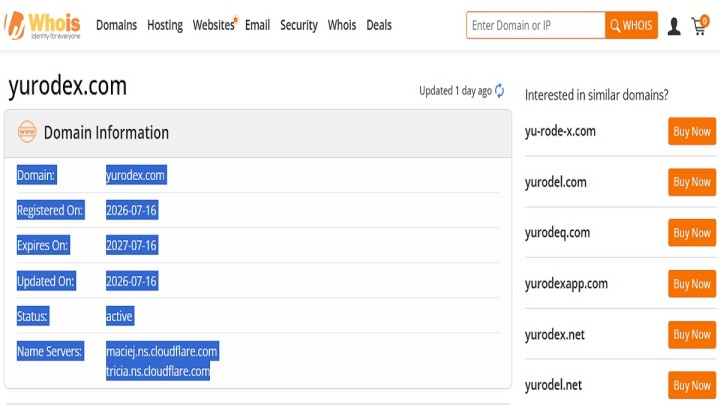
The exact current registration date for Yurodex.com could not be reliably confirmed through the accessible public results used in this investigation. Yurodex also claims to have served crypto users since 2017, but an on-page statement is not a substitute for historical domain records, archived pages, licensing history or verifiable company filings.
Young domains are particularly risky in gambling and cryptocurrency because operators can launch a platform, collect deposits and disappear before a meaningful reputation develops. A trustworthy casino should provide a consistent operating history, identifiable management, active licensing records and a stable domain footprint.
Trust Scores and Online Reputation
Molewin receives unusually negative results from several independent website-risk services. Scam Detector assigns Molewin.com a score of 12.6 out of 100, placing it in the service’s “Untrustworthy, Risky, Danger” category. Its report states that the score is based on indicators connected with suspicious websites, phishing, spam, malware and other technical factors.
Gridinsoft gives Molewin an even lower rating of 1 out of 100. Its July 2026 report lists multiple negative signals, including a very young domain, limited independent reputation, phishing-style characteristics and warnings from numerous security providers. Gridinsoft reported 17 provider warnings and classified the website as a cryptocurrency-scam risk.
A separate threat-intelligence report from PhishDestroy stated that Molewin had been flagged by 15 security vendors as of July 17, 2026. The service recorded a VirusTotal result of 15 detections out of 91 engines and associated the domain with two blocklists.
Automated trust scores should never be treated as a court judgment. Algorithms can make mistakes, and new legitimate websites sometimes receive low scores because they lack traffic or history. Nevertheless, several independent systems identifying similar risks is more serious than a single isolated warning. The combined picture around Molewin includes the young domain, conflicting history, hidden ownership, blacklist detections and limited reputation.
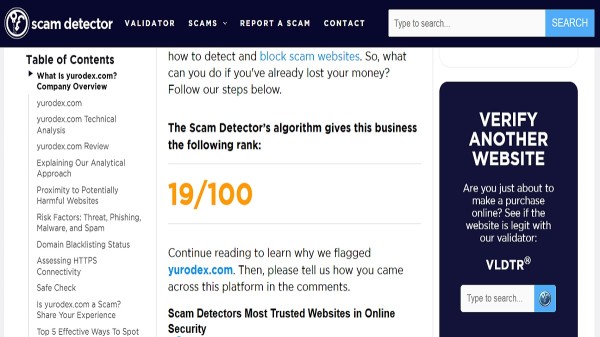
No dependable current Scam Detector score was located for Yurodex during this review. That does not automatically make Yurodex safe. A lack of negative records can simply mean the domain has not been reviewed extensively. A legitimate crypto casino should be able to demonstrate stronger evidence than the absence of a warning, including verifiable licensing, published support contacts, responsible-gambling information and a documented record of processing withdrawals.
Compared with established regulated casinos, both platforms have a thin independently verifiable reputation. Molewin’s results are especially concerning and justify avoiding deposits until the warnings are conclusively resolved.
Casino Services, Claims and Website Images
Yurodex and Molewin do not sell physical products. Their “products” are digital casino services involving crypto deposits, games, bonuses and potential withdrawals. Yurodex describes itself as a decentralized Web3 gambling platform using on-chain logic and provably fair play. Molewin describes itself as a blockchain casino with transparent smart contracts and secure betting.
These claims sound technical, but the presence of terms such as “blockchain,” “smart contract” or “provably fair” does not prove that the games, balances or withdrawal systems are independently audited. A proper investigation would require published contract addresses, third-party smart-contract audits, verifiable game hashes and evidence that player funds are held transparently. Promotional language alone is not proof.
The visual presentation also deserves scrutiny. Crypto-casino templates often use animated coins, neon casino graphics, wallet icons and fabricated activity counters to create the appearance of a busy international platform. No conclusive reverse-image match establishing that Yurodex or Molewin stole a particular image was confirmed during this review. However, their textual and technical similarities to other recently appearing casino domains are more revealing than the graphics themselves.
Molewin uses the description that it is a “blockchain-based crypto casino with transparent smart contracts, secure bets” and has operated since 2017. Nearly identical wording has appeared on unrelated casino domains such as Oxycas, Zetomax and Buzawin. A captured page associated with Zetomax contained the same description and the same “Leading Blockchain Casino” presentation style.
Reusing a website template is not automatically fraudulent. Many legitimate companies purchase commercial designs. The concern arises when the template also contains recycled company-history claims, unverifiable statistics and nearly identical marketing across unrelated domains. This can suggest a mass-produced network rather than an independently operated casino with a genuine long-term history.
Users should therefore focus less on polished images and more on auditable game systems, ownership records, withdrawal evidence and regulator-confirmed licensing.

Return Policy, Refunds and Customer Service
A crypto casino does not usually have a conventional return policy because it does not ship physical goods. Instead, users depend on deposit, withdrawal, wagering, verification and bonus rules. These terms can determine whether a player is allowed to withdraw winnings or recover an unused balance.
Neither platform provides the level of easily accessible customer-service transparency expected from a business handling potentially large deposits. Molewin does not clearly disclose a registered legal company name, public business address, verified telephone number or dependable customer-service email. This makes it difficult for users to identify who controls their funds or where a formal complaint should be sent.
Yurodex provides more corporate information. Its website says it is owned and operated by Famagousta B.V., registration number 152449, at Schout Bij Nacht Doormanweg 40 in Willemstad, Curaçao.
That disclosure is preferable to complete anonymity, but it still requires independent verification. The same Curaçao address is associated online with numerous gaming and software businesses. This may indicate a registered-office or corporate-services location rather than a staffed Yurodex customer-service centre.
No reliable public telephone number was identified for either platform. A gambling website that accepts cryptocurrency but cannot be contacted through a verifiable phone number, company-domain email and formal complaint process places the customer at a serious disadvantage.
Users should also read bonus conditions carefully. A casino may advertise a large reward while requiring extensive wagering before withdrawals are allowed. Other common restrictions involve identity verification, maximum cash-out limits, excluded games or additional deposits. An advertised bonus is not equivalent to withdrawable money.
A platform should clearly explain how account closures, unused balances, disputed transactions and complaints are handled. Without these protections, users may have no realistic route to challenge a rejected withdrawal.
Payment Methods and Financial Security
Yurodex and Molewin appear primarily focused on cryptocurrency and wallet-based transactions. Crypto payments are particularly attractive to questionable operators because they are fast, international and usually irreversible.
The US Federal Trade Commission warns that cryptocurrency payments generally do not include the protections available with credit or debit cards. Once cryptocurrency is transferred, users can usually recover it only if the recipient voluntarily returns it. Blockchain transactions may be visible publicly, but that does not guarantee that the recipient’s real identity can be established.
This makes ownership and reputation especially important. When a customer pays a regulated merchant by credit card, a chargeback or payment dispute may be possible. When a customer sends Bitcoin, Ethereum, USDT or another cryptocurrency directly to a casino wallet, the payment normally cannot be cancelled.
Users should also distinguish between HTTPS encryption and business legitimacy. Molewin appears to have an active SSL certificate, meaning the connection between the visitor and website may be encrypted. Gridinsoft nevertheless classified it as high risk and reported multiple security-provider warnings.
An SSL certificate only confirms that information is encrypted in transit. It does not prove that the casino operator is honest, licensed or financially solvent. Scam websites can obtain valid certificates easily.
There is no verified evidence in this investigation that either website has directly stolen credit-card details. Such a claim would require stronger proof. The more immediate risk is that users could voluntarily send irreversible cryptocurrency, connect a wallet or reveal identity documents to an operator whose accountability is uncertain.
Never provide a seed phrase or private key to a casino. Users should also avoid approving unknown smart-contract permissions, because a malicious token approval can allow assets to be transferred from a connected wallet later.
Website Design and Technical Footprint
Both platforms use the visual language of modern Web3 services: dark backgrounds, bright accent colours, crypto symbols, animated components and claims of blockchain transparency. A sophisticated interface can make a recently launched platform look much older and more established than it is.
Molewin’s technical footprint is more concerning than its appearance. The domain uses Cloudflare nameservers and Cloudflare Browser Insights. Cloudflare is a legitimate and widely used service, but it can hide the website’s origin server behind its network. Gridinsoft identified the visible hosting location as the United States while noting that the domain was only weeks old during its July 2026 assessment.
The available technical captures suggest that Molewin is built with a reusable Next.js-style casino template. Similar page titles, descriptions, scripts and design language have appeared across other casino domains. Gridinsoft’s reports also connect Molewin with websites sharing a similar technical fingerprint.
Template reuse matters because a network can rapidly generate new casino brands by replacing only the logo and domain name. When one domain becomes blocked or attracts complaints, another can be activated with similar content. That possibility does not prove the same person controls every related site, but it is a risk pattern worth considering.
Yurodex’s website could not be fetched consistently during parts of this investigation, although search engines continued to index its description. Temporary accessibility problems can result from maintenance, geographic restrictions, DNS changes or security filtering. They do not prove fraud, but unstable access is undesirable for a platform holding customer balances.
No verified hidden subdomain, exposed customer database or direct server breach was confirmed for either website. The principal technical concerns are Molewin’s young domain, security detections, copied template language and limited operational history—not a proven data leak.
Social Media and Online Presence
Established gambling brands usually maintain active social-media accounts for customer announcements, responsible-gambling information, maintenance updates and complaint handling. Those accounts should be linked from the official website and should display a consistent history extending beyond a few promotional posts.
No clearly verified, long-standing official social-media network was identified for Molewin. Its limited online footprint is dominated by automated security reports and review videos rather than years of organic player discussion. That is inconsistent with the website’s claim of operating since 2017.
Yurodex has received promotional attention on social media, but authenticity remains uncertain. One indexed Instagram post advertised Yurodex with a casino promotion and displayed a claim of 34.8 million followers. The available result does not establish that the post came from an official Yurodex account, that the audience figure was genuine or that the person involved had an authorised relationship with the casino.
Users should be especially cautious with casino advertisements involving famous personalities, influencers or large follower counts. Fraudulent campaigns frequently use hacked social-media accounts, copied videos or fabricated endorsements. A post appearing on Instagram, TikTok, Facebook or X does not automatically prove that the promoted casino is legitimate.
Before acting on a promotion, visit the influencer’s verified profile independently and check whether the same partnership appears in older posts, press releases or other official channels. Avoid links delivered through direct messages or comments.
A legitimate casino should also respond publicly to complaints and publish scheduled service updates. When a platform has no consistent community, no verified support profile and no historical activity, customers cannot easily determine whether other users have successfully withdrawn funds.
The lack of a credible long-term social presence is therefore another unresolved concern for both platforms, particularly Molewin.
Customer Reviews and Testimonials
Independent customer feedback is one of the most important elements in a casino review because technical claims mean little if users cannot withdraw their money. However, the available search footprint for Yurodex and Molewin does not provide a substantial history of verified player experiences.
Search results are dominated by recent YouTube review videos discussing whether Yurodex and Molewin are suspicious. These videos can be useful for identifying warning signs, but they are not the same as authenticated transaction records or verified customer reviews.
No well-established body of exact-match customer feedback from recognised consumer-review platforms was located during this investigation. For Molewin, that absence is understandable because the domain was only registered in June 2026. It is also another reason that the website’s claimed 2017 history is difficult to accept without supporting evidence.
On-site testimonials, user counters, winner notifications and withdrawal screenshots should not be treated as independent evidence. Website operators control their own pages and can create names, profile pictures, balances and transaction notifications without external verification.
Review readers should also watch for recovery-scam comments. Fraudsters frequently post fake stories claiming that a special investigator, blockchain expert or recovery company recovered lost cryptocurrency. They then demand an advance fee from victims. The FTC warns that refund and recovery scams specifically target people who have already lost money.
Reliable feedback should include details such as deposit method, verification process, withdrawal request date, amount received and customer-service response. A group of repetitive five-star reviews posted within a short period is less persuasive than a long history of balanced feedback.
Until either Yurodex or Molewin develops a stronger record of independently verified withdrawals and complaint resolution, promotional testimonials should be treated as unproven marketing.
Additional Warning Signs
The most serious warning sign is Molewin’s operating-history contradiction. The platform says it has provided casino services since 2017, but its domain was registered on June 19, 2026. A legitimate company could move to a new domain, but it should clearly explain the previous brand, earlier website and migration history. Molewin does not provide that supporting evidence in the information reviewed.
The second major issue is the repeated casino template. Molewin’s description and technical presentation closely resemble those used by unrelated, recently appearing crypto-casino domains. This raises the possibility of a mass-produced network using interchangeable brand names.
Other concerns include:
Missing accountability
Molewin does not publish a clearly verifiable legal company, staffed address, telephone number or transparent management team. Yurodex publishes a company name and Curaçao address, but accessible customer-support information remains limited.
Security warnings
Molewin has received a 12.6/100 Scam Detector score, a 1/100 Gridinsoft score and detections from multiple security providers.
Irreversible payments
Crypto deposits provide fewer recovery options than regulated card payments. A request for an additional “verification fee,” “tax,” “wallet activation deposit” or “withdrawal charge” should be treated as a major danger sign.
Unverified bonuses
Large bonuses can be used to encourage quick deposits. Users may later discover wagering conditions or withdrawal restrictions that make the displayed balance inaccessible.
Limited independent reputation
Neither platform has demonstrated the kind of long-term public feedback expected from a casino supposedly operating for many years.
These warning signs are more meaningful when considered together. A single missing phone number may be poor business practice. A young domain combined with copied claims, hidden ownership, crypto-only payments and blacklist warnings creates a substantially higher-risk profile. You can read more about Is willisjudd com a Scam or Legit? Full Investigative Report.
Expert Verdict: Are Yurodex and Molewin Legit?
Based on the evidence available in July 2026, Molewin should be treated as a high-risk crypto-casino website. Its domain was registered only recently, its claimed 2017 operating history conflicts with the WHOIS record, and several security services have reported extremely low trust scores, phishing-related indicators or blacklist detections. There is not enough independently verifiable evidence to justify depositing money, connecting a wallet or submitting identity documents to Molewin.
Yurodex presents a less clear-cut case. It discloses Famagousta B.V. as its claimed operator and publishes a Curaçao address. However, major questions remain about its domain history, customer-support channels, independent reputation, bonus conditions and verifiable licensing. The information currently available is insufficient to classify Yurodex as a reliably established casino.
Therefore, our Yurodex and Molewin reviews 2026 reach two related conclusions:
Molewin: Strong risk indicators; avoid depositing cryptocurrency.
Yurodex: Not conclusively proven to be fraudulent, but insufficiently verified and too risky to recommend.
Users should select only gambling operators whose licences can be confirmed directly through the relevant regulator’s official register. Never rely solely on a logo, licence statement, influencer post or affiliate review.
Anyone who has already deposited should stop sending additional funds, save wallet addresses and transaction hashes, document all conversations and contact the exchange used to purchase or transfer the cryptocurrency.
Frequently Asked Questions
Is Yurodex or Molewin safe to use?
Molewin does not currently appear safe enough to trust with money or personal information. Its new domain, conflicting history and multiple security warnings create a high-risk profile. Yurodex publishes more company information, but its licensing, support and operational history still require stronger independent verification. Avoid both platforms until their claims can be confirmed through official regulatory sources.
How can I check whether a crypto casino is a scam?
Begin with the domain-registration date and compare it with the casino’s claimed history. Verify its gambling licence directly on the regulator’s official website rather than clicking a licence badge. Search for a registered company, working telephone number, physical address, withdrawal complaints and independent reviews. Also examine the bonus rules and determine whether cryptocurrency is the only payment method.
What should I do if I already deposited money?
Do not send another payment, even if the platform says it is required for taxes, verification, wallet activation or withdrawal. Save screenshots, emails, chat records, wallet addresses and transaction hashes. Contact the cryptocurrency exchange or wallet provider used for the payment and report the receiving address. You should also file a report with your local cybercrime authority or police.
Can I get my cryptocurrency back after being scammed?
Recovery is difficult because cryptocurrency transfers are normally irreversible. An exchange may be able to freeze funds if they reach a verified account and are reported quickly, but there is no guarantee. Be cautious of anyone promising certain recovery in exchange for an upfront fee. Such offers may be secondary recovery scams.
How do fake crypto casinos trick users?
They may advertise a large welcome bonus, display a fabricated balance or allow a small initial withdrawal to build confidence. When the victim attempts a larger withdrawal, the platform may demand additional deposits for taxes, account upgrades, verification or liquidity. Fake celebrity endorsements and urgent promo codes are also commonly used to drive users to newly registered domains.
What are the warning signs of a fake gambling website?
Common warning signs include a recently registered domain, hidden ownership, copied website content, no verified licence, no phone number, crypto-only deposits, unrealistic bonuses, fake countdown timers, withdrawal complaints and demands for extra payments. A valid SSL certificate or professional design does not eliminate these risks.
Which trusted casino websites should I use instead?
Use only operators listed in the official gambling-regulator register for your country or state. Check the licence number directly with the regulator and confirm that the approved domain exactly matches the website you are visiting. Avoid selecting a casino solely because it appears in a sponsored search result, influencer video or affiliate “best casino” list@Deep Research.