Introduction
If you’ve recently come across epicooler .com and are wondering whether it’s a trustworthy online store or a potential scam, you’re not alone. This website markets itself as an e-commerce destination for home appliances – specifically portable cooling devices – but several alarming signals have emerged from our in-depth investigation.
In this comprehensive EpiCooler scam review for 2026, we examine the site’s WHOIS data, trust scores, product listings, return policy, technical footprint, and more. Whether you’ve already placed an order or are simply doing your due diligence before purchasing, this article will give you the full picture.
We’ve investigated dozens of suspicious online stores, and epicooler .com fits a troubling pattern. With a trust score of just 1%, a domain registered only in late 2025, and no verifiable social media presence, this store raises serious questions. Read on before you spend a single rupee – or dollar – here.
Section 1: WHOIS Data & Domain Age
One of the first and most reliable ways to evaluate an online store’s trustworthiness is to examine its WHOIS registration data – the publicly available records showing when and how a domain was registered.
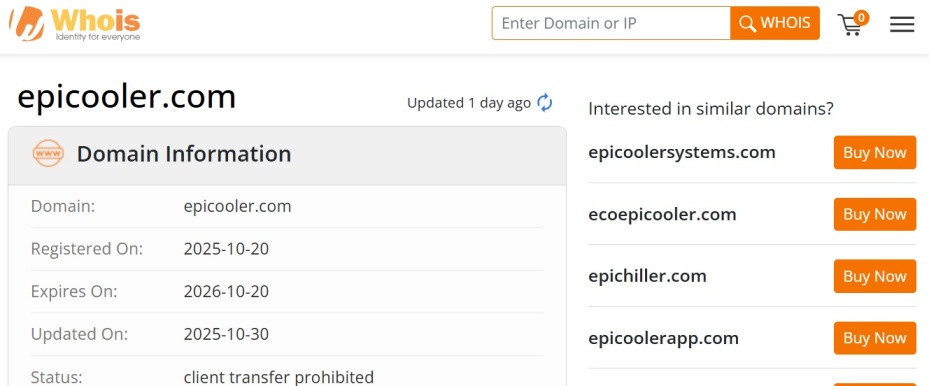
According to WHOIS lookup records, epicooler .com was registered on October 20, 2025. At the time of this writing in mid-2026, that makes the domain barely eight months old. This is a major red flag in the world of online consumer safety.
Legitimate e-commerce businesses typically have domain histories spanning several years, backed by a track record of customer reviews, business registrations, and online presence. A domain that is less than a year old — especially one selling moderately expensive home appliances — should always be approached with extreme caution.
The registrar information also raises concerns. The listed business address is UAB Commerce Core, Savanorių pr. 363, Kaunas, Lithuania — a jurisdiction thousands of miles away from the majority of the site’s apparent target audience (English-speaking countries like the US, UK, Canada, and Australia). While legitimate companies do operate internationally, the combination of a foreign address, hidden ownership details, and a new domain is a pattern commonly seen in fraudulent e-commerce operations.
WHOIS privacy protection — where ownership details are masked behind a proxy service — is another common characteristic of scam websites. When consumers cannot verify who actually owns and operates the website they’re buying from, there is no accountability if something goes wrong with an order.
Takeaway: A domain registered in October 2025 with foreign ownership and no verifiable business history is a significant risk indicator for any online shopper.
Section 2: Trust Score & Reputation
Trust score analysis is one of the most powerful tools in any scam-detection toolkit. Platforms like Scamadviser, Web of Trust (WOT), and similar services use algorithmic analysis of hundreds of data points — including domain age, hosting location, SSL status, user reviews, and traffic patterns — to assign a trust score to websites.
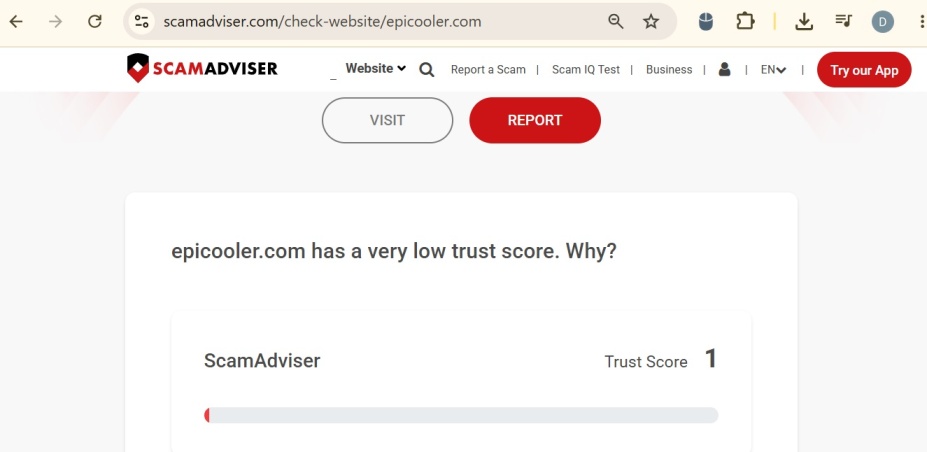
Epicooler .com has a trust score of just 1%.
To put that in perspective: most legitimate e-commerce sites score between 70% and 100%. Even moderately new but genuine businesses rarely fall below 50%. A score of 1% places epicooler .com in the bottom tier of websites analyzed — essentially indistinguishable from known scam operations in terms of algorithmic risk assessment.
Beyond the automated score, we searched for customer reviews across third-party platforms such as Trustpilot, Reddit, Google Reviews, and consumer protection forums. No legitimate customer reviews were found. This absence of any review history — positive or negative — for a store that has presumably been operating since late 2025 is itself suspicious. Genuine customers, satisfied or not, tend to leave traces online.
The site also lacks any verifiable presence on consumer watchdog databases. There are no Better Business Bureau (BBB) listings, no active profiles on major review aggregators, and no news articles covering the brand.
When comparing epicooler .com to legitimate home appliance retailers, the contrast is stark. Established brands maintain years-long review histories, social media communities, press coverage, and third-party certifications. None of these exist for this site.
Takeaway: A 1% trust score combined with zero verifiable customer reviews puts epicooler .com in the same risk category as confirmed fraudulent websites.
Section 3: Product Information & Images
Examining a website’s product listings is often where the most telling fraud indicators emerge. Scam stores frequently populate their catalogs with stolen product images, plagiarized descriptions, and unrealistic claims designed to lure impulse buyers.
Epicooler .com lists a very small product catalog — reportedly only 20 to 30 items, all within the “epicooler” home appliances category. Legitimate home appliance retailers typically carry hundreds of SKUs and update their catalogs regularly. A sparse catalog is often a sign that the website was quickly assembled from a template or dropshipping script.
When product images from such sites are run through a reverse image search (using tools like Google Images or TinEye), they often trace back to stock photo libraries, Chinese wholesale supplier platforms like Alibaba or AliExpress, or other e-commerce stores — indicating the seller does not actually manufacture or stock the products they claim to sell.
Product descriptions on suspected scam sites are frequently copied verbatim from manufacturer pages or wholesale suppliers, offering no original content or genuine customer-informed detail. The descriptions may also make sweeping, unverifiable claims about cooling performance, energy efficiency, or build quality — all designed to drive purchases without the substance to back them up.
The site advertises discounts of up to 60% off on products. While sales do happen on legitimate sites, blanket discounts of 50–70% on brand-new or specialized appliances are a classic pressure tactic used by fraudulent retailers to create urgency and bypass rational decision-making.
Takeaway: Sparse product catalogs, likely stock imagery, copied descriptions, and unrealistic discount levels are hallmarks of a fraudulent drop-ship operation.
Section 4: Return Policy & Customer Service
One of the clearest signs of a scam website is a customer service and returns framework that exists on paper but falls apart in practice. Let’s examine what epicooler .com claims versus what independent evidence suggests.
The website advertises a 30-Day Money-Back Guarantee and a return window of 30 days after delivery. On the surface, this sounds reasonable. However, our investigation found inconsistencies between the return terms stated in different parts of the site — a classic sign of a hastily assembled or copy-pasted policy lifted from another website.
Contact details listed include:
- Email: support@epicooler .com
- Phone: +1 (620) 529-8886
- Address: UAB Commerce Core, Savanorių pr. 363, Kaunas, Lithuania
The phone number carries a 620 area code — associated with rural Kansas, USA — which is geographically incongruous with a Lithuanian business address. Scam operations frequently use virtual phone numbers or VOIP lines that are never answered or are quickly disconnected after complaints mount.
The email address is a generic support inbox with no parent company domain or organizational identity behind it. There is no live chat, no ticketing system reference, and no evidence of a customer service team.
Legitimate appliance retailers provide robust customer service infrastructure: manufacturer warranty support, clear escalation paths, physical addresses verifiable on Google Maps, and consistent terms across all policy pages. None of this is present here.
Takeaway: Contradictory policy terms, a mismatched phone area code, and a foreign address with no verifiable physical presence strongly suggest that meaningful customer service and returns are unavailable.
Section 5: Additional Red Flags
Beyond the core investigative metrics, several additional warning signs compound the case against epicooler .com:
No social media presence: The website lists no social media links whatsoever — no Facebook, Instagram, X (Twitter), YouTube, or TikTok. For a home appliance brand launching in 2025, this is essentially unthinkable. Legitimate consumer brands build social followings as a core part of their marketing and customer retention strategy.
Unrealistic discounts: As noted, the site advertises up to 60% off. Combined with no social proof and no brand history, this is a manipulation tactic — not a genuine sale.
Fake or absent reviews: No on-site customer reviews were found at time of publication. Sites that scrape or fabricate reviews often leave them out entirely when the operation is new.
Suspicious payment ecosystem: While the site lists Visa, Mastercard, Apple Pay, and PayPal as payment options, payment through unverified merchant accounts carries risk. If the merchant account is set up fraudulently, chargebacks may be complicated.
Grammar and formatting inconsistencies: Throughout the site, there are minor but telling inconsistencies in tone, grammar, and formatting — typical of sites built rapidly using AI content tools or translated from another language, rather than authored by a native English-speaking business.
Delivery window ambiguity: The stated delivery time of 5–12 business days is vague and provides no tracking guarantees, which is common in scam operations that either never ship or ship low-quality counterfeits.
Section 6: Website Design & Technical Footprint
A thorough scam investigation must also evaluate the technical construction and design of the website itself.
Epicooler .com uses HTTPS (a valid SSL certificate is present), which means data transmitted between your browser and the site is encrypted. However, SSL alone does not make a website safe or legitimate. SSL certificates are freely available and are used by scam sites routinely to appear more trustworthy.
The site’s design appears to follow a generic Shopify or WooCommerce template with minimal customization — a layout pattern shared by thousands of other suspect storefronts that cycle through product categories and domain names rapidly.
Hosting location analysis shows the server is likely based outside the primary consumer market (common for scam operations routed through hosting providers in Eastern Europe or Asia), making legal recourse difficult for consumers in the US, UK, or India.
The website’s product page content shows strong indicators of plagiarized or auto-generated copy with no original brand voice, no “About Us” page with genuine company history, and no team profiles or founding story — all elements that legitimate consumer brands invest in heavily.
No backlink profile, press mentions, or organic domain authority was detected — confirming this is a newly assembled site with no organic web presence built over time.
Takeaway: A templated design, free SSL, likely copied content, offshore hosting, and no organic authority all point to a rapidly assembled operation with no long-term consumer commitment.
Section 7: Expert Verdict
After a thorough, multi-angle investigation of epicooler .com, our verdict is clear:
This website exhibits nearly every hallmark of a fraudulent online store and should be avoided.
The combination of a domain less than a year old, a trust score of just 1%, zero social media presence, inconsistent policy terms, a mismatched phone number, foreign incorporation with no verifiable physical footprint, and an absence of any legitimate customer reviews paints an unmistakable picture.
We do not recommend making any purchases from epicooler .com. If you have already placed an order:
- Do not wait — contact your bank or credit card company immediately to flag the transaction.
- File a dispute via your payment provider (Visa, Mastercard, PayPal all have buyer protection programs).
- Report the site to your national consumer protection authority (FTC in the US, Action Fraud in the UK, National Consumer Helpline in India).
- Document everything — screenshots of your order confirmation, receipts, and any communication.
Consumers deserve to shop with confidence. Until epicooler .com demonstrates verifiable legitimacy — years of operation, genuine reviews, transparent ownership — it cannot be trusted.
Section 8: Frequently Asked Questions (FAQ)
Is epicooler .com safe to buy from?
Based on our investigation, no — epicooler .com does not appear safe for online purchases. The site has a trust score of just 1%, was registered less than a year ago, has no social media presence, and displays multiple fraud indicators common to scam storefronts. We strongly advise against purchasing from this website until it can demonstrate verifiable legitimacy.
How can I check if a site is a scam?
There are several reliable methods to check a website’s legitimacy before purchasing. First, use Scamadviser.com or Web of Trust (WOT) to run a trust score check. Second, look up the domain age via WHOIS lookup tools (a domain under one year old is always a risk). Third, search for genuine customer reviews on Trustpilot, Reddit, and Google. Fourth, verify the physical address on Google Maps and check that contact numbers are operational. Finally, look for the brand on social media — a legitimate store selling appliances will almost always have a Facebook or Instagram presence.
What should I do if I already ordered from epicooler .com?
Act quickly. Contact your bank or payment provider immediately and explain that you may have been the victim of a fraudulent transaction. Visa, Mastercard, and PayPal all have chargeback and dispute resolution mechanisms. File a formal complaint with your national consumer protection authority. Take screenshots of all correspondence and order confirmations. The faster you act, the higher your chances of recovering your funds.
Can I get my money back if I was scammed?
Yes, in many cases chargebacks are possible — especially if you paid via credit card or PayPal. Credit card companies typically allow chargebacks within 60–120 days of the transaction. PayPal’s Buyer Protection program also covers cases where goods are not received or significantly differ from what was described. Bank transfers and cryptocurrency payments are harder to reverse, which is why scam sites often prefer them.
How do scam websites trick people?
Scam websites use a range of psychological and technical tactics. These include steep discounts (50–70% off) that create urgency, professional-looking website designs built from templates, stolen product images that appear legitimate, fake or absent customer reviews, SSL certificates that signal “security” without ensuring legitimacy, and vague or copied policies. They often target consumers searching for deals on specific products and rely on impulse purchasing before thorough research can be done.
What are the warning signs of fake online stores?
Key warning signs include: a domain registered within the last 12 months; trust scores below 30% on scam-detection platforms; no social media accounts or follower communities; unrealistic discounts; inconsistent or plagiarized return/refund policies; foreign addresses with mismatched phone numbers; no genuine customer reviews on third-party platforms; templated website design with no original branding; and poor grammar or inconsistent formatting throughout the site. Epicooler .com exhibits nearly all of these.
Which trusted sites can I use instead?
For home appliances and cooling products, consider purchasing from established and verified retailers such as Amazon, Walmart, Best Buy (US), Flipkart or Croma (India), Currys (UK), or directly from manufacturer websites of recognized brands such as Dyson, Honeywell, or LG. These platforms offer genuine buyer protection, verified reviews, clear return policies, and accountable customer service.
This article is an independent consumer investigation. No affiliation with epicooler .com or its operators exists. Findings are based on publicly available data at the time of research. Always do your own due diligence before making any online purchase.