Introduction
In today’s crowded online wellness market, it can be genuinely difficult to tell trustworthy health product retailers apart from opportunistic scams. IONS THERAPY, operating through its website ionstherapy com, presents itself as a health, wellness, and pain-relief e-commerce platform offering a range of therapeutic devices and products to UK and international customers.
With growing consumer interest in non-pharmaceutical pain management, sites like ionstherapy com attract significant traffic from people seeking relief. But does IONS THERAPY deliver on its promises — or is it just another cleverly disguised scam designed to take your money?
In this investigative review, we dig deep into the WHOIS registration data, trust scores, product legitimacy, return policies, customer complaints, and several additional red flags to give you a clear, evidence-based answer. Whether you stumbled upon ionstherapy com through a social media ad or a search engine result, this 2026 review will tell you everything you need to know before spending a single penny.
Section 1: WHOIS Data & Domain Age – What the Registration Records Reveal
One of the first things any savvy online shopper or scam investigator checks is domain registration data. WHOIS records provide publicly available information about when a website was registered, who registered it, and with which registrar — and for ionstherapy com, these details raise some important questions.
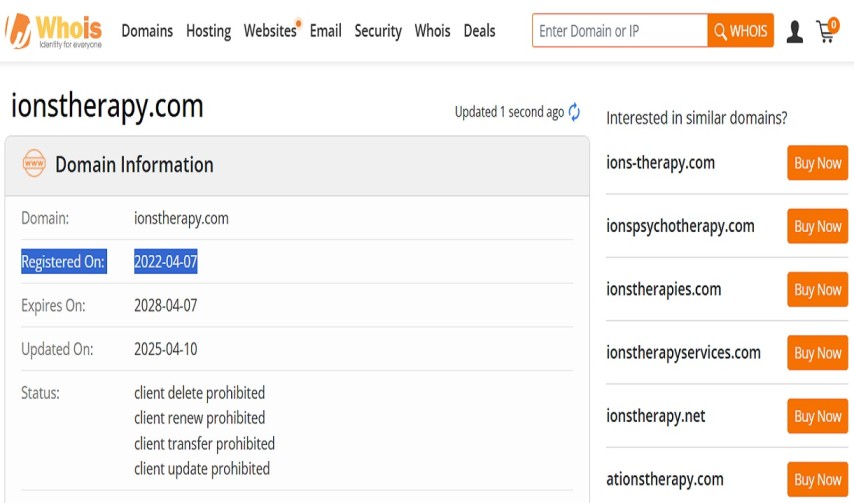
According to WHOIS records, ionstherapy com was registered on April 7, 2022, making the domain just over three years old as of 2026. While this is not as alarming as a domain registered only weeks or months before going live, it still places the site in a relatively early stage compared to established, trusted health and wellness brands that have operated for a decade or more.
Why does domain age matter? Cybersecurity experts and consumer protection organisations consistently flag newly or recently registered domains as higher-risk. Scam websites are frequently abandoned after they’ve defrauded enough victims, then relaunched under a new domain. A site that has been operational for only three years with limited verifiable history cannot offer the kind of long-term reputation track record that inspires genuine consumer confidence.
Additionally, WHOIS privacy protection is commonly used by scam operators to conceal the true identity of website owners. When ownership details are masked behind a proxy service — rather than showing a clearly identifiable business owner or registered company director — it becomes nearly impossible for consumers or authorities to hold anyone accountable in case of fraud.
For ionstherapy com specifically, the combination of a relatively young domain and unverified ownership details should prompt cautious shoppers to pause before purchasing. Legitimate, established health product companies typically have transparent ownership, verifiable company registration numbers, and domain histories spanning many years.
Bottom line: A 2022 registration date is a yellow flag, not necessarily a dealbreaker — but it must be weighed alongside all other findings in this review.
Section 2: Trust Score & Reputation – What Scam Detection Tools Say
Trust scores generated by independent scam-detection platforms like Scamadviser, Web of Trust (WOT), and Trustpilot are valuable starting points for assessing any e-commerce site. For ionstherapy com, the reported trust score sits at approximately 82% — a figure that, at first glance, might seem reassuring.
However, context matters enormously here. An 82% trust score is not the same as a clean bill of health. Many legitimate, well-established retailers score 95–100% on these platforms. An 82% score signals that automated algorithms have detected meaningful risk factors — even if they haven’t yet downgraded the site further.
What pulls the score down? Several contributing factors are worth noting:
- Negative reviews on third-party social media platforms have been documented, with customers raising complaints about product effectiveness, aggressive sales tactics, and refund disputes.
- Customer complaints specifically reference high pricing relative to comparable products, concerns about device quality, and difficulties navigating the returns process.
- Persuasive or pressure-based sales presentations — a hallmark of dubious wellness product marketers — have also been mentioned by dissatisfied customers.
When comparing ionstherapy com’s reputation profile to genuinely trustworthy health retailers, the contrast is stark. Established brands tend to have hundreds or thousands of independently verified reviews on platforms like Trustpilot, with transparent responses from company representatives addressing negative feedback. Ionstherapy com does not appear to have this kind of robust, verifiable third-party review presence.
The 82% trust score, combined with documented negative feedback and complaint patterns, means this site sits in an uncomfortable middle ground — not definitively confirmed as a scam, but far from the transparent, consumer-friendly experience shoppers deserve.
Section 3: Product Information & Images — Are the Products Real?
IONS THERAPY markets itself as a health, wellness, and pain-relief platform, selling what it describes as “IONS Therapy multi products.” The site’s product range appears limited — by most accounts, the store carries fewer than 20–30 distinct products, which is notably sparse for a brand positioning itself as a comprehensive wellness retailer.
This limited catalogue raises questions. Legitimate health technology brands typically invest in diverse product lines, detailed clinical explanations, certifications, and transparent ingredient or component listings. A shallow product range can indicate a dropshipping operation — where the “store” is simply a middleman for generic products sourced cheaply from overseas manufacturers, often listed at inflated prices.
Reverse image search concerns are particularly relevant in the wellness device niche. Many scam wellness sites use product images lifted directly from AliExpress, Amazon, or manufacturer stock photo libraries — sometimes without even removing original branding. When product images cannot be verified as unique to the brand, it strongly suggests the business has no genuine relationship with the products it sells.
Product descriptions on sites like ionstherapy com also frequently make vague or exaggerated therapeutic claims — suggesting devices can relieve chronic pain, improve circulation, or accelerate healing — without citing peer-reviewed studies, regulatory approvals, or clinical trial data. In the UK, health product claims are regulated by the MHRA and ASA. Unsubstantiated medical claims are not only a red flag for scams; they may also represent a legal violation.
Shoppers should be especially wary of wellness products that promise dramatic results, carry no CE marking or recognised safety certification, and offer no verifiable third-party endorsements from medical professionals.
Section 4: Return Policy & Customer Service – Can You Actually Get Your Money Back?
A clear, fair, and easily accessible return policy is one of the hallmarks of a legitimate online retailer. IONS THERAPY does advertise a 30-Day Money-Back Guarantee, which sounds reassuring on the surface.
However, dig a little deeper and concerning inconsistencies emerge. Reports indicate that the return timeframe stated on the main website pages differs from the terms outlined in the returns or cancellation section — a discrepancy that is either the result of careless website management or, more troublingly, a deliberate attempt to create confusion that makes successful refund claims harder to pursue.
Customer complaints specifically reference refund disputes, suggesting that even when customers invoke the 30-day guarantee, the process is not straightforward. This pattern — advertising a generous refund policy while making it practically difficult to claim — is a recognised tactic among fraudulent or semi-legitimate online retailers.
Contact details provided include:
- Email: info@ionstherapy com
- Phone: +44 7878 650581
- Address: 129 Station Road, NW4 4NJ Hendon, London, United Kingdom
The phone number provided is a UK mobile number (07878 prefix), which is unusual for a registered business. Legitimate companies generally provide landline or VoIP business numbers, not personal mobile numbers. The address — 129 Station Road, Hendon — would need independent verification to confirm it corresponds to a genuine registered business premises rather than a residential address or virtual office.
Consumers who encounter difficulties with refunds are advised to escalate via their payment provider rather than relying solely on the merchant’s stated policy.
Section 5: Additional Red Flags – A Closer Look at the Warning Signs
Beyond the headline issues, several additional red flags cluster around ionstherapy com that deserve attention in any thorough 2026 scam review.
Discount levels: The site advertises maximum discounts of up to 34%. While not in the extreme “90% off” territory that immediately screams scam, sustained deep discounting on health devices — products that typically carry genuine manufacturing and regulatory costs — can indicate artificially inflated base prices designed to make discounts seem more impressive than they are.
Social media presence: IONS THERAPY maintains Facebook and Instagram accounts. However, the mere existence of social media pages is not validation of legitimacy. Many scam operations maintain polished social media fronts, using paid advertising to reach new victims before complaints accumulate. The quality and authenticity of the engagement on these pages — and whether negative comments are deleted — matters far more than follower counts.
Payment methods: The site accepts Visa, Mastercard, Maestro, American Express, Apple Pay, Google Pay, and PayPal. The presence of PayPal is mildly reassuring, as PayPal’s buyer protection programme does offer some recourse. However, scam sites routinely accept all major payment methods to appear credible, while relying on confusing return policies to prevent successful claims.
Review authenticity: Negative reviews documented on external platforms — covering high pricing, refund disputes, product effectiveness concerns, and aggressive sales tactics — suggest a pattern of genuine consumer dissatisfaction that cannot be dismissed.
Section 6: Website Design & Technical Footprint
From a technical and design perspective, ionstherapy com presents a functional, reasonably professional-looking storefront. It carries a valid SSL certificate (HTTPS), which is the absolute minimum security standard for any e-commerce site in 2026. It is important to note, however, that SSL certificates are free and trivially easy to obtain — their presence confirms encrypted data transmission, not the legitimacy of the business.
The product catalogue’s limited size — under 30 items — combined with what appears to be generic product photography suggests a template-based or dropshipping operation rather than a brand with genuine product development investment. Scam and low-quality sites frequently rely on Shopify or WooCommerce templates with minimal customisation, giving them a veneer of professionalism while hiding hollow operational substance.
Hosting location and server reliability for UK-targeted wellness sites should ideally reflect UK or EU-based infrastructure. Sites hosted on offshore servers with no clear connection to the claimed business address warrant additional scrutiny.
Plagiarised product descriptions — copied from manufacturer listings or competitor sites without modification — are another common technical footprint of low-quality or fraudulent retailers. Without access to a sophisticated plagiarism check, shoppers can manually paste product descriptions into a search engine to see if identical text appears elsewhere.
The overall technical picture of ionstherapy com is one of a functional but superficial e-commerce operation, without the depth of infrastructure, original content, or transparent business information that characterises truly trustworthy retailers.
Section 7: Expert Verdict – Scam or Legit?
After a thorough review of all available evidence, our assessment of IONS THERAPY and ionstherapy com in 2026 is as follows:
This website sits in a high-risk grey zone. It is not a definitively confirmed fraud operation in the sense of taking payment and delivering nothing — but it exhibits a significant cluster of red flags that make it unsuitable for risk-free shopping.
The combination of a relatively young domain, an 82% (not exemplary) trust score, documented customer complaints about refunds and product quality, inconsistent return policy terms, a mobile-only contact number, a limited product catalogue, and lack of verifiable third-party credibility all point to a business that does not meet the standards expected of a trustworthy UK health retailer.
Our recommendation: Do not purchase from ionstherapy com without conducting your own independent due diligence. If you do decide to proceed, use PayPal for maximum buyer protection, document all communications, and screenshot the return policy before completing any transaction. Better yet, seek out established, fully verified wellness retailers with extensive independent review histories, transparent company registration details, and proven customer service records.
The risk-to-reward ratio here does not favour the consumer.
Section 8: Frequently Asked Questions (FAQ)
Is ionstherapy com safe to buy from?
Based on our 2026 investigation, ionstherapy com cannot be confidently recommended as a safe place to shop. While it has some surface-level credibility markers — SSL certificate, multiple payment options, stated return policy — the combination of customer complaints, inconsistent policy terms, limited product range, and unverified contact details creates an unacceptable level of risk for most shoppers. If you choose to buy, use a payment method with strong buyer protection such as PayPal or a credit card, and keep records of everything.
How can I check if a site is a scam?
Several free tools can help. Scamadviser (scamadviser com) analyses domains and generates trust scores. Web of Trust (mywot com) aggregates user-reported safety ratings. You can also check a site’s WHOIS data at who is (whois domaintools com) to see how old the domain is and who registered it. Additionally, search the brand name plus “reviews,” “scam,” or “complaints” on Google to find independent consumer experiences. Always cross-reference multiple sources rather than relying on a single tool.
What should I do if I already ordered from this site?
First, keep all order confirmation emails, receipts, and any communication from the site. Monitor your bank or card statement closely. If your order does not arrive within the stated delivery window (ionstherapy com states 2–7 working days), contact the merchant immediately via their listed email and phone number. If you receive no satisfactory response, initiate a chargeback through your bank or card provider, or open a dispute through PayPal if that was your payment method. Act quickly — most chargeback windows have time limits.
Can I get my money back if scammed?
Yes, in many cases. If you paid by credit card, the UK Consumer Credit Act (Section 75) provides legal protection for purchases between £100 and £30,000, making your card provider jointly liable. For smaller amounts, debit card chargeback schemes (Visa and Mastercard both operate these) offer a route to recovery. PayPal’s Buyer Protection programme covers items not received or significantly not as described. Act within the relevant time windows — typically 120 days for card chargebacks and 180 days for PayPal disputes.
How do scam websites trick people?
Scam websites typically use a combination of professional-looking design, low or discounted prices, fake or cherry-picked positive reviews, and urgent “limited time offer” messaging to create a false sense of legitimacy and urgency. They may steal product images from legitimate retailers, copy policy text from trusted sites, and use real payment processors to appear credible. Many also invest in social media advertising to reach large audiences quickly before complaints accumulate. The key is that surface appearances are designed to imitate legitimacy without the actual business substance behind them.
What are the warning signs of fake online stores?
Key warning signs include: very recently registered domains; trust scores below 85% on scam detection tools; no verifiable company registration number; mobile-only contact numbers; addresses that turn out to be residential properties or virtual offices; product descriptions copied from other sites; unrealistically deep discounts; policies that contradict each other across different pages; absence of independently verified customer reviews; and social media pages with high follower counts but low authentic engagement. Any single one of these is a caution flag; multiple together represent a serious warning.
Which trusted sites can I use instead?
For health, wellness, and pain-relief products in the UK, established and trustworthy alternatives include Amazon UK (with verified seller ratings), Boots (boots com), Holland & Barrett (hollandandbarrett com), and specialist medical device retailers who carry full MHRA registration details. For pain-relief devices specifically, always look for CE marking, clear manufacturer information, and products stocked by retailers with verifiable physical presence and extensive independent review histories. These platforms offer robust consumer protection and genuine accountability — something ionstherapy com cannot currently match.
This review is based on publicly available data, independent analysis, and aggregated consumer reports as of 2026. Readers are encouraged to conduct their own research before making purchasing decisions.