Lumlara presents itself as an online shop with a products area, a clearance page, and homepage prices ranging from $19.99 to $84.99 when ZeroThought checked on September 1, 2026. The transparency gap is more significant than the storefront presentation: the supplied contact-page evidence identifies the operator or company only as “lumlara com,” rather than naming a clearly distinguishable legal business. Our investigation therefore followed the available trail through the domain record, seller-displayed information, contact disclosures, and independent reputation checks. The evidence does not establish fraud, but it also does not provide enough independently verifiable history or business identity to treat the store as established.
Quick Verdict
Our lumlara com review finds a very recently registered store with limited business-identification evidence and no usable independent reputation result in the supplied checks. The seller displayed products and prices, but its policies and operating identity were not sufficiently documented in the evidence. We recommend waiting for stronger verification or using a payment method with meaningful dispute protection.
Background and reason for our Lumlara review
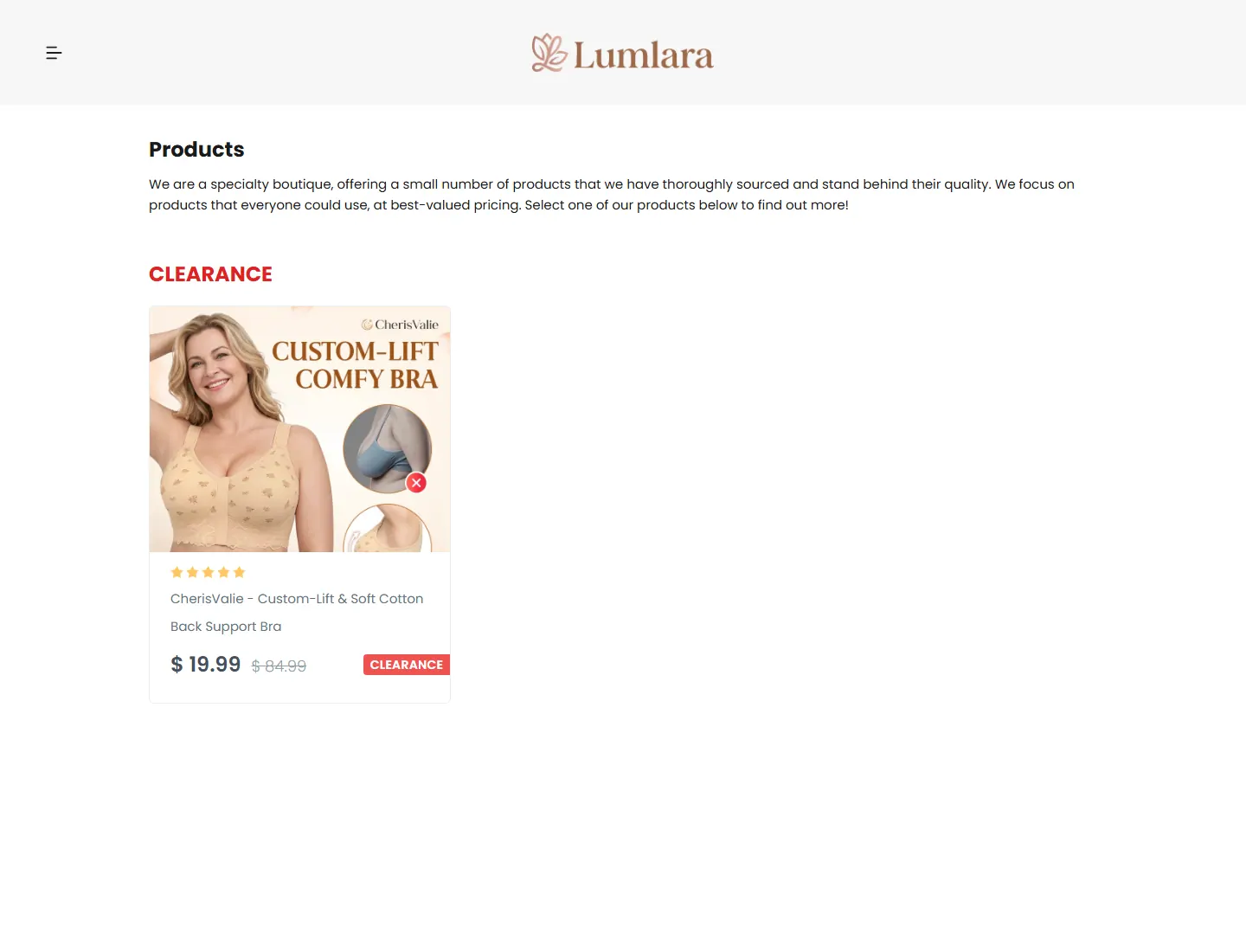
The collected storefront evidence shows a site branded “lumlara,” with a page labelled “Products” under a clearance section. That establishes the site’s apparent retail purpose, but it does not tell buyers who owns the operation, where orders are fulfilled, or how long the business has traded.
On September 1, 2026, the homepage displayed two separate prices: $19.99 and $84.99. These are dated seller-displayed amounts, not prices independently verified by ZeroThought. The evidence does not identify which individual products, variants, quantities, taxes, or shipping charges were attached to either figure, so we cannot responsibly compare or reconcile them.
A functioning product presentation is only the beginning of a buyer check. In our Uproot Clean consumer-product review, we likewise examine the evidence behind a sales presentation rather than treating the storefront itself as proof of reliability. For Lumlara, the specific reason for closer scrutiny is the gap between the retail-facing pages and the limited operator information captured from its contact page.
Domain history: a registration dating from June 2026
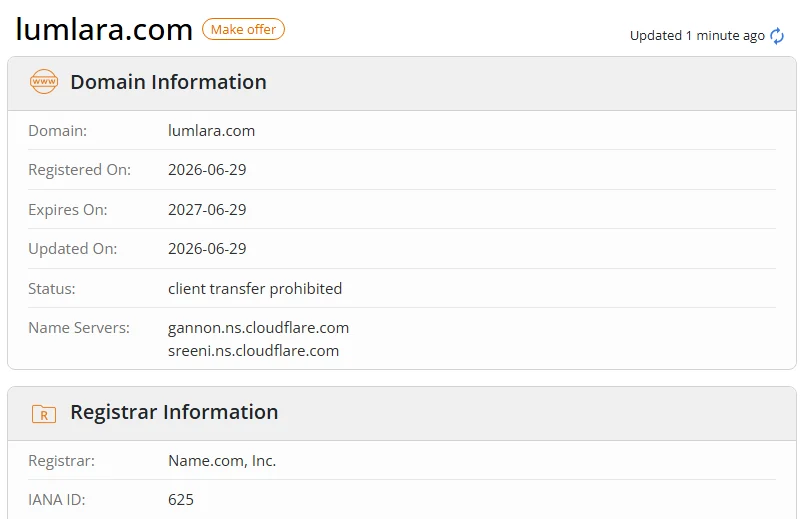
The WHOIS com record for lumlara com gives June 29, 2026 as the domain registration date. Because our evidence was retrieved on September 1, 2026, the domain was only about two months old at the time of this review. That is a short observable domain history, although domain age alone cannot determine whether a seller will fulfil orders.
WHOIS com lists Name com, Inc. as the registrar and June 29, 2027 as the recorded expiry date. It also identifies gannon.ns.cloudflare com and sreeni.ns.cloudflare com as the nameservers. Those are technical registration details; they do not identify the seller’s legal owner and should not be interpreted as an endorsement by the registrar or infrastructure provider.
The short registration history matters because buyers have had relatively little time to generate a durable public record of ordering, delivery, returns, or dispute handling. Our guide on checking the warning signs of potentially unsafe shopping sites explains why domain age is best assessed alongside business identity, policy clarity, and protected payment options—not used as a stand-alone verdict.
Business identity and contact transparency
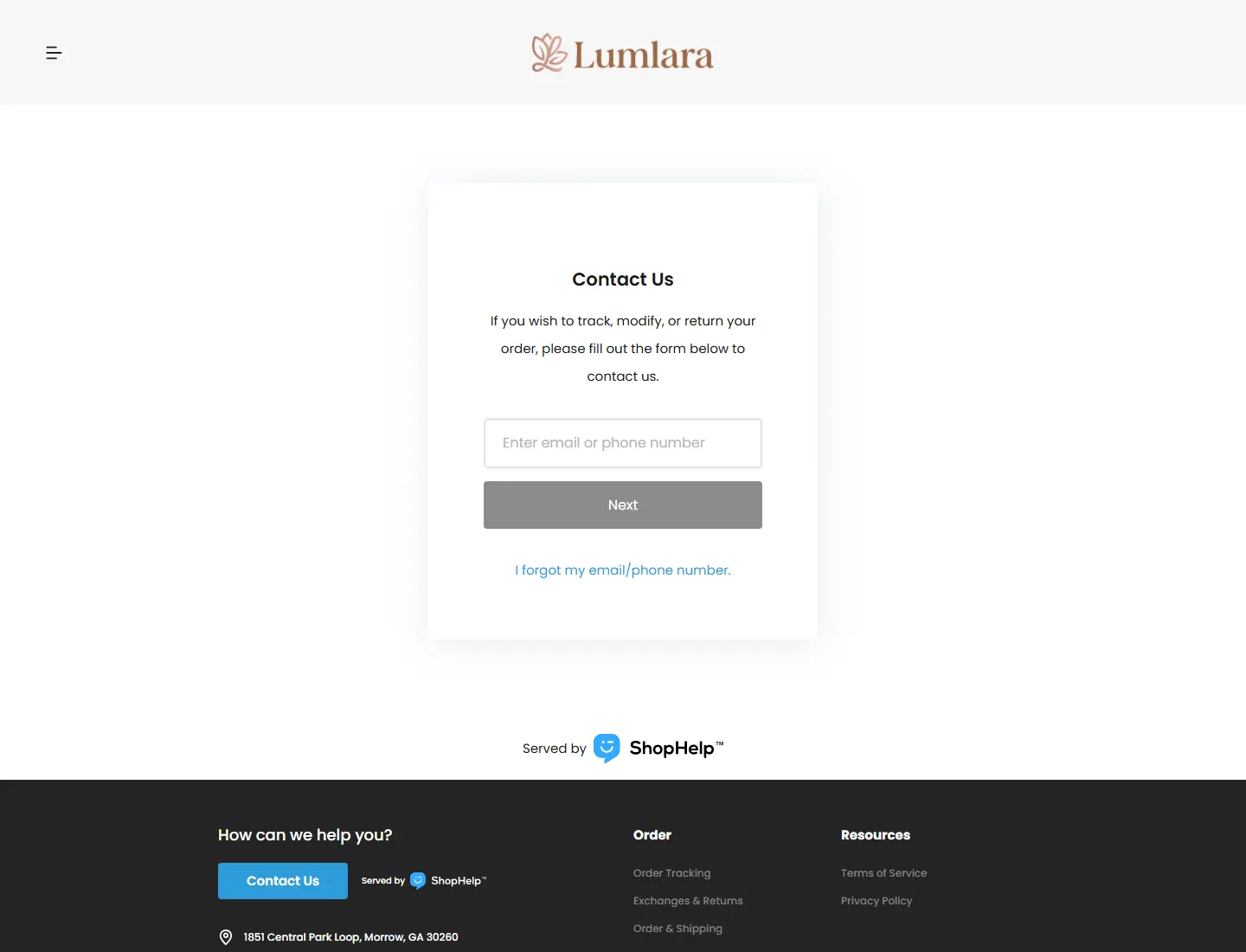
The supplied contact-page extraction records the website operator or company name as lumlara com. That is circular identification: it repeats the domain but does not establish a separate company, registered entity, proprietor, or trading name. ZeroThought cannot infer a legal operator from that wording.
The evidence ledger does not provide a verified street address, named representative, company-registration number, or independently confirmed customer-service channel. This does not prove those disclosures are absent from every version of the site; it means they were not established by the supplied evidence. We also would not treat a mailing address, had one been captured, as a verified headquarters without corroboration.
This distinction is important for a new shop because buyers need to know whom they would contact if an order fails to arrive or a refund is disputed. Our Margot & Ivy Greenville store investigation offers a relevant example of assessing an online boutique through identity, fulfilment, and transparency signals rather than judging it solely by its catalogue.
Independent reputation checks did not produce usable scores
The research did not obtain a usable independent reputation score for Lumlara. Trustpilot was blocked during collection with an HTTP 403 response, so no Trustpilot rating or review count is available from this investigation. ScamAdviser and Scam Detector were also blocked with HTTP 403 responses. We did not attempt to bypass those restrictions, and we do not attribute any score to those platforms.
The BBB check was unavailable because a reliable business match could not be made from the URL alone without a business name and location. “Find the Scam” returned a not-found or restricted result and did not independently verify the seller. These outcomes must not be misread as either positive ratings or negative findings; they simply leave the reputation question unresolved.
A lack of accessible third-party history is especially limiting for a domain registered only recently. It prevents our review from comparing the seller’s presentation with a meaningful body of independently hosted customer reports. Similar caution is useful when reviewing mismatched or uncertain brand signals, as discussed in ZeroThought’s Bose-related online-store review. Lumlara’s case is not the same, but the underlying lesson is relevant: branding alone does not establish who operates a website.
Returns, shipping, and payment protection remain unverified
The evidence supplied for this review does not record a return window, return destination, restocking fee, cancellation rule, warranty term, order-processing period, or delivery/transit estimate. Consequently, ZeroThought cannot tell readers how long fulfilment is supposed to take, whether return postage is paid by the buyer, or which conditions could disqualify a refund.
This is not a claim that Lumlara has no policy pages. It means no policy terms were captured in the evidence ledger, and our assessment cannot fill those gaps with assumptions. Processing time and transit time are also different concepts: processing covers the period before dispatch, while transit begins after shipment. Neither period is established here.
The payload likewise does not identify which payment methods the checkout accepts. Before purchasing, a buyer should confirm the final total, save the product description and applicable policies, and prefer a payment method offering a documented dispute process. A bank transfer, cryptocurrency transfer, gift card, or other hard-to-reverse payment would provide less practical recourse than a qualifying card or established payment service. That is general buyer-safety guidance, not a statement about methods offered by Lumlara.
Positive signals and warning signs
The available evidence supports a balanced, but cautious, reading.
What can be confirmed:
- The website presented a products area and a clearance page.
- Its homepage displayed at least two dollar-denominated amounts on September 1, 2026.
- A public WHOIS com record identifies the registration date, registrar, expiry date, and nameservers.
What remains concerning or unresolved:
- The domain had only about two months of registration history when checked.
- The captured contact-page identity repeated lumlara com instead of establishing a distinct legal operator.
- No verified physical business identity was included in the evidence.
- The collected material did not establish return, shipping, warranty, or payment terms.
- Independent checks produced no usable rating or reliably matched business profile.
The positive items show that there is a storefront and an independently checkable domain record. They do not demonstrate successful order fulfilment, product quality, responsive support, or reliable refunds. Conversely, the unresolved items justify caution but do not establish deliberate wrongdoing. These warning signs do not conclusively prove that the website is a scam.
Practical assessment for prospective buyers
For now, our findings place Lumlara in the insufficiently established category. The short domain history is not decisive by itself, but it carries more weight when combined with a contact-page identity that does not reveal a distinct operator, unverified policy terms, and no usable independent reputation record.
A cautious buyer should postpone a substantial order until the seller provides a verifiable business identity, a clear return address and refund procedure, separate processing and transit estimates, and payment options with meaningful dispute rights. If someone still chooses to test the store, the exposure should be kept low: preserve screenshots, record the promised price and delivery terms, and avoid payment methods that are difficult to reverse.
This verdict may change if stronger evidence emerges. A longer operating history, independently corroborated ownership details, consistent policy disclosures, and credible customer outcomes would materially improve the assessment. At the time of this review, however, the available record is too thin for ZeroThought to recommend the store confidently.
Final Verdict
ZeroThought cannot verify lumlara com as an established online retailer from the available evidence. The seller has a visible retail presentation, but its domain was registered on June 29, 2026, the captured contact-page identity merely repeats the domain, and no usable independent reputation result was obtained. Policy and payment protections were also not established in the evidence. These gaps support caution, not a definitive scam accusation. Our practical verdict is to wait for clearer ownership, fulfilment, return, and buyer-protection evidence before placing an order.
Frequently Asked Questions
Is lumlara com legit?
The available evidence is insufficient to confirm Lumlara as an established, reliably operated retailer. Its recent domain registration, limited operator identification, and unavailable independent reputation results justify caution, but they do not conclusively prove fraud.
When was lumlara com registered?
WHOIS com records the domain as registered on June 29, 2026, with a recorded expiry date of June 29, 2027. The record was retrieved on September 1, 2026.
Who operates Lumlara?
The captured contact-page evidence identifies the operator or company only as “lumlara com.” It does not establish a separate legal entity, proprietor, or verified business headquarters.
Does Lumlara have independent customer ratings?
No usable rating was collected. Trustpilot, ScamAdviser, and Scam Detector were blocked during research; the BBB check could not produce a reliable business match; and the other recorded check did not independently verify the seller. These are unavailable results, not scores.
What prices did the seller display?
On September 1, 2026, the homepage evidence recorded separate seller-displayed prices of $19.99 and $84.99. The ledger does not identify the corresponding products or explain taxes, variants, quantities, or shipping, so the amounts should not be reconciled by inference.
Should I buy from Lumlara?
ZeroThought does not recommend proceeding without additional verification. Before ordering, confirm the seller’s identity, return destination, refund conditions, processing and transit periods, full checkout price, and availability of a payment method with dispute protection.@Deep Research