Online jewelry stores frequently attract customers with polished product photographs, emotional brand stories and steep limited-time discounts. Morgan & Miller, operating through morganandmiller com, follows a similar approach by offering rings, necklaces, bracelets, earrings and jewelry sets at heavily reduced prices. The website promotes itself as a fashion-jewelry retailer connected with New York, while advertising discounts of up to 80% or even 85% on selected products.
At first glance, the store may appear professionally presented. However, several details deserve closer examination before shoppers provide payment information. The domain was registered on June 24, 2026, meaning the website has a very limited operating history. Its ownership information is privacy-protected, no complete physical business address is disclosed, and no customer-service phone number is available. Customers who want to return an order may also be required to ship the product to China at their own expense.
This Morgan & Miller review examines the domain registration, trust score, product presentation, return conditions, customer-support options, discount strategy and overall technical footprint. The purpose is not to make an unsupported accusation, but to determine whether morganandmiller com appears legitimate, suspicious or too risky for an ordinary online purchase.
Quick Verdict: Is Morgan & Miller Legit?
Based on the information currently available, Morgan & Miller should be treated as a high-risk and suspicious online store rather than a clearly established jewelry retailer.
The strongest concern is the contradiction between the impression of an established fashion brand and the extremely recent domain-registration date. The store also lacks a publicly verified street address, customer-service telephone number and recognizable social-media presence. Its 21.2 out of 100 trust score adds another warning signal.
A low trust score alone does not prove that every order will result in fraud. New websites can be legitimate, and privacy-protected domain registration is not automatically evidence of wrongdoing. The risk comes from the combination of multiple concerns: a young domain, hidden ownership, unusually large discounts, an overseas return destination and limited company transparency.
Overall risk level: High
Recommended action: Avoid large purchases until the company develops a verifiable operating history
Main concern: Limited transparency combined with a newly registered domain
Payment advice: Use a credit card or another payment method that provides formal dispute protection
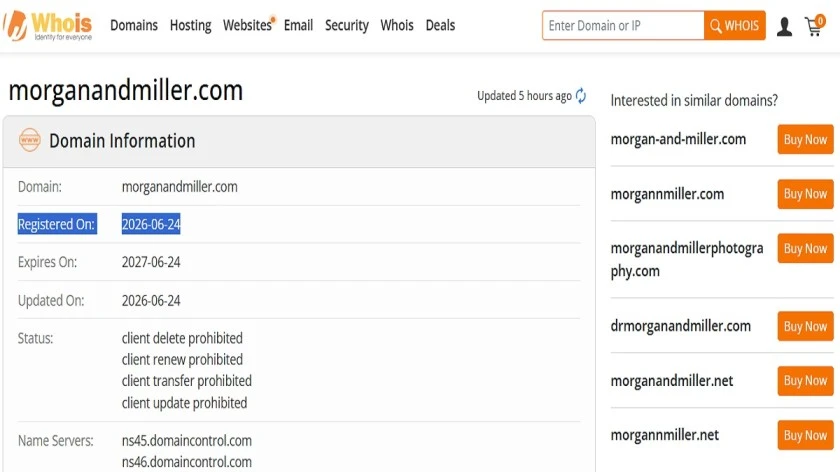
WHOIS Data and Domain Age
WHOIS records are one of the first places investigators check when reviewing an unfamiliar online retailer. These records can reveal when a domain was registered, which registrar manages it, when it expires and whether the owner has chosen to publish or hide identifying information.
The domain associated with Morgan & Miller was reportedly registered on June 24, 2026. This makes morganandmiller com a very young website with almost no independently established trading history. A newly registered domain does not automatically mean a website is fraudulent. Thousands of genuine businesses launch new websites every year. Nevertheless, domain age becomes important when a store presents itself with the visual identity, storytelling and promotional confidence of a long-standing company.
Why a Young Domain Increases the Risk
Reliable online retailers generally build a track record over time. Customers can often find older reviews, archived website pages, social-media discussions, business-directory listings and evidence of previous transactions. A website registered only recently does not yet have this history.
Short-lived scam stores commonly use new domains because they can operate briefly, collect orders and disappear before a large number of complaints become visible. The same operators may later return under a different domain and brand name. This does not prove that Morgan & Miller follows that pattern, but it explains why a recent registration date deserves attention.
The ownership details are also reportedly protected through Domains By Proxy. Privacy services are widely used by individuals and legitimate businesses to reduce spam and identity theft. Therefore, hidden WHOIS information should never be treated as proof of a scam by itself. The concern is that Morgan & Miller also fails to provide a complete and verifiable business address directly on the website.
Ownership Transparency
The website mentions New York, but no complete street address has been disclosed. At the same time, its legal terms are reportedly governed by UK law, while returned products must be sent to a warehouse in China. This creates uncertainty about where the company is legally registered, where management operates and which jurisdiction would handle a customer dispute.
A transparent retailer normally provides a legal company name, registration number, physical address and clear jurisdiction. Morgan & Miller does not appear to provide enough information for shoppers to independently confirm who operates the store. That lack of accountability is one of the most significant findings in this review.
Trust Score and Online Reputation
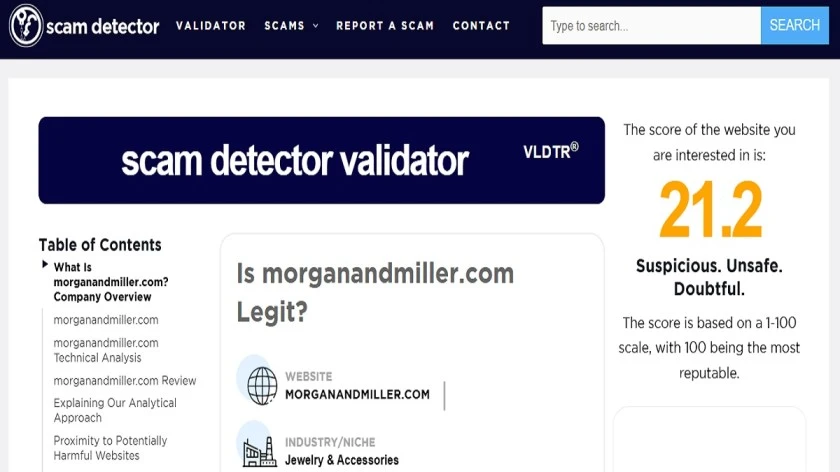
Scam Detector reportedly gives morganandmiller com a trust score of 21.2 out of 100, placing it in a suspicious or high-risk range. Automated trust-scoring systems generally consider factors such as domain age, website metadata, technical associations, ownership visibility and possible connections with other low-reputation websites.
A trust score is not a legal judgment and should not be treated as absolute proof. Automated tools can sometimes score new legitimate websites poorly simply because they lack history. They may also fail to detect sophisticated scam stores that use technically clean websites. The score is most useful when considered alongside manually verified evidence.
What the 21.2 Trust Score Suggests
A score of 21.2 indicates that the website has not established the level of credibility normally expected from a mature online business. In Morgan & Miller’s case, the low rating is consistent with other observable concerns:
- The domain was registered very recently.
- The ownership information is privacy-protected.
- No complete business address is shown.
- No customer-service telephone number is available.
- The company’s claimed location is unclear.
- Returns reportedly have to be shipped to China.
- The store uses discounts as high as 80% to 85%.
- No active official social-media profiles were identified.
A legitimate established retailer generally leaves a broader public footprint. This may include verified customer feedback across multiple platforms, consistent company information, historical website records and active interaction with customers through social media. Morgan & Miller appears to have little independent history that shoppers can examine.
Lack of Reputation Should Not Be Confused With a Positive Reputation
One mistake consumers make is assuming that the absence of complaints means a store is safe. For a domain registered recently, there may not have been enough time for complaints to accumulate or appear in search results. Orders can take several weeks to arrive, and customers may wait longer before filing disputes.
Therefore, the absence of widespread negative reviews should not be interpreted as evidence that morganandmiller com is legitimate. At this stage, the company’s reputation is better described as unproven. Until verified customer experiences appear over a longer period, shoppers would be taking a substantial risk based mainly on the website’s own claims.
Product Information and Images
Morgan & Miller sells fashion-jewelry products such as the Crystals Cluster Halo Statement Ring, Soft Glow Opal Gold Bracelet, Lustrous Pearl Necklace, Vintage Crystalline Silver Ring and Retro Gold Hoop Earrings. These product names are descriptive and designed to create a premium or boutique-style impression.
The website’s product range is broad enough to appeal to gift buyers and customers looking for affordable alternatives to luxury jewelry. However, attractive product titles and polished photographs do not confirm who manufactured an item or whether the delivered product will match the advertisement.
Product Image Concerns
No verified reverse-image-search evidence has been supplied showing that Morgan & Miller’s photographs were definitively copied from another retailer. Therefore, it would be inaccurate to claim that every image is stolen or plagiarized.
Still, shoppers should perform their own reverse-image searches before ordering. Product photos used by questionable fashion stores are often taken from wholesalers, marketplace listings or established brands. In some cases, several websites advertise the same image under different product names and prices.
When checking an image, consumers should look for:
- Identical photographs appearing on unrelated websites.
- The same jewelry design being sold under multiple brand names.
- Large differences in pricing between the original source and the reviewed store.
- Product descriptions that appear word-for-word on other websites.
- Customer-review photographs that do not match the advertised item.
- Images with cropped-out logos or inconsistent backgrounds.
Descriptions and Material Claims
Jewelry shoppers should pay close attention to material descriptions. Words such as “gold,” “silver,” “pearl,” “crystal” and “opal” can describe a color or design rather than the actual composition of a product. A listing may use phrases such as “gold finish” or “silver tone” without clearly identifying the base metal.
Before purchasing, customers should confirm whether the jewelry is solid gold, gold plated, sterling silver, stainless steel, brass or another alloy. They should also look for details regarding stone type, plating thickness, allergy information, sizing and care requirements.
If a product page relies mainly on emotional language while avoiding measurable specifications, the shopper cannot accurately judge its quality or value. Morgan & Miller’s steep discounts should also be considered when evaluating whether the original prices represent genuine market values or promotional reference prices.
Return Policy and Customer Service
A retailer’s return policy often reveals more about the customer experience than its homepage. Morgan & Miller reportedly allows customers to request a return or exchange within 14 days. On the surface, this sounds like a standard return period. The practical conditions, however, may make obtaining a refund difficult or expensive.
Customers reportedly have to send returned products to a warehouse in China using tracked shipping. Return postage is paid by the customer and may start at approximately $25 or more. For a relatively inexpensive piece of fashion jewelry, international return shipping could cost nearly as much as the product itself.
Why the China Return Requirement Matters
The website creates an association with New York, but its return process leads to China. This does not automatically indicate fraud; many online stores use international suppliers and fulfillment centers. The problem is the lack of transparency before purchase.
Customers may reasonably assume they are buying from a New York-based retailer and later discover that returning an unsuitable item requires international postage, customs documentation and tracking. This can discourage customers from exercising their return rights.
The policy also reportedly requires damaged products to be reported within 24 hours. That window is unusually restrictive. Customers may not open a package immediately, or damage may become noticeable only after the item is worn. A narrow reporting period can make it easier for a seller to reject complaints.
Limited Customer-Support Options
The listed email address is support@morganandmiller com, but no telephone number was found. Email-only support is common among small online stores, yet it provides limited reassurance when no physical address or independently verified company registration is available.
If the company stops answering emails, customers have no direct telephone channel and no clearly disclosed domestic office to contact. The absence of multiple support options becomes especially concerning when returns involve an international warehouse.
Before ordering, a shopper could send a detailed question about materials, delivery or returns. A genuine response should directly answer the question rather than provide a generic template. Customers should retain screenshots of the product listing, checkout page, policy pages and all correspondence in case a payment dispute becomes necessary.
Additional Red Flags
Several other details increase the overall risk surrounding morganandmiller com. None of these issues independently proves that the website is a scam, but together they create a pattern that cautious shoppers should not ignore.
Extremely Large Discounts
The homepage reportedly promotes discounts of up to 80%, while a collection page advertises savings as high as 85%. Customers may also receive automatic discounts of up to 25% when buying five items.
Large markdowns are a common marketing technique used by fashion stores. The important question is whether the original price was ever genuinely charged. A product listed as reduced from $150 to $25 may appear to offer an exceptional bargain, but the higher amount may simply be a reference price created to increase urgency.
Constant sitewide discounts can be misleading when they make ordinary low-cost products look like premium merchandise being sold at clearance prices.
Social-Media Absence
No official Facebook, Instagram, TikTok or other social-media accounts were found through the website. This is unusual for a fashion-jewelry brand because visual platforms are normally central to jewelry marketing.
An active social account does not prove legitimacy, as fake stores can purchase followers or steal content. Nevertheless, genuine profiles can provide evidence of history, customer interaction, tagged purchases and public responses to complaints. Morgan & Miller’s lack of an identifiable social presence makes its claimed brand identity harder to verify.
SSL and Payment Security
The presence of HTTPS or a padlock symbol only means that information transmitted between the browser and website is encrypted. It does not confirm that the seller is trustworthy. Scam stores can obtain SSL certificates easily and at little or no cost.
Morgan & Miller reportedly accepts Visa, Mastercard, American Express, Discover, Apple Pay, Shop Pay and Klarna. Recognizable payment logos can make a checkout page appear reassuring, but customers should verify which methods are actually available during checkout.
Credit cards usually offer stronger dispute options than bank transfers, cryptocurrency or direct debit. Customers should avoid any seller that asks them to move the transaction away from the official checkout process or pay using a method with no chargeback protection.
Reviews and Testimonials
Website testimonials should be treated cautiously unless they can be independently verified. A store controls which reviews appear on its own pages and may remove negative feedback. Repeated wording, generic customer names, stock photographs and large clusters of five-star ratings are warning signs.
Independent reviews are more valuable when they include realistic details about delivery time, product quality, packaging, refund handling and customer support. You can read more about Lumvelle Drops Review 2026: Scam or Legit? An In-Depth Investigation of lumvelle com.
Website Design and Technical Footprint
Morgan & Miller appears to use a modern online-store layout with organized product categories, promotional banners and familiar checkout options. A polished design can create immediate trust, especially when the website uses professional photographs and luxury-style branding.
However, website design is no longer a reliable indicator of legitimacy. Ready-made e-commerce themes allow almost anyone to build a professional-looking store quickly. A website can appear established even when its domain was registered only days or weeks earlier.
Design Quality Versus Business Transparency
The most important question is not whether the website looks attractive. It is whether the business information behind the design can be verified. In this case, the public-facing presentation appears stronger than the underlying corporate transparency.
A trustworthy technical footprint would normally include:
- Consistent company information across every policy page.
- A verifiable legal entity and complete address.
- Working customer-service links.
- Clear product specifications.
- Stable historical domain records.
- Transparent shipping and fulfillment information.
- Active and authentic social profiles.
- Independent reviews collected over time.
Morgan & Miller currently lacks several of these trust signals.
Broken Links, Hosting and Reliability
No confirmed evidence has been supplied showing specific broken links, repeated server outages or a particular suspicious hosting location. Those claims should not be invented without technical verification.
Even so, shoppers can perform simple checks. They should open every policy link, verify that the contact form works, review the footer, inspect the checkout page and confirm that all product pages use consistent company information. Poorly copied policy pages, incomplete placeholders or contradictory company names would be serious warning signs.
A newly launched website may also disappear or change rapidly. Customers should save copies of relevant pages because terms, prices and return instructions can be modified after an order is placed.
Expert Verdict: Morgan & Miller Scam or Legit?
After reviewing the available information, morganandmiller com cannot presently be considered a well-established or fully trustworthy online jewelry store. The evidence supports a high-risk or suspicious classification rather than a definitive claim that every transaction is fraudulent.
The store’s recent domain registration is the central concern. It has little operating history, privacy-protected ownership and no complete publicly disclosed business address. The location story is also confusing: the website references New York, its terms reportedly use UK law, and returns must be shipped to China.
Additional concerns include the low 21.2 out of 100 trust score, the absence of a customer-service phone number, limited independent reputation, no visible official social-media presence and discounts reaching 80% to 85%.
Some customers may still receive products, but legitimacy involves more than simply shipping an item. Product quality, advertising accuracy, refund accessibility and customer-support reliability also matter. A store can deliver inexpensive goods while still creating a poor or misleading purchasing experience.
For these reasons, consumers should avoid making large purchases from Morgan & Miller until the website establishes a longer history and provides clearer ownership details. Anyone who decides to order should use a credit card, keep the order value low, save screenshots and read the return policy carefully.
The safest conclusion is that Morgan & Miller is currently unproven and carries substantial consumer risk. You can read more about Before You Buy Ionix Labs Leggings, Read This Honest Review.
Frequently Asked Questions
Is morganandmiller com Safe to Buy From?
Morgan & Miller does not currently show enough independently verifiable information to be considered a low-risk retailer. Its domain is extremely new, its ownership information is hidden, and no complete street address or customer-service telephone number has been found. Returns may also have to be sent to China at the customer’s expense. These factors suggest that shoppers should avoid large orders.
How Can I Check Whether an Online Store Is a Scam?
Start by checking the domain-registration date and comparing it with the company’s claimed history. Search for a legal business name, physical address, telephone number and independent customer reviews. Read the shipping and return policies carefully. Reverse-search product photographs and compare prices across other websites. Also check whether the store uses secure payment methods that offer chargeback rights.
What Should I Do If I Already Ordered From Morgan & Miller?
Save your order confirmation, product-page screenshots, payment receipt and all email correspondence. Monitor the tracking number and contact the seller in writing if the order is delayed. Do not delete any messages. If the seller fails to deliver, sends a significantly different product or refuses a valid refund, contact your card issuer or payment provider promptly.
Can I Get My Money Back If I Was Scammed?
A refund may be possible depending on the payment method and the evidence available. Credit-card users can ask their issuer about a chargeback for non-delivery, misrepresentation or unauthorized charges. Other payment services may have buyer-protection procedures. Report the problem quickly because dispute deadlines vary. Provide screenshots, tracking information, correspondence and photographs of any incorrect product.
How Do Scam Websites Trick Shoppers?
Fake or misleading stores often use professional themes, stolen product photographs, fabricated reviews and unusually high discounts. They may create urgency through countdown timers, low-stock warnings or “today only” promotions. Some deliver low-quality substitutes, while others provide false tracking numbers or stop responding after receiving payment.
What Are the Warning Signs of a Fake Online Store?
Common warning signs include a recently registered domain, hidden ownership, no physical address, copied policy text, unrealistic discounts, poor-quality grammar, fake-looking reviews, email-only customer service and expensive international returns. Contradictory claims about where the company operates are also important. The more warning signs that appear together, the greater the risk.
Which Trusted Stores Can I Use Instead?
Choose established jewelry retailers with long domain histories, verifiable company registration, clear material descriptions and accessible customer support. Prefer sellers that provide a domestic return address, transparent refund terms and payment protection. Official manufacturer websites, recognized department stores and established marketplaces with formal buyer-protection programs are generally safer than unknown stores advertised through temporary social-media promotions.