Introduction
If you’ve stumbled across myfloatski com while searching for electric water sports equipment online, you’re not alone and you’re right to pause before reaching for your wallet. MyFloatSki markets itself as a cutting-edge electric jet ski brand, selling a compact motorized personal watercraft called the “FloatSki” that supposedly delivers 19 mph top speed, a 90-minute runtime, and no-license riding convenience. The price tags are enticing, the marketing is slick, and the product sounds genuinely exciting.
But beneath the polished surface lies a trail of serious red flags that no responsible consumer should ignore. This investigative review was put together to arm you with hard facts: domain registration data, trust scores, WHOIS records, payment analysis, and a full breakdown of every warning sign we uncovered about myfloatski com. Whether you found this site through a social media ad, a search engine, or a friend’s recommendation, read this article in full before making any purchasing decision. The evidence strongly suggests this site may be a scam operation and the stakes are high.
Section 1: WHOIS Data & Domain Age A Site Barely Out of the Box
One of the most powerful tools for evaluating any online store is a WHOIS lookup, which reveals when a domain was registered, who owns it, and where it’s hosted. For myfloatski com, the results are deeply alarming.
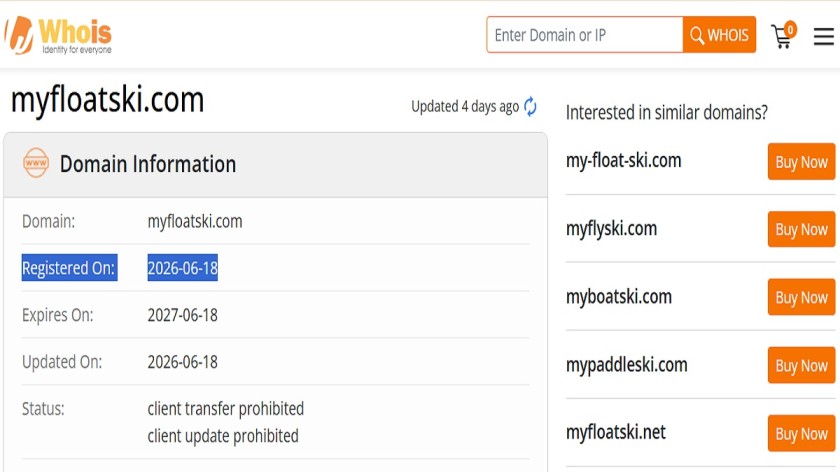
According to publicly available WHOIS data and data collected by ScamAdviser, the domain myfloatski com was registered on June 18, 2026 making this website less than two weeks old at the time of this writing. That is not a misprint. This site is brand new, and that alone is one of the most reliable indicators of a fraudulent online store. Legitimate ecommerce businesses build their web presence over months and years; scam operations launch, harvest payments, and disappear within weeks.
But the domain age issue doesn’t stop there. The WHOIS ownership details are entirely hidden behind a privacy shield specifically listed under “Contact Privacy Inc. Customer 0178636985,” based in Toronto, Canada. This is a common practice used by scammers to prevent victims from identifying who is behind the website. Genuine businesses that stand behind their products typically have no reason to hide their domain ownership.
The registrar of record is Tucows Domains Inc., a legitimate registrar platform, but that doesn’t lend credibility to the site itself anyone can register a domain through Tucows. The hosting country appears to be Canada, while the listed business address is in Sheridan, Wyoming, USA. That geographic inconsistency is another flag worth noting.
Cybersecurity experts and consumer protection agencies consistently advise that websites under 6 months old carry substantially elevated risk for online shoppers. Young domains are favored by scammers precisely because they haven’t accumulated enough negative reviews or fraud reports to trigger automatic red flag systems. By the time the complaints pile up, the scammers simply close the site and open a new one with a fresh domain.
The combination of an ultra-new domain (less than 10 days old at the time of our investigation), hidden WHOIS ownership, and a mismatched hosting location versus listed business address constitutes a serious pattern consistent with fraudulent e-commerce activity.
Section 2: Trust Score & Reputation Near the Bottom of the Barrel
Trust scores provide a data-driven snapshot of a website’s legitimacy by analyzing dozens of factors including domain age, owner transparency, blacklist status, SSL certificate type, review volume, and more. For myfloatski com, these scores are catastrophic.
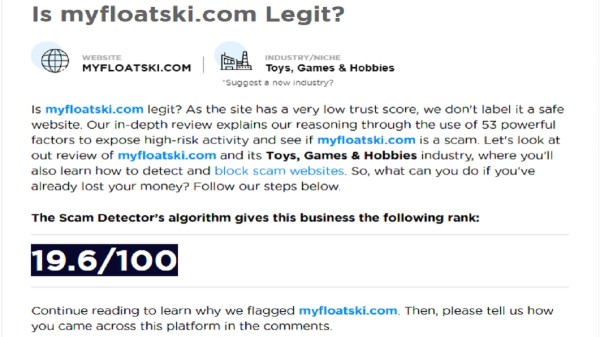
ScamAdviser, one of the most widely used online scam detection platforms, assigned myfloatski com a trust score of just 19.6 out of 100. The platform explicitly states that this score is “a strong indicator that the website may be a scam.” To put that number in context, most established and legitimate online retailers score above 80. A score below 30 is considered high-risk territory.
The key reasons behind this devastatingly low score include the site’s extreme youth (less than a week old at the time ScamAdviser analyzed it), the hidden WHOIS ownership, and the absence of any verifiable online reputation. There are no customer reviews, no social media presence, no media coverage, and no third-party verification of the business’s legitimacy.
ScamAdviser also notes that myfloatski com appears to be running on Shopify, a legitimate ecommerce platform. Unfortunately, Shopify’s accessibility is a double-edged sword it allows anyone, including bad actors, to spin up a convincing online store within hours. The presence of a Shopify backend means nothing about the trustworthiness of the seller.
Additionally, the SSL certificate in use is a Domain Validated (DV) certificate the lowest and least trustworthy form of SSL. DV certificates simply confirm that the certificate holder controls the domain; they do not verify the identity of the business or confirm that the site is legitimate. Scam sites routinely use DV SSL certificates to appear secure to casual shoppers, while collecting payment information with no intention of delivering any product.
There is currently no indication that myfloatski com appears on major blacklists, but given the domain is less than two weeks old, it’s simply too new for most blacklisting systems to have flagged it yet.
Section 3: Product Information & Images Extraordinary Claims, Zero Proof
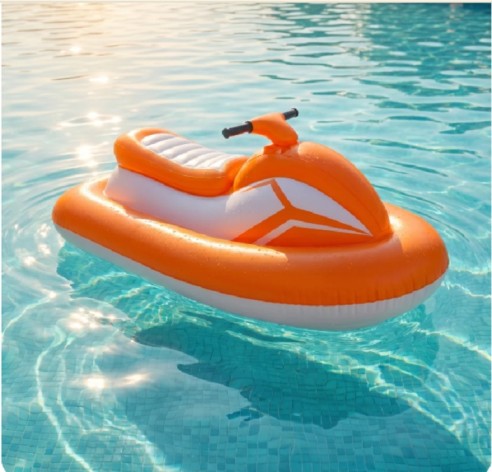
MyFloatSki markets a single flagship product: a compact electric personal watercraft called the FloatSki. According to their own product page, this device allegedly delivers 19 mph top speed, a 90-minute runtime, is lightweight enough to carry solo, requires no license or trailer, and works across “lakes, rivers, and calm coastline.” The site promises “real propulsion, real control, real hardware this is a machine, not a toy.”
These are extraordinary claims for a brand with no established manufacturing history, no physical showrooms, no third-party reviews, and a website that is less than two weeks old. No independent testing organization, water sports publication, or verified customer has confirmed any of these specifications. Real electric watercraft brands such as Taiga (maker of the Orca, widely recognized as the world’s first commercially available electric jet ski) took years and tens of millions in investment to bring verified products to market, with full test data, safety certifications, and dealer networks.
The product imagery on myfloatski com is also a concern. The site features highly polished, lifestyle-oriented images that appear designed to appeal emotionally rather than inform technically. There is no visible manufacturing detail, no FCC or CE certification badge, no UL listing, no weight specs, and no battery safety documentation. For a motorized watercraft that allegedly reaches nearly 20 mph on open water, the absence of any verifiable safety certifications is not just a red flag it is a liability.
Standard investigative practice for suspicious product sites involves reverse image searching the product photos to identify if images have been lifted from other websites or manufacturers. Given the pattern of behavior observed with this site, this is strongly recommended before any consumer considers a purchase.
The product description language “No license. No trailer. Just ride” reads as marketing copy engineered for virality rather than technical documentation for a marine-grade device. Genuine watercraft manufacturers provide detailed owner’s manuals, warranty documentation, and regulatory compliance information.
Section 4: Return Policy & Customer Service Paper-Thin Promises
MyFloatSki states a 30-day return policy, which sounds reassuring at first glance. But a closer examination of the context around this policy reveals how hollow that promise may be.
The website provides a contact email of [email protected] a free Microsoft Outlook email address. Legitimate businesses operating in the electric watercraft space, which involves expensive, high-value products requiring shipping logistics and technical support, invariably use domain-branded email addresses (e.g., [email protected]). Using a free email provider for customer support is a major red flag; it signals that the business either cannot afford or has deliberately chosen not to establish a professional communications infrastructure.
The listed contact number is +64 52329103, which uses a New Zealand country code (+64). However, the listed business address is in Sheridan, Wyoming, USA. This geographic inconsistency is hard to explain for any legitimate operation. It raises the question of whether the phone number is functional at all, and whether there is actually anyone in Wyoming operating this business.
The business address 1309 Coffeen Ave, Sheridan, WY 82801 is a commonly reused address that appears in the registration details of multiple online businesses. This type of shared or virtual address is frequently used by fraudulent operations to appear legitimate while having no actual physical presence.
Regarding the 30-day return policy itself: returning a heavy, motorized watercraft internationally (if the business is actually based overseas) would involve significant shipping costs that may well exceed the product’s refund value. Scam sites frequently advertise generous return policies knowing that the logistical barriers to actually executing a return make it practically impossible for consumers to follow through.
With a near-zero online reputation, a free email address, a mismatched international phone number, and a potentially virtual business address, the customer service infrastructure at myfloatski com offers consumers little meaningful recourse.
Section 5: Payment Methods & Security Who Has Your Card Data?
MyFloatSki accepts Visa, Mastercard, Apple Pay, Google Pay, and other payment methods. On the surface, this appears to be a point in the site’s favor scam sites that only accept wire transfer, cryptocurrency, or gift cards are far easier to identify. Credit card payments do offer some consumer protection via chargeback rights.
However, the presence of major payment logos on a website does not guarantee that the payment processing is secure or that the business is legitimate. Many fraudulent storefronts display payment brand logos to instill false confidence while routing transactions through unvetted or unauthorized payment processors.
The SSL certificate in use is a low-assurance, Domain Validated (DV) certificate issued by Google Trust Services. While this does encrypt the data in transit between your browser and the server, it does nothing to verify the identity or legitimacy of the business receiving your payment. This is the bare minimum of SSL, and it is the type universally used by scam sites.
There is no visible indication on the site of PCI-DSS compliance the payment card industry data security standard that all legitimate card-accepting merchants are required to meet. There is no independent security seal from organizations like Norton, McAfee, or Trustwave. For a site selling a product that could realistically be priced in the hundreds or even thousands of dollars, the absence of verifiable payment security infrastructure is deeply concerning.
If myfloatski com is indeed a scam operation, entering your credit card details could expose you to unauthorized charges, card cloning, or identity theft. While credit card chargebacks are available as a safety net, initiating a chargeback requires timely action (typically within 60–120 days of the transaction, depending on the card issuer) and is not guaranteed.
The safest approach: do not enter any financial information on this website until its legitimacy has been independently verified.
Section 6: Website Design & Technical Footprint Shallow Roots
At a glance, myfloatski com is visually appealing. It runs on Shopify, which provides a professionally designed storefront out of the box, and the product page copy is articulate and emotionally compelling. For a casual visitor, the site could easily pass as legitimate.
But look beneath the surface and the technical footprint is thin in ways that matter. The website is less than two weeks old, meaning it has zero historical web presence, no cached versions in the Wayback Machine to review, no indexed pages ranking organically in search results, and no backlink profile from trusted third-party sources. Established ecommerce brands accumulate years of digital history product reviews on external sites, press mentions, forum discussions, affiliate links, and organic SEO rankings. MyFloatSki has none of this.
The site title is simply “Floatski” and the meta description is equally sparse again, consistent with a quickly assembled storefront rather than a mature brand with a developed content strategy. There is no blog, no press page, no “about us” section detailing the founding team’s expertise in marine engineering or electric propulsion, and no verifiable manufacturing details.
The website also does not list any physical retail locations, authorized dealers, or service centers all of which would be essential for a product as complex and potentially dangerous as a motorized watercraft. Who performs warranty repairs? Where can you test the product before buying? These questions have no answers on the site.
Hosting infrastructure is located in Canada, despite the US business address, adding another layer of opacity to who is actually controlling the website. The Shopify platform handles the storefront, which means the actual server infrastructure provides no meaningful information about the identity or location of the business owner.
Section 7: Social Media & Online Presence Virtually Invisible
In the modern digital landscape, any legitimate consumer brand especially one selling an exciting, visual product like an electric watercraft would have an active and growing social media presence. Electric water sports are inherently photogenic and video-friendly; platforms like Instagram, TikTok, and YouTube are natural homes for this type of product marketing.
MyFloatSki has no verified social media presence whatsoever. According to our research, no social media links are listed on the website, and searches across Instagram, Facebook, TikTok, YouTube, and X (formerly Twitter) for “MyFloatSki” or “FloatSki” return no established brand accounts with meaningful follower counts or engagement histories.
This is extraordinarily unusual for a brand marketing a novel, visually compelling consumer electronics product in 2026. Even early-stage legitimate startups create social media profiles as part of their initial brand launch. The complete absence of social media presence for myfloatski com strongly suggests the site was assembled quickly with no real investment in long-term brand building a hallmark of hit-and-run scam operations.
Scam storefronts occasionally create social media pages with purchased followers or AI-generated engagement to simulate legitimacy, but even those token efforts are absent here. There are no user-generated videos of customers riding the FloatSki, no unboxing content, no influencer partnerships, and no community discussion on any platform.
The absence of any organic social footprint is one of the clearest signals that myfloatski com is not a genuine, operating consumer brand but rather a shell storefront designed to collect payments before vanishing.
Section 8: Customer Reviews & Testimonials The Silence Speaks Volumes
Legitimate online retailers accumulate customer reviews over time on platforms like Trustpilot, SiteJabber, Google Reviews, and the Better Business Bureau. These independent review ecosystems serve as the court of public opinion for ecommerce businesses. For myfloatski com, that court is empty.
At the time of this investigation, there are no verified customer reviews of myfloatski com on any major independent review platform not on Trustpilot, not on SiteJabber, not on the BBB, not on Reddit, and not on any water sports or consumer electronics forum. Given the domain is less than two weeks old, this absence of reviews is perhaps expected but it also means there is zero social proof that any customer has ever successfully purchased and received a product from this site.
The website itself may display positive testimonials, but any on-site testimonials for a new, unverified storefront should be treated with extreme skepticism. It takes seconds to fabricate testimonials; there is no accountability or verification process for on-site reviews. Scam sites routinely populate their pages with invented five-star testimonials to overcome consumer hesitation.
The pattern across the electric watercraft and water sports industry is clear: legitimate brands generate organic review ecosystems. Taiga, the maker of the world’s first commercially available electric jet ski, has independently verified reviews, press coverage in publications like Popular Science and Wired, and years of community discussion in water sports forums. MyFloatSki has none of this.
Until independent, verified reviews from real customers appear on trusted third-party platforms, there is no basis for consumer confidence in myfloatski com. You can read more about Alevia Amla Review: Legit or Scam? Real Benefits, Side Effects & User Results (2026).
Section 9: Additional Red Flags A Pattern Too Clear to Ignore
Beyond the individual issues examined above, the cumulative pattern of red flags at myfloatski com is deeply concerning. Let’s consolidate what we know:
Unrealistic discounts: The site advertises discounts of up to 50% on a novel electric watercraft product. For a product with this level of claimed technology sealed marine-grade electric jet propulsion, impact-resistant hull, UV-stable shell a 50% discount from a brand-new seller with no verifiable supply chain or manufacturer relationship is not a deal. It’s bait.
No verifiable manufacturer relationship: myfloatski com provides no information about who manufactures the FloatSki, where it is manufactured, what safety certifications it carries, or what regulatory bodies have approved it for use on public waterways. Personal watercraft are regulated by the US Coast Guard and equivalent agencies in other jurisdictions; the complete absence of any regulatory compliance information is alarming.
Delivery time inconsistency: A claimed 6–10 business day delivery window for a physical watercraft from an unverified seller is implausibly fast if the product is genuinely manufactured, warehoused, and shipped. It may be a fabricated timeline to delay chargebacks past critical windows.
Email domain mismatch: The use of [email protected] rather than a domain-matching email address is a hallmark of hastily assembled scam operations.
New Zealand phone number for a US company: The +64 country code is inconsistent with a Sheridan, Wyoming business.
Shopify as the sole technical infrastructure: While legitimate, Shopify is the platform of choice for scam storefronts precisely because it requires no technical sophistication to deploy.
No regulatory or safety documentation: A motorized watercraft reaching nearly 20 mph with no safety certifications listed is not a product it’s a promise.
Section 10: Expert Verdict Our Conclusion
Based on a comprehensive investigation of myfloatski com across all available data points domain registration, WHOIS data, trust scores, product claims, contact information, social media presence, customer reviews, payment infrastructure, and technical footprint our verdict is clear:
myfloatski com exhibits the hallmarks of a scam operation and should be avoided.
The site was registered just days ago, hides its ownership behind a privacy shield, lists inconsistent contact information, carries an extremely low trust score of 19.6/100 as assessed by ScamAdviser, has no social media presence, has no independent customer reviews, and makes extraordinary product claims with zero verifiable evidence.
We strongly advise against making any purchase on this website. Do not enter your credit card, debit card, or personal information on this site.
If you are looking for a legitimate electric personal watercraft experience, we recommend researching established brands such as Taiga (makers of the Orca electric PWC) or renting electric watercraft through verified, locally licensed rental operators. Always verify a retailer’s identity through independent review platforms, check their domain age, and confirm physical business details before purchasing high-value items online.
If you have already placed an order on myfloatski com, see the FAQ section below for guidance on next steps.
Section 11: Frequently Asked Questions (FAQ)
Is myfloatski com safe to buy from?
Based on our investigation, no myfloatski com does not appear safe to purchase from. The domain is less than two weeks old, ownership is hidden, the trust score from ScamAdviser is 19.6/100 (extremely low), there is no verified social media presence, no independent customer reviews exist, and contact details are inconsistent with a legitimate US business. All of these factors combined strongly suggest the site is not a trustworthy retailer. We recommend against any financial transaction on this site.
How can I check if a site is a scam?
Several free tools can help you evaluate a website’s legitimacy before purchasing. Visit ScamAdviser.com and enter the URL to get an automated trust score and analysis. Check the domain age using WHOIS lookup tools (young sites under 6 months are higher risk). Search for independent reviews on Trustpilot, SiteJabber, and the Better Business Bureau. Look up the company on social media platforms to verify an authentic, active presence. Finally, search the site name plus “scam” or “review” in Google to surface any consumer complaints or investigative articles.
What should I do if I already ordered from this site?
Act quickly. First, contact your bank or credit card issuer immediately and explain that you may have been defrauded by an online retailer. Request a chargeback or dispute process to be initiated. Most card issuers have a limited window (typically 60–120 days from the transaction date) for disputes, so do not wait. If you used a debit card, contact your bank directly, as protections may be more limited. Save all evidence screenshots of the website, confirmation emails, order numbers, and any communications. Report the site to the Internet Crime Complaint Center (IC3) at ic3.gov, the FTC at ReportFraud.ftc.gov, and to ScamAdviser.com.
Can I get my money back if I was scammed?
If you paid by credit card, you have the strongest chance of recovery through the chargeback process. Contact your card issuer immediately and explain the situation. Provide documentation showing you did not receive what was ordered. For debit cards, contact your bank some banks offer fraud protection for unauthorized transactions but the process may differ. If you paid through services like Apple Pay or Google Pay linked to a credit card, the same chargeback rights typically apply. PayPal’s Buyer Protection program can also facilitate refunds in many scam scenarios. Cryptocurrency and wire transfer payments are generally unrecoverable.
How do scam websites trick people?
Scam websites have become increasingly sophisticated. They use professional-looking templates (often through platforms like Shopify or WooCommerce), stock photos of desirable products, artificially low prices or large discounts, urgency tactics like “limited stock” warnings, and fabricated testimonials to create an illusion of legitimacy. Many now use SSL certificates (the padlock icon) and familiar payment logos to appear secure. They target consumers through social media advertising, often on platforms like Facebook, Instagram, and TikTok, where ad targeting allows them to reach people actively searching for specific products. The product category exciting, novel, and expensive is often chosen specifically because it attracts impulse buyers willing to overlook red flags for a deal.
What are the warning signs of fake online stores?
Key warning signs include: domain age under 6 months; hidden WHOIS ownership; no verifiable social media presence or very new social accounts; no independent reviews on Trustpilot, SiteJabber, or the BBB; contact information that uses free email services (Gmail, Outlook, Yahoo); phone numbers with country codes inconsistent with the listed business address; prices or discounts that seem too good to be true; no physical address or a fake/virtual address; poor or vague return policy language; no visible manufacturing, safety, or regulatory certifications for regulated products; and no “About Us” page with verifiable team information or business history.
Which trusted sites can I use instead?
For electric personal watercraft and water sports equipment, we recommend purchasing from established, verified brands and retailers. Taiga Motors (taigamotors.ca) is the manufacturer of the Orca, the world’s first commercially available electric jet ski, with years of verified reviews and a transparent business history. Major water sports retailers such as West Marine (westmarine.com), Overton’s (overtons.com), and official dealerships for brands like Sea-Doo, Yamaha WaterCraft, and Kawasaki Jet Ski offer legitimate products with full warranty support, physical service centers, and established consumer protections. Always verify that any online retailer has a multi-year domain history, independent customer reviews, and transparent contact information before making a high-value purchase.
This article is intended for consumer protection and educational purposes. All findings are based on publicly available data at the time of investigation (June 2026). Readers are encouraged to conduct their own due diligence.