Glycoguard presents glyco-guard com as a seller of a wellness supplement intended to support blood-sugar-related functions. The presentation includes several prices, substantial discount claims and explanations involving chromium, insulin function and metabolism. What prompted our closer buyer check was the transparency gap between that detailed marketing and the website’s extremely recent domain history. The domain was registered only six days before our evidence was collected on August 29, 2026. Our investigation therefore focused on what can actually be verified: the domain record, the seller-displayed claims, available contact and policy evidence, and the limited independent reputation trail.
Quick Verdict
Our quick verdict is that glyco-guard com is insufficiently established. It is a functioning seller presentation with unusually candid limitations around its health claims, but the domain was only six days old when checked, independent reputation evidence was thin, and essential buyer-policy details were not captured in the supplied evidence. These points justify caution, although they do not establish fraud.
Background and reason for our review
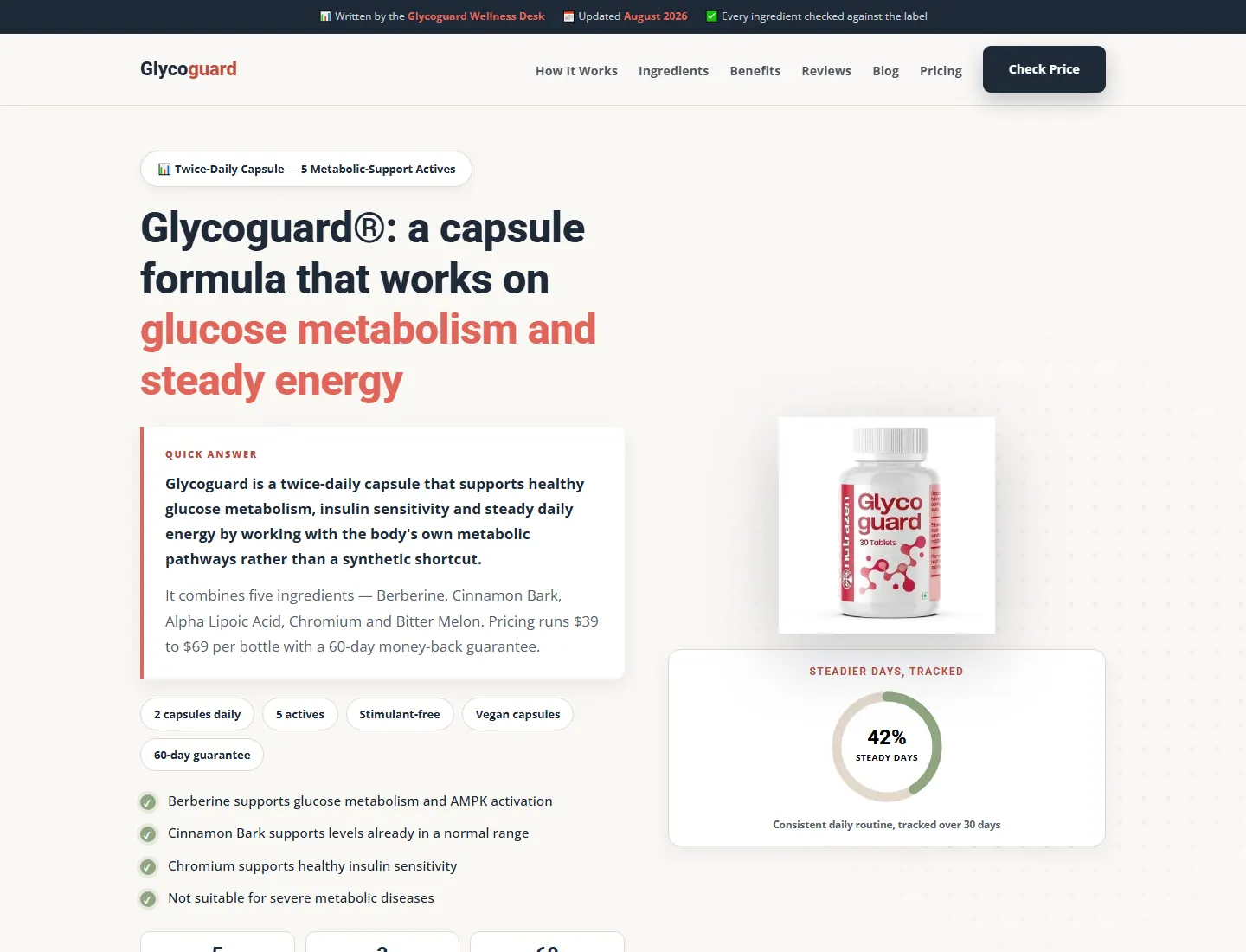
The website identifies the seller or product brand as Glycoguard and markets a wellness supplement around blood-sugar support. Its own copy attributes potential support for insulin function and macronutrient metabolism to chromium sourced from yeast in what the brand calls clinically studied amounts. Those are seller statements—not findings independently confirmed by ZeroThought.
Importantly, the seller also supplies limiting language. It says the benefits are supportive rather than promised medical outcomes, that individual results vary, and that the product is not a treatment for diabetes or severe metabolic disease. Another seller page states that the finished product has not undergone its own clinical trial. This qualification is more restrained than an unqualified cure claim, but it also tells buyers why ingredient-level marketing must not be treated as proof that the finished supplement produces a particular outcome.
Readers comparing wellness-product marketing can also consult our Curalona wellness-claims investigation, which explains the same essential distinction between promotional statements and independently demonstrated product results.
Domain history leaves almost no operating track record
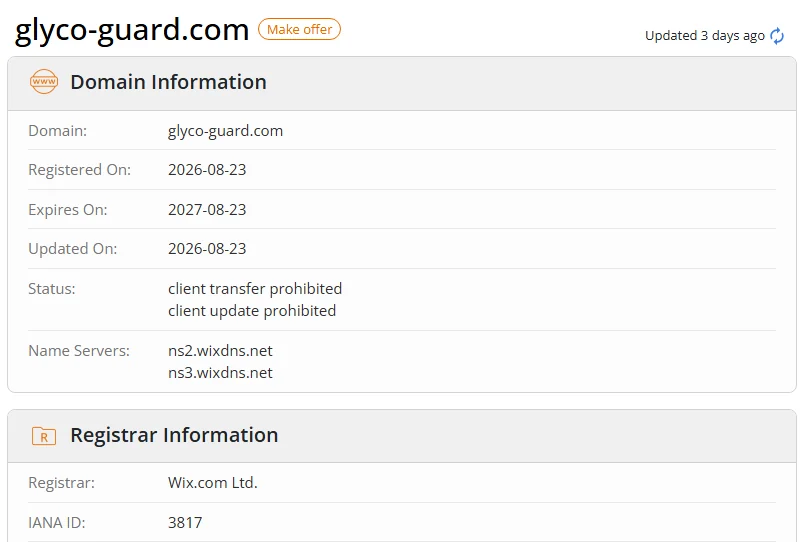
The WHOIS com record for glyco-guard com reports a registration date of August 23, 2026. Our evidence was retrieved on August 29, meaning the domain was approximately six days old at the time of review. WHOIS com lists Wix com Ltd. as the registrar, an expiry date of August 23, 2027, and the nameservers ns2.wixdns net and ns3.wixdns net.
A one-year registration term is common and does not prove bad intent. Wix-related registration and nameservers likewise identify technical infrastructure, not the legal identity or reliability of the merchant. The material issue is age: a six-day history is far too short to demonstrate consistent fulfilment, stable customer support or a durable refund record.
That does not make the store fraudulent. It means buyers cannot rely on years of observable domain history when assessing it. Our guide to identifying scam-website warning signs offers a broader checklist for evaluating a young store without treating domain age alone as decisive evidence.
Business identity and contact transparency
The collected homepage evidence names Glycoguard as the website operator or company, but it does not establish a separately registered legal entity behind that name. No verified business headquarters, responsible individual, telephone number or independently confirmed support address appears in the supplied ledger. We therefore cannot tell readers who legally operates the store from this evidence alone.
The Better Business Bureau check was unavailable because a reliable business match requires a business name and location, and the URL alone did not provide enough information. That is not a negative BBB rating and should never be reported as one. It simply means our investigation could not use BBB information to connect the website to an established business profile.
A recognizable brand label is useful, but it is not equivalent to legal-operator transparency. Before ordering, a buyer should look for a company name, physical correspondence address, working support channel and clear identification of the entity that will appear on the payment statement. Those details should agree across checkout, policies and order confirmation.
Pricing requires careful checkout verification
On August 29, 2026, the seller-displayed material contained multiple distinct price figures: $69, $49 and $39, as well as $691, $414, $234, $207 and $147. The same capture included “Save 45%” and “Save 20%” claims. These are dated seller-displayed figures, not prices independently validated by ZeroThought.
The evidence does not reliably map every number to a package size, quantity, crossed-out comparison price, subtotal or final payable amount. We will not infer a bundle structure or reconcile the figures without that missing context. The page title’s “Pay Just $39/Bottle” wording may indicate a per-bottle promotional rate, but buyers should not assume that it is the total transaction price.
Before authorizing payment, preserve a screenshot showing the selected quantity, per-unit price, subtotal, shipping charge, tax and final total. Also check whether the purchase is one-time or recurring. Similar price-display issues can occur outside the supplement category; our Uproot Clean buyer review illustrates why the checkout total matters more than a prominent headline price.
Independent reputation and content checks
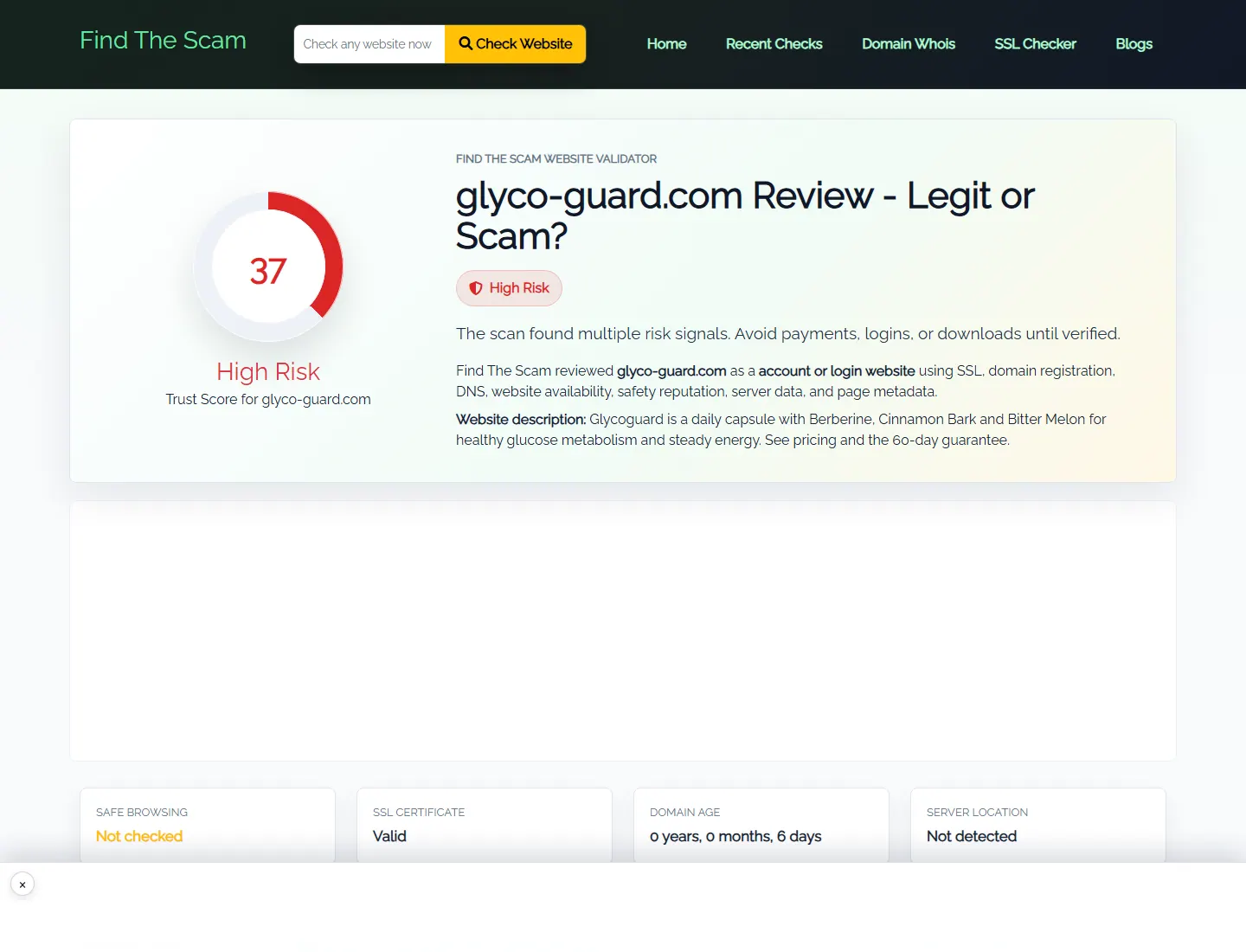
The independent reputation trail was limited when our evidence was collected. Find the Scam displayed a rating of 37 out of 100 for the domain. That is solely Find the Scam’s platform-specific rating; ZeroThought has not converted it into another scale or treated it as proof of wrongdoing.
Trustpilot, ScamAdviser and Scam Detector were blocked during collection, so their results are unavailable. No score from any of those services should be inferred. The BBB result was also unavailable for matching reasons rather than because of an adverse profile.
This leaves one named third-party rating and very little accessible reputation history. A newly registered domain may naturally have few independent reviews, but that also deprives buyers of evidence about delivery, refunds and customer-service performance. Search results and testimonials can change quickly, so shoppers should look for detailed, independently hosted reviews and verify that they concern this exact hyphenated domain rather than a similarly named product.
Returns, shipping and payment protection
The supplied evidence does not record a return window, return destination, restocking fee, order-processing period, delivery or transit estimate, warranty term, accepted payment methods, or subscription-cancellation procedure. Consequently, our review cannot confirm any of those protections. This is an evidence limitation, not a claim that the website has no policies.
Processing and transit are different: processing covers the time before dispatch, while transit begins after a carrier receives the parcel. Buyers should require both figures in writing and should not treat a generic delivery estimate as confirmation of dispatch speed. The same care applies to refunds—look for the number of days allowed, whether opened supplements qualify, who pays return postage and when the refund clock starts.
Use a payment method with a documented dispute process, avoid transfers or other hard-to-reverse methods, and retain the offer, checkout screen, confirmation and correspondence. For another example of how store identity and policy clarity affect buyer risk, see our Margot & Ivy Greenville store review.
Positive signals and warning signs
Potentially positive signals
- The seller expressly says the product is not a diabetes treatment and is unsuitable as a substitute for medical care involving severe metabolic disease.
- It acknowledges that individual results vary and that the finished product has not undergone its own clinical trial.
- A public WHOIS com record supplies consistent registration, registrar, expiry and nameserver data.
Reasons for caution
- The domain was only about six days old when the evidence was collected.
- The available material names Glycoguard but does not independently establish the legal operator behind it.
- Numerous displayed prices and two discount percentages cannot be reliably mapped to exact packages from the evidence.
- Trustpilot, ScamAdviser and Scam Detector results were unavailable, while Find the Scam displayed its own 37/100 rating.
- The supplied record does not allow ZeroThought to verify returns, delivery, warranty, cancellation or payment-protection terms.
These warning signs do not conclusively prove that the website is a scam. They show that the seller has not yet accumulated enough independently verifiable history for a high-confidence trust assessment.
Practical assessment: should you order?
Our findings support a wait-and-verify approach. Glycoguard’s own health-claim qualifications are a constructive feature, but they do not resolve the store-level questions created by the exceptionally young domain, limited operator evidence, ambiguous price context and unavailable buyer-policy details.
If you are still considering an order, first identify the legal seller at checkout, read and save every return and shipping term, confirm that no recurring charge is preselected, and verify the final total rather than relying on a per-bottle headline. Use a payment method offering a dispute route and begin with no more financial exposure than you can comfortably contest.
For health decisions, treat the website’s ingredient and benefit statements as marketing claims. The seller itself says the finished formula has not had its own clinical trial and is not a treatment for a diagnosed blood-sugar condition. Anyone managing such a condition should discuss supplements with an appropriately qualified clinician rather than changing treatment based on website copy.
Final Verdict
ZeroThought considers glyco-guard com insufficiently established as of August 29, 2026. The site includes useful limitations on its own wellness claims, but the domain was only six days old, the legal operator was not independently established, the captured prices lack enough context for reconciliation, and important fulfilment and refund protections could not be verified from the supplied evidence. A third-party platform, Find the Scam, displayed 37/100, while several other reputation services were unavailable. These warning signs do not conclusively prove that the website is a scam. They do justify postponing a purchase until clearer company details, stable policies and a meaningful independent fulfilment record emerge.
Frequently Asked Questions
Is glyco-guard com a scam?
The evidence does not justify a conclusive scam label. However, the domain was only about six days old when checked, independently verifiable business information was limited, and several reputation checks were unavailable. ZeroThought therefore regards it as insufficiently established and recommends caution.
When was glyco-guard com registered?
WHOIS com reports that glyco-guard com was registered on August 23, 2026, with Wix com Ltd. listed as registrar. Its reported expiry date is August 23, 2027.
How much does Glycoguard cost?
The seller displayed $69, $49, $39, $691, $414, $234, $207 and $147 on August 29, 2026, alongside “Save 45%” and “Save 20%.” The evidence does not map every figure to a specific quantity or show which amount is the final checkout total, so buyers should verify the complete transaction before paying.
Does Glycoguard claim to treat diabetes?
No. The seller’s own material says Glycoguard is not a treatment for diabetes or a diagnosed blood-sugar condition. It presents the proposed effects as supportive wellness benefits, says individual results vary, and acknowledges that the finished product has not undergone its own clinical trial.
What independent rating was available?
Find the Scam displayed 37 out of 100. That score belongs only to Find the Scam and is not a ZeroThought rating. Trustpilot, ScamAdviser and Scam Detector were blocked during collection, so their results were unavailable rather than negative.@Deep Research