Ironbark presents tryironbark com as a seller of soap, skin-care products, an antifungal pen and related personal-care items. The storefront provides product pages, policies and an email contact, but our investigation found a substantial transparency gap: prices, discounts and money-back periods recorded across the site do not form a clear, consistent buyer offer. The domain was also only about five months old when checked on August 29, 2026. Those points prompted a closer ZeroThought review of the domain history, stated identity, contact channels, shipping terms, refund language and the evidence buyers would need before placing an order.
Quick Verdict
Our findings do not establish that tryironbark com is a scam, but they also do not provide enough consistency or business transparency for an uncomplicated recommendation. A very recent domain, conflicting contact emails, an unclear registration-number field, numerous contradictory displayed prices and discounts, and guarantee periods ranging from 30 to 90 days justify caution. Buyers should obtain written confirmation of the exact price, refund period and return procedure before paying.
Background and reason for our review
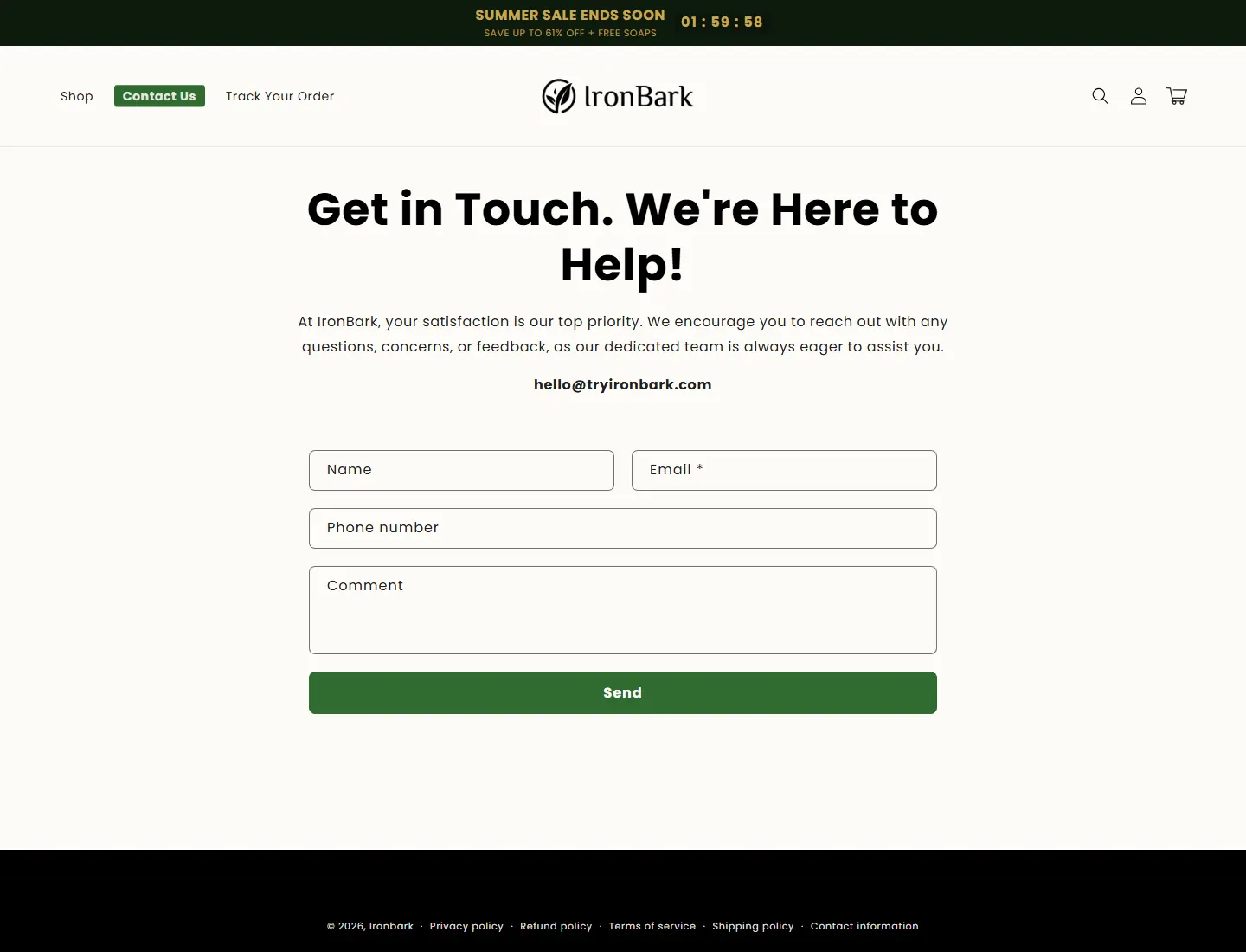
The seller identified itself as “Ironbark” on its contact page. Captured product subjects included the Ironbark Relief & Clear Bar, Ironbark Antifungal Soap, Ironbark Antifungal Soap Bar®, Dry Skin Moisturising Cream and Fortress Tea Tree Balm. These are seller descriptions, not independent confirmation of effectiveness or product quality.
The main concern is not merely that the store sells unfamiliar products. It is that the captured pages presented unusually varied commercial terms. That makes it difficult for a buyer to know which price, discount or guarantee would actually govern an order. Readers comparing similarly marketed household and personal-care products may find our Uproot Clean buyer review useful for understanding why storefront claims and independently verifiable facts should be assessed separately.
What products and prices did the seller display?
On August 29, 2026, the captured Relief & Clear Bar page displayed multiple price values: $0.00, $5, $20 and $23.95. The same page produced discount references of 1%, 2%, 7%, 60%, 84%, 87%, 89%, 90%, 91%, 92%, 93%, “61% OFF,” “10% Off” and “SAVE 0%.” These are separate seller-displayed values from one retrieval date; our investigation cannot determine from the ledger whether they represented variants, crossed-out comparisons, embedded promotional elements or conflicting page components.
The antifungal-pen page was similarly difficult to interpret. It displayed $30, $400, $600 and $1,000, alongside discount values of 25%, 80%, 88%, 94%, 97% and 98%. We have not reconciled those figures because the evidence does not establish which combination applied at checkout.
Other captured pages were more conventional but still varied by listing: Deep Cleanse Exfoliating Poufs showed $14.99; Dry Skin Moisturising Cream showed $10.99; Fortress Tea Tree Balm showed $29.95 and $39.95; and three soap listings showed $19.99, $22.95 and $28.99. Each was a seller-displayed price recorded on August 29, 2026, not proof of a completed transaction or a stable current price. The scale of the discrepancies makes a checkout screenshot and written order total especially important.
Domain history: a recently registered address
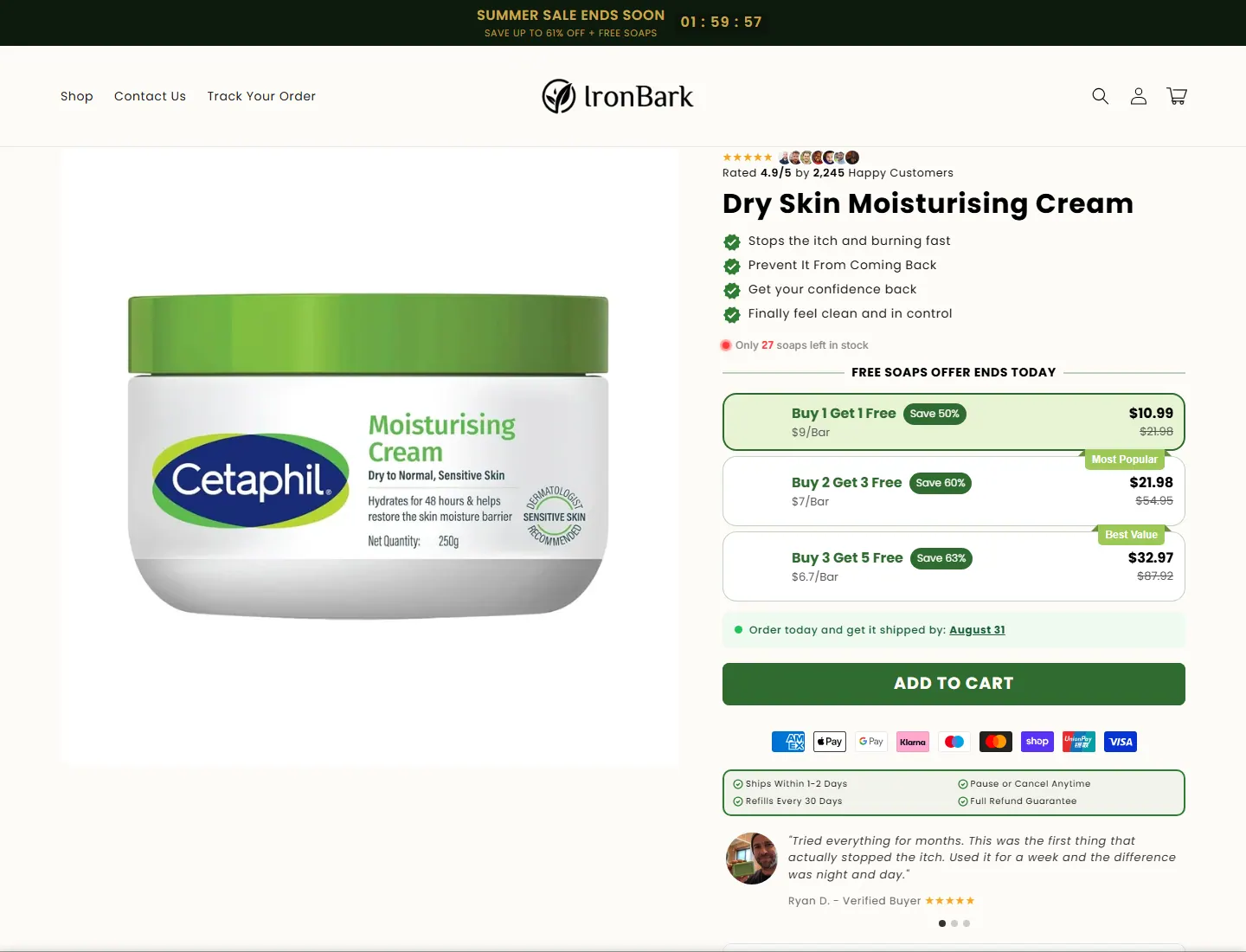
The WHOIS com record for tryironbark com listed a registration date of March 26, 2026, an expiry date of March 26, 2027 and Tucows Domains Inc. as registrar. When ZeroThought checked on August 29, 2026, the domain was therefore about five months old.
A young domain is not proof of misconduct; legitimate businesses launch new websites every day. It does, however, mean the site lacks a long domain history that could otherwise support continuity. The one-year registration window should also be treated neutrally: it is common, but it does not demonstrate long-term operation. WHOIS com listed four Google Domains-branded nameservers, which is technical hosting-related information rather than proof of who runs the seller or how reliably it fulfils orders.
Business identity and contact channels
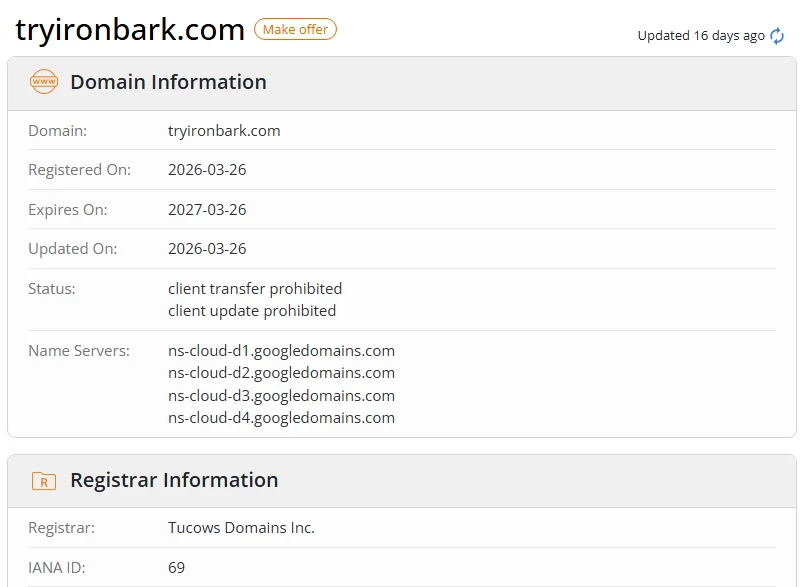
The contact page named the operator or company simply as “Ironbark” and displayed [email protected]. The refund policy, however, displayed [email protected]. An email address is a contact route, not evidence of the legal operator, and the presence of two addresses may create uncertainty over where a return request should be sent.
The contact-information policy produced “Trade” as the value captured for the company-registration-number field. That is not a usable registration number in the supplied evidence. No verified legal entity, verified headquarters or independently confirmed business registration was provided in the research ledger. This does not establish that no such entity exists; it means our review could not verify one from the collected material.
Before buying, ask which entity appears on the card statement, where returns must be sent and which email controls refund deadlines. Our guide on how to identify scam websites explains additional checks buyers can make when a store’s identity details are limited.
Reputation and content checks
The supplied evidence contains no independent customer-rating platform score, review count, corporate-registry match or third-party product test. Those checks are therefore unavailable in this review; we will not imply a favorable or unfavorable score where none was collected.
Some of the strongest statements in the ledger appear in the seller’s own product-page responses and guarantee copy. They discuss periods for use and anticipated results, but these remain seller claims rather than independent medical evidence. ZeroThought does not assess whether a product can diagnose, treat or cure a condition. Anyone considering a product for a persistent health concern should avoid relying solely on storefront marketing.
Repeated or overlapping product names also warrant attention: the evidence captured the Relief & Clear Bar, Ironbark Antifungal Soap and Ironbark Antifungal Soap Bar® on different pages with different displayed prices. The ledger does not show whether these are distinct formulations, renamed listings or duplicate offers. This resembles the broader transparency issue discussed in our Curalona marketing-claims investigation: product-page wording should not be mistaken for independent substantiation.
Returns, guarantees and shipping terms
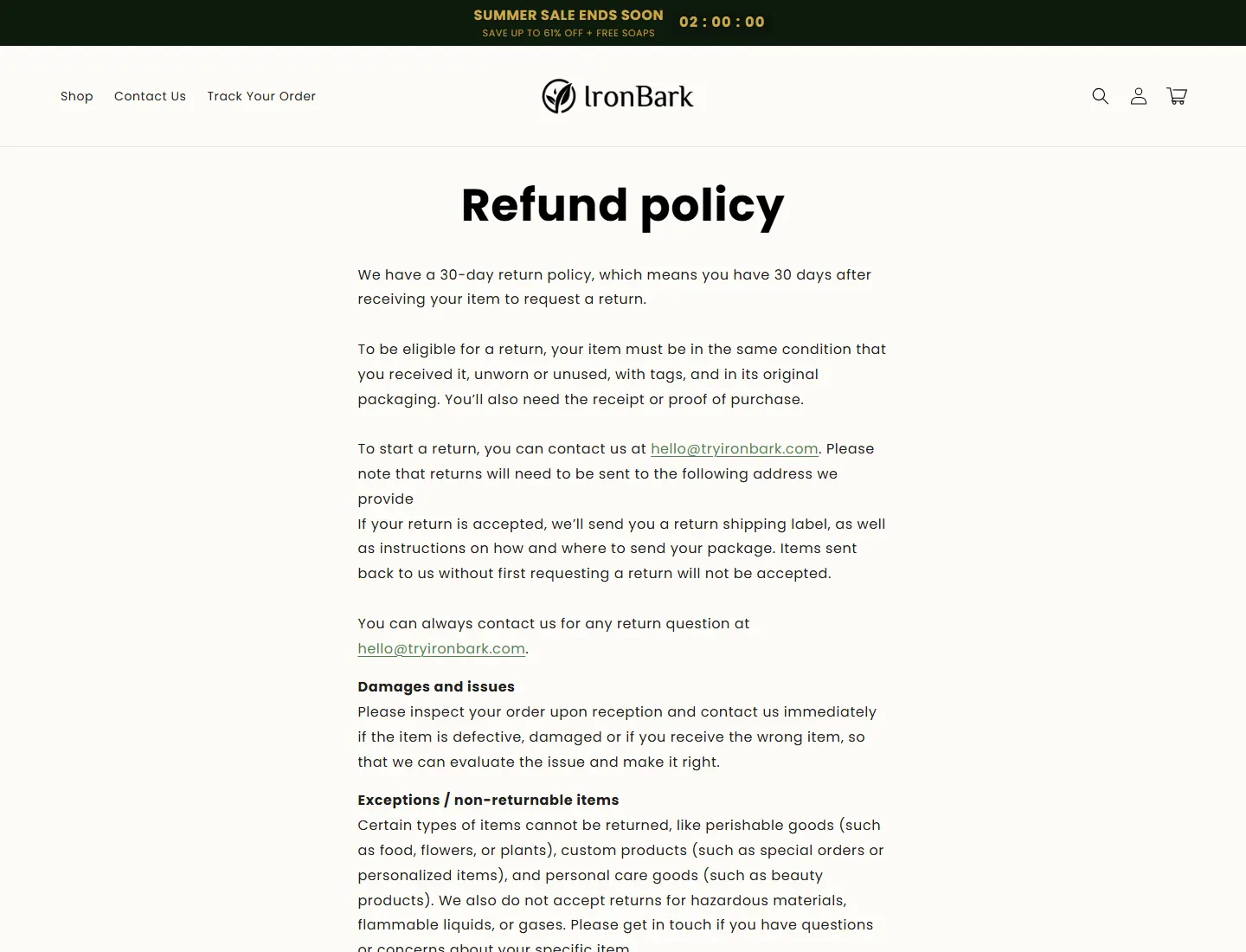
The refund policy stated a 14-day return period. Separately, the Relief & Clear Bar page contained seller statements referring to a 30-day guarantee, a 60-day money-back guarantee, a refund when visible results were not seen within 60 days, and a 90-day money-back guarantee described as a full refund with no questions asked.
These are four materially different seller-displayed time frames, captured on August 29, 2026. They should not be blended into one assumed policy. A statutory or policy return window, a satisfaction guarantee and a results-based promise might have different eligibility rules, but the evidence does not resolve how these statements interact. Buyers should ask in writing whether the applicable period is 14, 30, 60 or 90 days, when the clock begins, whether opened goods qualify, who pays return postage and what proof is required.
The shipping policy stated standard delivery of 7–11 business days and express shipping, if available, of 1–3 business days. The captured evidence labels these as delivery estimates and records no separate order-processing period, so buyers should not assume dispatch is included. For another example of why fulfilment and return details matter when assessing an unfamiliar boutique, see our Margot & Ivy Greenville store review.
Balanced signals: what helps and what concerns us
Positive signals in the collected evidence include a named brand, a domain-based contact email, published refund and shipping policies, stated delivery estimates and a domain record visible through WHOIS com. The product range and individual listing prices were also accessible enough to be captured.
The concerns carry more weight for a purchase decision: the domain was recently registered; the legal business identity was not verified; two different contact emails appeared; the purported registration-number field contained only “Trade”; several pages produced sharply conflicting prices and discount percentages; and seller guarantee statements ranged from 30 to 90 days while the refund policy stated 14 days. Independent reputation evidence was not collected.
These warning signs do not conclusively prove that the website is a scam. They do show that a buyer would be accepting avoidable uncertainty unless the seller clarifies the offer before payment.
Practical buyer advice and assessment
Our practical assessment is to pause before purchasing. Save the complete product page and checkout screen, including currency, quantity, recurring-charge language, discount and final total. Ask the seller to identify the legal contracting entity and provide the physical return destination before the order is placed. Obtain written confirmation of the applicable guarantee and whether opening or trying the product affects eligibility.
If proceeding despite the uncertainty, use a payment method that offers a dispute process, retain all correspondence and avoid bank transfer, cryptocurrency or another hard-to-reverse method. Check the descriptor and total before authorising payment. If the amount changes or the refund answer remains ambiguous, leave the transaction rather than relying on promotional copy.
Because no independent reputation record was supplied, a small test purchase would still carry uncertainty rather than establish trust. The safer course is to wait for clearer, consistent policies and a verifiable business identity.
Final Verdict
ZeroThought cannot verify tryironbark com as a sufficiently established and transparent retailer from the supplied evidence. The store publishes products, contact routes and buyer policies, but its very recent domain, unverified legal identity, conflicting contact information, unclear registration-number field, numerous incompatible price and discount displays, and 14-, 30-, 60- and 90-day refund or guarantee references create material uncertainty. These warning signs do not conclusively prove that the website is a scam. Our evidence-qualified verdict is insufficiently established: wait for clearer terms and verifiable operator information, or proceed only with strong payment protection and complete records.
Frequently Asked Questions
Is tryironbark com a scam?
The supplied evidence is not strong enough to support that conclusion. It does show significant warning signs, including a recently registered domain, inconsistent commercial terms and limited verifiable business identity. These warning signs do not conclusively prove that the website is a scam.
How old is tryironbark com?
WHOIS com listed the domain as registered on March 26, 2026. It was about five months old when checked on August 29, 2026, with an expiry date of March 26, 2027.
What is Ironbark’s return period?
The refund policy stated 14 days, while product-page text separately referred to 30-, 60- and 90-day guarantees. Because the supplied evidence does not explain which promise takes precedence, buyers should obtain the applicable terms in writing before ordering.
How long does Ironbark say delivery takes?
The seller’s shipping policy stated 7–11 business days for standard delivery and 1–3 business days for express shipping if available. No separate processing time was recorded, so these delivery estimates should not automatically be treated as the full order-to-arrival period.
Which email address does Ironbark use?
The contact page displayed [email protected], while the refund policy displayed [email protected]. Neither address independently verifies the legal operator, and buyers should confirm which one handles returns.
Why do the displayed prices raise concern?
The August 29, 2026 capture found multiple values on individual pages. The Relief & Clear Bar page showed $0.00, $5, $20 and $23.95, while the antifungal-pen page showed $30, $400, $600 and $1,000. The ledger does not establish which values applied at checkout, so buyers should rely only on a documented final total.@Deep Research